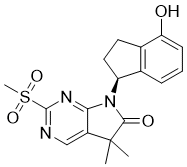
MRT199665 is a novel and potent salt-inducible kinases (SIKs) inhibitor. MRT199665 increases IL-10 production while suppressing IL-6, IL-12, and TNF secretion.
Physicochemical Properties
| Molecular Formula | C18H19N3O4S |
| Molecular Weight | 373.426162958145 |
| Exact Mass | 469.247 |
| CAS # | 1456858-57-3 |
| PubChem CID | 71725150 |
| Appearance | Off-white to light yellow solid powder |
| LogP | 4.3 |
| Hydrogen Bond Donor Count | 2 |
| Hydrogen Bond Acceptor Count | 6 |
| Rotatable Bond Count | 5 |
| Heavy Atom Count | 35 |
| Complexity | 770 |
| Defined Atom Stereocenter Count | 1 |
| SMILES | S(C)(C1=NC=C2C(=N1)N(C(C2(C)C)=O)[C@@H]1C2C=CC=C(C=2CC1)O)(=O)=O |
| InChi Key | LZUYOYKXEXENTQ-ZDUSSCGKSA-N |
| InChi Code | InChI=1S/C18H19N3O4S/c1-18(2)12-9-19-17(26(3,24)25)20-15(12)21(16(18)23)13-8-7-11-10(13)5-4-6-14(11)22/h4-6,9,13,22H,7-8H2,1-3H3/t13-/m0/s1 |
| Chemical Name | 7-[(1S)-4-Hydroxy-2,3-dihydro-1H-inden-1-yl]-5,5-dimethyl-2-(methylsulfonyl)-5,7-dihydro-6H-pyrrolo[2,3-d]pyrimidin-6-one |
| Synonyms | MRT199665 MRT-199665 MRT 199665 |
| HS Tariff Code | 2934.99.9001 |
| Storage |
Powder-20°C 3 years 4°C 2 years In solvent -80°C 6 months -20°C 1 month |
| Shipping Condition | Room temperature (This product is stable at ambient temperature for a few days during ordinary shipping and time spent in Customs) |
Biological Activity
| ln Vitro | MRT199665 (1 μM; 1 hour post-death) enhances the synthesis of IL-10 and Nurr77 mRNA in response to LPS (100 ng/mL; stimulation lasting up to 24 hours) [1]. Treatment with MRT199665 inhibits the phosphorylation of MEF2C S222 in acute myeloid leukemia (AML) cells. MRT199665 inhibits the growth of leukemia by causing total MEF2C at 10 nM-1000 nM for 12 hours and -100 μM for 48 hours [2]. Additionally, MRT199665 lowers the amount of MEF2C protein overall [2]. |
| Cell Assay |
Western Blot Analysis[2] Cell Types: OCI-AML2 and MOLM-13 Cell Tested Concentrations: 10, 100, 500, and 1000 nM Incubation Duration: 12 Experimental Results: Compared to untreated cells, 10 nM resulted in total MEF2C and pS222 dose-dependently diminished MEF2C, resulting in a >40% reduction in MEF2C phosphorylation. Cell proliferation assay [2] Cell Types: human AML cell lines OCI-AML2, MV4-11, MOLM-13 and Kasumi-1 with endogenous MEF2C phosphorylation; human AML cell lines NB-4, HEL, HL lacking MEF2C -60 and U937 Tested Concentrations: 1 nM, 10 nM, 100n M, 1 μM, 10 μM, 100μM Incubation Duration: 48 hrs (hours) Experimental Results: Human AML cell lines with endogenous MEF2C phosphorylation vs. cell lines lacking MEF2C (NB- 4. Compared with HEL, HL-60 and U937), (OCI-AML2, MV4-11, MOLM-13 and Kasumi-1) are more sensitive, with an average IC50 of 26±13 and an average IC50 of 990 and ±29 nM respectively. . |
| References |
[1]. Phosphorylation of CRTC3 by the salt-inducible kinases controls the interconversion of classically activated and regulatory macrophages. Proc Natl Acad Sci U S A. 2012 Oct 16;109(42):16986-91. [2]. MEF2C Phosphorylation Is Required for Chemotherapy Resistance in Acute Myeloid Leukemia. Cancer Discov. 2018 Apr;8(4):478-497. [3]. Salt-inducible kinases (SIKs) regulate TGFβ-mediated transcriptional and apoptotic responses.Cell Death Dis. 2020 Jan 22;11(1):49. |
Solubility Data
| Solubility (In Vitro) | DMSO : ~125 mg/mL (~266.20 mM) |
| Solubility (In Vivo) |
Solubility in Formulation 1: ≥ 2.08 mg/mL (4.43 mM) (saturation unknown) in 10% DMSO + 40% PEG300 + 5% Tween80 + 45% Saline (add these co-solvents sequentially from left to right, and one by one), clear solution. For example, if 1 mL of working solution is to be prepared, you can add 100 μL of 20.8 mg/mL clear DMSO stock solution to 400 μL PEG300 and mix evenly; then add 50 μL Tween-80 to the above solution and mix evenly; then add 450 μL normal saline to adjust the volume to 1 mL. Preparation of saline: Dissolve 0.9 g of sodium chloride in 100 mL ddH₂ O to obtain a clear solution. Solubility in Formulation 2: ≥ 2.08 mg/mL (4.43 mM) (saturation unknown) in 10% DMSO + 90% (20% SBE-β-CD in Saline) (add these co-solvents sequentially from left to right, and one by one), clear solution. For example, if 1 mL of working solution is to be prepared, you can add 100 μL of 20.8 mg/mL clear DMSO stock solution to 900 μL of 20% SBE-β-CD physiological saline solution and mix evenly. Preparation of 20% SBE-β-CD in Saline (4°C,1 week): Dissolve 2 g SBE-β-CD in 10 mL saline to obtain a clear solution. Solubility in Formulation 3: ≥ 2.08 mg/mL (4.43 mM) (saturation unknown) in 10% DMSO + 90% Corn Oil (add these co-solvents sequentially from left to right, and one by one), clear solution. For example, if 1 mL of working solution is to be prepared, you can add 100 μL of 20.8 mg/mL clear DMSO stock solution to 900 μL of corn oil and mix evenly. (Please use freshly prepared in vivo formulations for optimal results.) |
| Preparing Stock Solutions | 1 mg | 5 mg | 10 mg | |
| 1 mM | 2.6779 mL | 13.3894 mL | 26.7788 mL | |
| 5 mM | 0.5356 mL | 2.6779 mL | 5.3558 mL | |
| 10 mM | 0.2678 mL | 1.3389 mL | 2.6779 mL |