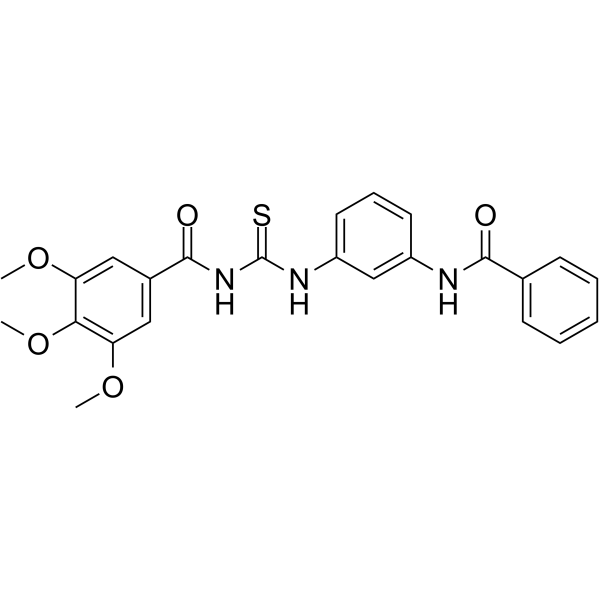
Physicochemical Properties
| Molecular Formula | C24H23N3O5S |
| Molecular Weight | 465.52 |
| Exact Mass | 465.136 |
| CAS # | 330829-30-6 |
| PubChem CID | 1139102 |
| Appearance | White to off-white solid powder |
| LogP | 5.27 |
| Hydrogen Bond Donor Count | 3 |
| Hydrogen Bond Acceptor Count | 6 |
| Rotatable Bond Count | 7 |
| Heavy Atom Count | 33 |
| Complexity | 659 |
| Defined Atom Stereocenter Count | 0 |
| InChi Key | KVQVEZQDNHMQJV-UHFFFAOYSA-N |
| InChi Code | InChI=1S/C24H23N3O5S/c1-30-19-12-16(13-20(31-2)21(19)32-3)23(29)27-24(33)26-18-11-7-10-17(14-18)25-22(28)15-8-5-4-6-9-15/h4-14H,1-3H3,(H,25,28)(H2,26,27,29,33) |
| Chemical Name | N-[(3-benzamidophenyl)carbamothioyl]-3,4,5-trimethoxybenzamide |
| HS Tariff Code | 2934.99.9001 |
| Storage |
Powder-20°C 3 years 4°C 2 years In solvent -80°C 6 months -20°C 1 month |
| Shipping Condition | Room temperature (This product is stable at ambient temperature for a few days during ordinary shipping and time spent in Customs) |
Biological Activity
| ln Vitro | In HEK293 cells, MRT-10 suppresses the Smo-induced IP accumulation in a dose-dependent manner (IC50=2.5 μM)[1]. With an IC50=0.5 μM, MRT-10 (10-9-10-5 M; 2 h) inhibits the binding of bodipy-cyclopamine (5 nM; 2 h) to cells expressing mouse Smo in a dose-dependent manner[1]. MRT-10 (10-9-10-5 M; 40 h) has an IC50=0.64 μM and suppresses ShhN signaling in Shh-light2 cells in a dose-dependent manner[1]. MRT-10 (10-9-10-5 M; 6 days) suppresses the alkaline phosphatase (AP) activity in C3H10T1/2 cells that is stimulated by SAG (0.1 μM) (IC50=0.90 μM). |
| References |
[1]. Virtual screening-based discovery and mechanistic characterization of the acylthiourea MRT-10 family as smoothened antagonists. Mol Pharmacol. 2010 Oct;78(4):658-65. [2]. Acylthiourea, acylurea, and acylguanidine derivatives with potent hedgehog inhibiting activity. J Med Chem. 2012 Feb 23;55(4):1559-71. |
Solubility Data
| Solubility (In Vitro) | DMSO: 100 mg/mL (214.81 mM) |
| Solubility (In Vivo) |
Solubility in Formulation 1: ≥ 2.5 mg/mL (5.37 mM) (saturation unknown) in 10% DMSO + 90% Corn Oil (add these co-solvents sequentially from left to right, and one by one), clear solution. For example, if 1 mL of working solution is to be prepared, you can add 100 μL of 25.0 mg/mL clear DMSO stock solution to 900 μL of corn oil and mix evenly. (Please use freshly prepared in vivo formulations for optimal results.) |
| Preparing Stock Solutions | 1 mg | 5 mg | 10 mg | |
| 1 mM | 2.1481 mL | 10.7407 mL | 21.4814 mL | |
| 5 mM | 0.4296 mL | 2.1481 mL | 4.2963 mL | |
| 10 mM | 0.2148 mL | 1.0741 mL | 2.1481 mL |