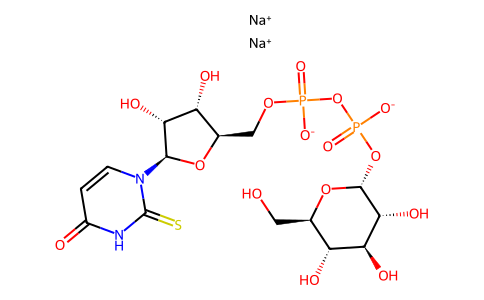
Physicochemical Properties
| Molecular Formula | C15H22N2NA2O16P2S |
| Molecular Weight | 626.32 |
| Exact Mass | 625.996 |
| Elemental Analysis | C, 28.77; H, 3.54; N, 4.47; Na, 7.34; O, 40.87; P, 9.89; S, 5.12 |
| CAS # | 15039-58-4 |
| PubChem CID | 73755042 |
| Appearance | Typically exists as solid at room temperature |
| Hydrogen Bond Donor Count | 7 |
| Hydrogen Bond Acceptor Count | 17 |
| Rotatable Bond Count | 9 |
| Heavy Atom Count | 38 |
| Complexity | 981 |
| Defined Atom Stereocenter Count | 9 |
| SMILES | [Na+].[Na+].OC[C@H]1O[C@H](OP(OP(OC[C@H]2O[C@@H](N3C=CC(=O)NC3=S)[C@H](O)[C@@H]2O)(=O)[O-])(=O)[O-])[C@H](O)[C@@H](O)[C@@H]1O |
| InChi Key | TYVFMVSNSGMZPA-QBNUFUENSA-L |
| InChi Code | InChI=1S/C15H24N2O16P2S.2Na/c18-3-5-8(20)10(22)12(24)14(31-5)32-35(27,28)33-34(25,26)29-4-6-9(21)11(23)13(30-6)17-2-1-7(19)16-15(17)36;;/h1-2,5-6,8-14,18,20-24H,3-4H2,(H,25,26)(H,27,28)(H,16,19,36);;/q;2*+1/p-2/t5-,6-,8-,9-,10+,11-,12-,13-,14-;;/m1../s1 |
| Chemical Name | disodium;[[(2R,3S,4R,5R)-3,4-dihydroxy-5-(4-oxo-2-sulfanylidenepyrimidin-1-yl)oxolan-2-yl]methoxy-oxidophosphoryl] [(2R,3R,4S,5S,6R)-3,4,5-trihydroxy-6-(hydroxymethyl)oxan-2-yl] phosphate |
| Synonyms | MRS 2690; MRS-2690; MRS2690; MRS 2690; MRS-2690; 15039-58-4; GTPL3337; GLXC-04134; [[[(2R,3S,4R,5R)-3,4-dihydroxy-5-(4-oxo-2-sulfanylidenepyrimidin-1-yl)oxolan-2-yl]methoxy-sodiooxyphosphoryl]oxy-[(2R,3R,4S,5S,6R)-3,4,5-trihydroxy-6-(hydroxymethyl)oxan-2-yl]oxyphosphoryl]oxysodium; MRS 2690; DIPHOSPHORIC ACID 1-A-D-GLUCOPYRANOSYL ESTER 2-[(4'-METHYLTHIO)URIDIN-5''-YL] ESTER DISODIUM SALT; MRS2690 |
| HS Tariff Code | 2934.99.9001 |
| Storage |
Powder-20°C 3 years 4°C 2 years In solvent -80°C 6 months -20°C 1 month |
| Shipping Condition | Room temperature (This product is stable at ambient temperature for a few days during ordinary shipping and time spent in Customs) |
Biological Activity
| Targets | P2Y14 receptor |
| ln Vitro | Aims: UDP-sugars can act as extracellular signalling molecules, but relatively little is known about their cardiovascular actions. The P2Y14 receptor is a Gi/o-coupled receptor which is activated by UDP-glucose and related sugar nucleotides. In this study we sought to investigate whether P2Y14 receptors are functionally expressed in the porcine coronary artery using a selective P2Y14 receptor agonist, MRS2690, and a novel selective P2Y14 receptor antagonist, PPTN (4,7-disubstituted naphthoic acid derivative). Methods and results: Isometric tension recordings were used to evaluate the effects of UDP-sugars in porcine isolated coronary artery segments. The effects of the P2 receptor antagonists suramin and PPADS, the P2Y14 receptor antagonist PPTN, and the P2Y6 receptor antagonist MRS2578, were investigated. Measurement of vasodilator-stimulated phosphoprotein (VASP) phosphorylation using flow cytometry was used to assess changes in cAMP levels. UDP-glucose, UDP-glucuronic acid UDP-N-acetylglucosamine (P2Y14 receptor agonists), elicited concentration-dependent contractions of the porcine coronary artery. MRS2690 was a more potent vasoconstrictor than the UDP-sugars. Concentration dependent contractile responses to MRS2690 and UDP-sugars were enhanced in the presence of forskolin (activator of cAMP), where the level of basal tone was maintained by addition of U46619, a thromboxane A2 mimetic. Contractile responses to MRS2690 were blocked by PPTN, but not by MRS2578. Contractile responses to UDP-glucose were also attenuated by PPTN and suramin, but not by MRS2578. Forskolin-induced VASP-phosphorylation was reduced in porcine coronary arteries exposed to UDP-glucose and MRS2690, consistent with P2Y14 receptor coupling to Gi/o proteins and inhibition of adenylyl cyclase activity. Conclusions: Our data support a role of UDP-sugars as extracellular signalling molecules and show for the first time that they mediate contraction of porcine coronary arteries via P2Y14 receptors [1]. |
| References | [1]. UDP-sugars activate P2Y14 receptors to mediate vasoconstriction of the porcine coronary artery. Vascul Pharmacol. 2018 Apr:103-105:36-46. |
| Additional Infomation | Background: Enterochromaffin cells (EC) synthesize and release 5-HT and ATP to trigger or modulate gut neural reflexes and transmit information about visceral/pain sensation. Alterations in 5-HT signaling mechanisms may contribute to the pathogenesis of IBD or IBS, but the pharmacologic or molecular mechanisms modulating Ca2+-dependent 5-HT release are not understood. Previous studies indicated that purinergic signaling via ATP and ADP is an important mechanism in modulation of 5-HT release. However, EC cells also respond to UTP and UDP suggesting uridine triphosphate receptor and signaling pathways are involved as well. We tested the hypothesis that UTP is a regulator of 5-HT release in human EC cells. Methods: UTP signaling mechanisms were studied in BON cells, a human EC model, using Fluo-4/Ca2+imaging, patch-clamp, pharmacological analysis, immunohistochemistry, western blots and qPCR. 5-HT release was monitored in BON or EC isolated from human gut surgical specimens (hEC). Results: UTP, UTPγS, UDP or ATP induced Ca2+oscillations in BON. UTP evoked a biphasic concentration-dependent Ca2+response. Cells responded in the order of UTP, ATP > UTPγS > UDP >> MRS2768, BzATP, α,β-MeATP > MRS2365, MRS2690, and NF546. Different proportions of cells activated by UTP and ATP also responded to UTPγS (P2Y4, 50% cells), UDP (P2Y6, 30%), UTPγS and UDP (14%) or MRS2768 (<3%). UTP Ca2+responses were blocked with inhibitors of PLC, IP3R, SERCA Ca2+pump, La3+sensitive Ca2+channels or chelation of intracellular free Ca2+ by BAPTA/AM. Inhibitors of L-type, TRPC, ryanodine-Ca2+pools, PI3-Kinase, PKC or SRC-Kinase had no effect. UTP stimulated voltage-sensitive Ca2+currents (ICa), Vm-depolarization and inhibited IK (not IA) currents. An IKv7.2/7.3 K+ channel blocker XE-991 mimicked UTP-induced Vm-depolarization and blocked UTP-responses. XE-991 blocked IK and UTP caused further reduction. La3+ or PLC inhibitors blocked UTP depolarization; PKC inhibitors, thapsigargin or zero Ca2+buffer did not. UTP stimulated 5-HT release in hEC expressing TPH1, 5-HT, P2Y4/P2Y6R. Zero-Ca2+buffer augmented Ca2+responses and 5-HT release. Conclusion: UTP activates a predominant P2Y4R pathway to trigger Ca2+oscillations via internal Ca2+mobilization through a PLC/IP3/IP3R/SERCA Ca2+signaling pathway to stimulate 5-HT release; Ca2+influx is inhibitory. UTP-induced Vm-depolarization depends on PLC signaling and an unidentified K channel (which appears independent of Ca2+oscillations or Ica/VOCC). UTP-gated signaling pathways triggered by activation of P2Y4R stimulate 5-HT release. Front Pharmacol. 2017 Jul 13:8:429. |
Solubility Data
| Solubility (In Vitro) | May dissolve in DMSO (in most cases), if not, try other solvents such as H2O, Ethanol, or DMF with a minute amount of products to avoid loss of samples |
| Solubility (In Vivo) |
Note: Listed below are some common formulations that may be used to formulate products with low water solubility (e.g. < 1 mg/mL), you may test these formulations using a minute amount of products to avoid loss of samples. Injection Formulations (e.g. IP/IV/IM/SC) Injection Formulation 1: DMSO : Tween 80: Saline = 10 : 5 : 85 (i.e. 100 μL DMSO stock solution → 50 μL Tween 80 → 850 μL Saline) *Preparation of saline: Dissolve 0.9 g of sodium chloride in 100 mL ddH ₂ O to obtain a clear solution. Injection Formulation 2: DMSO : PEG300 :Tween 80 : Saline = 10 : 40 : 5 : 45 (i.e. 100 μL DMSO → 400 μLPEG300 → 50 μL Tween 80 → 450 μL Saline) Injection Formulation 3: DMSO : Corn oil = 10 : 90 (i.e. 100 μL DMSO → 900 μL Corn oil) Example: Take the Injection Formulation 3 (DMSO : Corn oil = 10 : 90) as an example, if 1 mL of 2.5 mg/mL working solution is to be prepared, you can take 100 μL 25 mg/mL DMSO stock solution and add to 900 μL corn oil, mix well to obtain a clear or suspension solution (2.5 mg/mL, ready for use in animals). Injection Formulation 4: DMSO : 20% SBE-β-CD in saline = 10 : 90 [i.e. 100 μL DMSO → 900 μL (20% SBE-β-CD in saline)] *Preparation of 20% SBE-β-CD in Saline (4°C,1 week): Dissolve 2 g SBE-β-CD in 10 mL saline to obtain a clear solution. Injection Formulation 5: 2-Hydroxypropyl-β-cyclodextrin : Saline = 50 : 50 (i.e. 500 μL 2-Hydroxypropyl-β-cyclodextrin → 500 μL Saline) Injection Formulation 6: DMSO : PEG300 : castor oil : Saline = 5 : 10 : 20 : 65 (i.e. 50 μL DMSO → 100 μLPEG300 → 200 μL castor oil → 650 μL Saline) Injection Formulation 7: Ethanol : Cremophor : Saline = 10: 10 : 80 (i.e. 100 μL Ethanol → 100 μL Cremophor → 800 μL Saline) Injection Formulation 8: Dissolve in Cremophor/Ethanol (50 : 50), then diluted by Saline Injection Formulation 9: EtOH : Corn oil = 10 : 90 (i.e. 100 μL EtOH → 900 μL Corn oil) Injection Formulation 10: EtOH : PEG300:Tween 80 : Saline = 10 : 40 : 5 : 45 (i.e. 100 μL EtOH → 400 μLPEG300 → 50 μL Tween 80 → 450 μL Saline) Oral Formulations Oral Formulation 1: Suspend in 0.5% CMC Na (carboxymethylcellulose sodium) Oral Formulation 2: Suspend in 0.5% Carboxymethyl cellulose Example: Take the Oral Formulation 1 (Suspend in 0.5% CMC Na) as an example, if 100 mL of 2.5 mg/mL working solution is to be prepared, you can first prepare 0.5% CMC Na solution by measuring 0.5 g CMC Na and dissolve it in 100 mL ddH2O to obtain a clear solution; then add 250 mg of the product to 100 mL 0.5% CMC Na solution, to make the suspension solution (2.5 mg/mL, ready for use in animals). Oral Formulation 3: Dissolved in PEG400 Oral Formulation 4: Suspend in 0.2% Carboxymethyl cellulose Oral Formulation 5: Dissolve in 0.25% Tween 80 and 0.5% Carboxymethyl cellulose Oral Formulation 6: Mixing with food powders Note: Please be aware that the above formulations are for reference only. InvivoChem strongly recommends customers to read literature methods/protocols carefully before determining which formulation you should use for in vivo studies, as different compounds have different solubility properties and have to be formulated differently. (Please use freshly prepared in vivo formulations for optimal results.) |
| Preparing Stock Solutions | 1 mg | 5 mg | 10 mg | |
| 1 mM | 1.5966 mL | 7.9831 mL | 15.9663 mL | |
| 5 mM | 0.3193 mL | 1.5966 mL | 3.1933 mL | |
| 10 mM | 0.1597 mL | 0.7983 mL | 1.5966 mL |