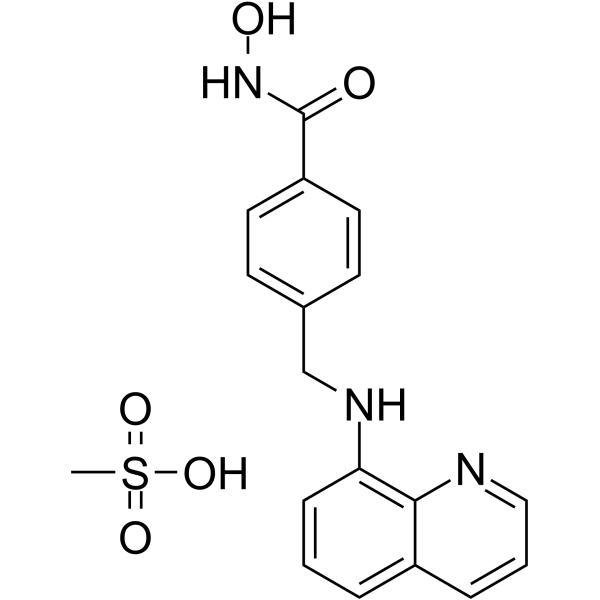
Physicochemical Properties
| Molecular Formula | C19H21N3O4S |
| Molecular Weight | 387.45 |
| Exact Mass | 389.104 |
| CAS # | 2151854-33-8 |
| Related CAS # | MPT0G211;2151853-97-1 |
| PubChem CID | 139488510 |
| Appearance | Typically exists as solid at room temperature |
| Hydrogen Bond Donor Count | 4 |
| Hydrogen Bond Acceptor Count | 7 |
| Rotatable Bond Count | 4 |
| Heavy Atom Count | 27 |
| Complexity | 462 |
| Defined Atom Stereocenter Count | 0 |
| InChi Key | PRIVCNWCWYRYNJ-UHFFFAOYSA-N |
| InChi Code | InChI=1S/C17H15N3O2.CH4O3S/c21-17(20-22)14-8-6-12(7-9-14)11-19-15-5-1-3-13-4-2-10-18-16(13)15;1-5(2,3)4/h1-10,19,22H,11H2,(H,20,21);1H3,(H,2,3,4) |
| Chemical Name | N-hydroxy-4-[(quinolin-8-ylamino)methyl]benzamide;methanesulfonic acid |
| HS Tariff Code | 2934.99.9001 |
| Storage |
Powder-20°C 3 years 4°C 2 years In solvent -80°C 6 months -20°C 1 month |
| Shipping Condition | Room temperature (This product is stable at ambient temperature for a few days during ordinary shipping and time spent in Customs) |
Biological Activity
| Targets | HDAC6 0.291 μM (IC50) |
| ln Vitro | The phosphorylation of tau Ser396 was considerably reduced by MPT0G211 mesylate (0.1 μM; cells were transfected with pCAX APP 695 and pRK5-EGFP-Tau P301L for 24 hours)[1]. The inhibition of HDAC6/Hsp90 binding by MPT0G211 mesylate leads to the subsequent proteasomal degradation of proteins that are polyubiquitinated [1]. By inactivating GSK3β, MPT0G211 mesylate dramatically reduces tau phosphorylation[1]. were transfected with pCAX APP 695 and pRK5-EGFP-Tau P301L for a duration of 24 hours[1]. The proliferation of MDA-MB-231 and MCF-7 cells is inhibited by MPT0G211 mesylate (GI50 = 16.19 and 5.6 μM, respectively)[2]. MPT0G211 mesylate increases the cytotoxic effects of DOXO in AML cells by causing damage to the machinery that repairs DNA and triggering cell apoptosis that is dependent on Bcl-2-associated X protein (BCL-XL)[3]. |
| ln Vivo | The spatial memory impairment is greatly improved by MPT0G211 mesylate (50 mg/kg; po; daily for 3 months)[1]. Mesylate (25 mg/kg; intraperitoneal; QD; day 73 post-tumor injection) MPT0G211 decreases lung weights and nodule counts[2]. In addition to reducing tau phosphorylation by blocking GSK3β activity, MPT0G211 mesylate therapy also increases Hsp90's acetylation, which downregulates HDAC6/Hsp90 binding and speeds up the proteasomal breakdown of polyubiquitinated p-tau[1]. |
| Animal Protocol |
Animal/Disease Models: Triple transgenic (3×Tg-AD) mice (harboring APPSwe and tauP301L mutant transgenes[1] Doses: 50 mg/kg Route of Administration: Po; daily for 3 months Experimental Results: Dramatically ameliorated the spatial memory impairment. Animal/Disease Models: Female SCID (severe combined immunodeficient) mouse (bearing MDA-MB-231 cells)[2] Doses: 25 mg/kg Route of Administration: Ip; qd; day 73 post-tumor injection Experimental Results: Dramatically diminished numbers of nodules and lung weights. |
| References |
[1]. The novel histone de acetylase 6 inhibitor, MPT0G211, ameliorates tau phosphorylation and cognitive deficits in an Alzheimer's disease model. Cell Death Dis. 2018;9(6):655. Published 2018 May 29. [2]. Anti-metastatic activity of MPT0G211, a novel HDAC6 inhibitor, in human breast cancer cells in vitro and in vivo. Biochim Biophys Acta Mol Cell Res. 2019;1866(6):992-1003. [3]. The anticancer effects of MPT0G211, a novel HDAC6 inhibitor, combined with chemotherapeutic agents in human acute leukemia cells. Clin Epigenetics. 2018;10(1):162. Published 2018 Dec 29. |
Solubility Data
| Solubility (In Vitro) | May dissolve in DMSO (in most cases), if not, try other solvents such as H2O, Ethanol, or DMF with a minute amount of products to avoid loss of samples |
| Solubility (In Vivo) |
Note: Listed below are some common formulations that may be used to formulate products with low water solubility (e.g. < 1 mg/mL), you may test these formulations using a minute amount of products to avoid loss of samples. Injection Formulations (e.g. IP/IV/IM/SC) Injection Formulation 1: DMSO : Tween 80: Saline = 10 : 5 : 85 (i.e. 100 μL DMSO stock solution → 50 μL Tween 80 → 850 μL Saline) *Preparation of saline: Dissolve 0.9 g of sodium chloride in 100 mL ddH ₂ O to obtain a clear solution. Injection Formulation 2: DMSO : PEG300 :Tween 80 : Saline = 10 : 40 : 5 : 45 (i.e. 100 μL DMSO → 400 μLPEG300 → 50 μL Tween 80 → 450 μL Saline) Injection Formulation 3: DMSO : Corn oil = 10 : 90 (i.e. 100 μL DMSO → 900 μL Corn oil) Example: Take the Injection Formulation 3 (DMSO : Corn oil = 10 : 90) as an example, if 1 mL of 2.5 mg/mL working solution is to be prepared, you can take 100 μL 25 mg/mL DMSO stock solution and add to 900 μL corn oil, mix well to obtain a clear or suspension solution (2.5 mg/mL, ready for use in animals). Injection Formulation 4: DMSO : 20% SBE-β-CD in saline = 10 : 90 [i.e. 100 μL DMSO → 900 μL (20% SBE-β-CD in saline)] *Preparation of 20% SBE-β-CD in Saline (4°C,1 week): Dissolve 2 g SBE-β-CD in 10 mL saline to obtain a clear solution. Injection Formulation 5: 2-Hydroxypropyl-β-cyclodextrin : Saline = 50 : 50 (i.e. 500 μL 2-Hydroxypropyl-β-cyclodextrin → 500 μL Saline) Injection Formulation 6: DMSO : PEG300 : castor oil : Saline = 5 : 10 : 20 : 65 (i.e. 50 μL DMSO → 100 μLPEG300 → 200 μL castor oil → 650 μL Saline) Injection Formulation 7: Ethanol : Cremophor : Saline = 10: 10 : 80 (i.e. 100 μL Ethanol → 100 μL Cremophor → 800 μL Saline) Injection Formulation 8: Dissolve in Cremophor/Ethanol (50 : 50), then diluted by Saline Injection Formulation 9: EtOH : Corn oil = 10 : 90 (i.e. 100 μL EtOH → 900 μL Corn oil) Injection Formulation 10: EtOH : PEG300:Tween 80 : Saline = 10 : 40 : 5 : 45 (i.e. 100 μL EtOH → 400 μLPEG300 → 50 μL Tween 80 → 450 μL Saline) Oral Formulations Oral Formulation 1: Suspend in 0.5% CMC Na (carboxymethylcellulose sodium) Oral Formulation 2: Suspend in 0.5% Carboxymethyl cellulose Example: Take the Oral Formulation 1 (Suspend in 0.5% CMC Na) as an example, if 100 mL of 2.5 mg/mL working solution is to be prepared, you can first prepare 0.5% CMC Na solution by measuring 0.5 g CMC Na and dissolve it in 100 mL ddH2O to obtain a clear solution; then add 250 mg of the product to 100 mL 0.5% CMC Na solution, to make the suspension solution (2.5 mg/mL, ready for use in animals). Oral Formulation 3: Dissolved in PEG400 Oral Formulation 4: Suspend in 0.2% Carboxymethyl cellulose Oral Formulation 5: Dissolve in 0.25% Tween 80 and 0.5% Carboxymethyl cellulose Oral Formulation 6: Mixing with food powders Note: Please be aware that the above formulations are for reference only. InvivoChem strongly recommends customers to read literature methods/protocols carefully before determining which formulation you should use for in vivo studies, as different compounds have different solubility properties and have to be formulated differently. (Please use freshly prepared in vivo formulations for optimal results.) |
| Preparing Stock Solutions | 1 mg | 5 mg | 10 mg | |
| 1 mM | 2.5810 mL | 12.9049 mL | 25.8098 mL | |
| 5 mM | 0.5162 mL | 2.5810 mL | 5.1620 mL | |
| 10 mM | 0.2581 mL | 1.2905 mL | 2.5810 mL |