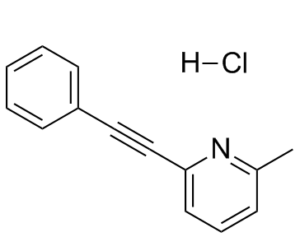
MPEP hydrochloride is a highly potent, selective, and non-competitive antagonist of mGlu5 receptor with IC50 of 36 nM, it exhibits no appreciable activity at mGlu1b/2/3/4a/7b/8a/6 receptors. In mice lacking Fmr1, MPEP improves maze learning and PSD-95 deficiencies. MPEP does not cause harm to the adult retrosplenial cortex, unlike the NMDA antagonist MK-801, where it is unable to induce heat shock protein 70 (Hsp70). Additionally, as demonstrated by caspase 3 expression, MPEP does not induce apoptosis in cortical areas during perinatal stages to the same degree as MK-801. The anxiolytic and antidepressant effects of MPEP have been linked to new cellular targets by these data, which also show that MPEP does not have the cortical neurotoxicity linked to psychotomimetic side effects that is present in MK-801. The medication MPEP may be used as an antidepressant or anxiolytic.
Physicochemical Properties
| Molecular Formula | C14H12CLN |
| Molecular Weight | 229.70478 |
| Exact Mass | 229.065 |
| Elemental Analysis | C, 73.20; H, 5.27; Cl, 15.43; N, 6.10 |
| CAS # | 219911-35-0 |
| Related CAS # | MPEP; 96206-92-7 |
| PubChem CID | 9794588 |
| Appearance | Yellow solid powder |
| Density | 1.1g/cm3 |
| Boiling Point | 336.3ºC at 760mmHg |
| Flash Point | 144.8ºC |
| Vapour Pressure | 0.000221mmHg at 25°C |
| Index of Refraction | 1.614 |
| LogP | 3.591 |
| Hydrogen Bond Donor Count | 1 |
| Hydrogen Bond Acceptor Count | 1 |
| Rotatable Bond Count | 2 |
| Heavy Atom Count | 16 |
| Complexity | 251 |
| Defined Atom Stereocenter Count | 0 |
| SMILES | CC1=NC(C#CC2=CC=CC=C2)=CC=C1.[H]Cl |
| InChi Key | PKDHDJBNEKXCBI-UHFFFAOYSA-N |
| InChi Code | InChI=1S/C14H11N.ClH/c1-12-6-5-9-14(15-12)11-10-13-7-3-2-4-8-13;/h2-9H,1H3;1H |
| Chemical Name | 2-methyl-6-(2-phenylethynyl)pyridine;hydrochloride |
| Synonyms | 2-methyl-6-(phenylethynyl)-pyridine;MPEP; MPEP HCl; MPEP hydrochloride |
| HS Tariff Code | 2934.99.9001 |
| Storage |
Powder-20°C 3 years 4°C 2 years In solvent -80°C 6 months -20°C 1 month Note: Please store this product in a sealed and protected environment, avoid exposure to moisture. |
| Shipping Condition | Room temperature (This product is stable at ambient temperature for a few days during ordinary shipping and time spent in Customs) |
Biological Activity
| Targets | mGluR5 ( IC50 = 36 nM ) | ||
| ln Vitro |
|
||
| ln Vivo |
|
||
| Enzyme Assay | MPEP has an IC50 of 36 nM and is a very strong, selective, and non-competitive mGlu5 receptor antagonist. It shows no discernible activity at mGlu1b/2/3/4a/7b/8a/6 receptors. | ||
| Cell Assay | In slices of rat neonatal hippocampus, striatum, and cortex but not cerebellum, MPEP inhibits DHPG-stimulated PI hydrolysis with IC50 of 8.0 nM, 20.5 nM, and 17.9 nM, respectively. MPEP activates the orthosteric agonist L-AP4, which is necessary for MPEP to have any effect. MPEP positively modulates hmGluR4 in a recombinant expression system. | ||
| Animal Protocol |
|
||
| References |
[1]. 2-Methyl-6-(phenylethynyl)-pyridine (MPEP), a Potent, Selective and Systemically Active mGlu5 Receptor Antagonist. Neuropharmacology. 1999 Oct;38(10):1493-503. [2]. Potential anxiolytic- and antidepressant-like effects of MPEP, a potent, selective and systemically active mGlu5 receptor antagonist. Br J Pharmacol. 2001 Apr;132(7):1423-30. |
||
| Additional Infomation | 2-methyl-6-(phenylethynyl)pyridine hydrochloride is a hydrochloride salt obtained by reaction of 2-methyl-6-(phenylethynyl)pyridine with one equivalent of hydrochloric acid. Potent and highly selective non-competitive antagonist at the mGlu5 receptor subtype (IC50 = 36 nM) and a positive allosteric modulator at mGlu4 receptors. Centrally active following systemic administration in vivo. Reverses mechanical hyperalgesia in the inflamed rat hind paw. It has a role as a metabotropic glutamate receptor antagonist and an anxiolytic drug. It contains a 2-methyl-6-(phenylethynyl)pyridinium(1+). |
Solubility Data
| Solubility (In Vitro) |
|
|||
| Solubility (In Vivo) |
Solubility in Formulation 1: 100 mg/mL (435.35 mM) in Saline (add these co-solvents sequentially from left to right, and one by one), clear solution; with sonication. Preparation of saline: Dissolve 0.9 g of sodium chloride in 100 mL ddH₂ O to obtain a clear solution. Solubility in Formulation 2: 2% DMSO+30% PEG 300+5% Tween 80: 10 mg/mL (Please use freshly prepared in vivo formulations for optimal results.) |
| Preparing Stock Solutions | 1 mg | 5 mg | 10 mg | |
| 1 mM | 4.3535 mL | 21.7675 mL | 43.5350 mL | |
| 5 mM | 0.8707 mL | 4.3535 mL | 8.7070 mL | |
| 10 mM | 0.4354 mL | 2.1768 mL | 4.3535 mL |