Physicochemical Properties
| Molecular Formula | C50H70N14O19S6 |
| Molecular Weight | 1363.56 |
| Exact Mass | 1362.326 |
| CAS # | 1092457-78-7 |
| PubChem CID | 156613899 |
| Sequence |
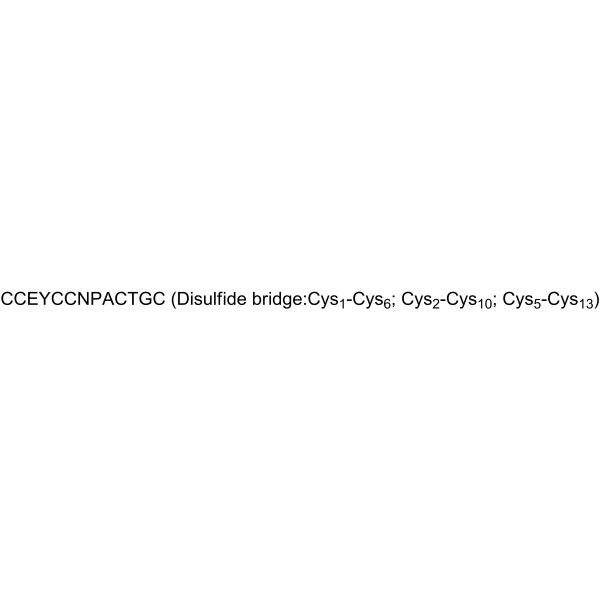
H-Cys(1)-Cys(2)-Glu-Tyr-Cys(3)-Cys(1)-Asn-Pro-Ala-Cys(2)-Thr-Gly-Cys(3)-OH CCEYCCNPACTGC (Disulfide bridge:Cys1-Cys6; Cys2-Cys10; Cys5-Cys13) L-cysteinyl-L-cysteinyl-L-alpha-glutamyl-L-tyrosyl-L-cysteinyl-L-cysteinyl-L-asparagyl-L-prolyl-L-alanyl-L-cysteinyl-L-threonyl-glycyl-L-cysteine (1->6),(2->10),(5->13)-tris(disulfide) |
| SequenceShortening |
CCEYCCNPACTGC H-C(1)C(2)EYC(3)C(1)NPAC(2)TGC(3)-OH |
| Appearance | White to off-white solid powder |
| LogP | -7.8 |
| Hydrogen Bond Donor Count | 17 |
| Hydrogen Bond Acceptor Count | 26 |
| Rotatable Bond Count | 9 |
| Heavy Atom Count | 89 |
| Complexity | 2650 |
| Defined Atom Stereocenter Count | 13 |
| SMILES | O=C1[C@@H](NC([C@]2([H])CSSC[C@@H](C(N[C@]3([H])C(N[C@@H](C(N[C@H](C(N[C@@]([H])(CSSC[C@H](NC(CNC(C(NC([C@]([H])(CSSC3)NC([C@@H](NC([C@]3([H])CCCN31)=O)C)=O)=O)[C@H](O)C)=O)=O)C(=O)O)C(N2)=O)=O)CC1C=CC(=CC=1)O)=O)CCC(=O)O)=O)=O)N)=O)CC(=O)N |
| InChi Key | PEHXAHVIVOAJQN-BRJMRMHMSA-N |
| InChi Code | InChI=1S/C50H70N14O19S6/c1-21-39(71)59-32-19-87-86-16-29-43(75)56-26(9-10-37(69)70)41(73)57-27(12-23-5-7-24(66)8-6-23)42(74)61-31(18-88-89-20-33(50(82)83)55-36(68)14-53-48(80)38(22(2)65)63-46(32)78)45(77)62-30(17-85-84-15-25(51)40(72)60-29)44(76)58-28(13-35(52)67)49(81)64-11-3-4-34(64)47(79)54-21/h5-8,21-22,25-34,38,65-66H,3-4,9-20,51H2,1-2H3,(H2,52,67)(H,53,80)(H,54,79)(H,55,68)(H,56,75)(H,57,73)(H,58,76)(H,59,71)(H,60,72)(H,61,74)(H,62,77)(H,63,78)(H,69,70)(H,82,83)/t21-,22+,25-,26-,27-,28-,29-,30-,31-,32-,33-,34-,38-/m0/s1 |
| Chemical Name | (1R,4S,7S,13S,16R,21R,24R,27S,30S,33R,38R,44S)-21-amino-13-(2-amino-2-oxoethyl)-27-(2-carboxyethyl)-44-[(1R)-1-hydroxyethyl]-30-[(4-hydroxyphenyl)methyl]-4-methyl-3,6,12,15,22,25,28,31,40,43,46,51-dodecaoxo-18,19,35,36,48,49-hexathia-2,5,11,14,23,26,29,32,39,42,45,52-dodecazatetracyclo[22.22.4.216,33.07,11]dopentacontane-38-carboxylic acid |
| Synonyms | MM 419447; 1092457-78-7; MM-419447; SCHEMBL24483647; MM419447; (1R,4S,7S,13S,16R,21R,24R,27S,30S,33R,38R,44S)-21-amino-13-(2-amino-2-oxoethyl)-27-(2-carboxyethyl)-44-[(1R)-1-hydroxyethyl]-30-[(4-hydroxyphenyl)methyl]-4-methyl-3,6,12,15,22,25,28,31,40,43,46,51-dodecaoxo-18,19,35,36,48,49-hexathia-2,5,11,14,23,26,29,32,39,42,45,52-dodecazatetracyclo[22.22.4.216,33.07,11]dopentacontane-38-carboxylic acid |
| HS Tariff Code | 2934.99.9001 |
| Storage |
Powder-20°C 3 years 4°C 2 years In solvent -80°C 6 months -20°C 1 month Note: Please store this product in a sealed and protected environment, avoid exposure to moisture. |
| Shipping Condition | Room temperature (This product is stable at ambient temperature for a few days during ordinary shipping and time spent in Customs) |
Biological Activity
| Targets | Guanylate cyclase-C; linaclotide metabolite |
| ln Vitro | High-affinity binding of MM 419447 to T84 cells causes a notable intracellular buildup of cyclic guanosine-39,59-monophosphate (cGMP) in a concentration-dependent manner[1]. |
| ln Vivo | The Cmax, AUC0-6, and t1/2 values for MM 419447 (10 mg/kg; po) dosing are 27 ng/mL, < 29.7 ng h/mL, and 0.33 hours, respectively[1]. |
| Animal Protocol |
Animal/Disease Models: Female SD (Sprague-Dawley) rats[1] Doses: 10 mg/kg Route of Administration: Po (pharmacokinetic/PK Analysis) Experimental Results: The Cmax, AUC0-6 and Tmax were 27 ng/mL, ≤ 29.7 ng h/mL and 0.33 hrs (hours), respectively. |
| References |
[1]. Pharmacologic properties, metabolism, and disposition of linaclotide, a novel therapeutic peptide approved for the treatment of irritable bowel syndrome with constipation and chronic idiopathic constipation. J Pharmacol Exp Ther. 2013;344. |
| Additional Infomation | Linaclotide, a potent guanylate cyclase C agonist, is a therapeutic peptide approved in the United States for the treatment of irritable bowel syndrome with constipation and chronic idiopathic constipation. We present for the first time the metabolism, degradation, and disposition of linaclotide in animals and humans. We examined the metabolic stability of linaclotide in conditions that mimic the gastrointestinal tract and characterized the metabolite MM-419447 (CCEYCCNPACTGC), which contributes to the pharmacologic effects of linaclotide. Systemic exposure to these active peptides is low in rats and humans, and the low systemic and portal vein concentrations of linaclotide and MM-419447 observed in the rat confirmed both peptides are minimally absorbed after oral administration. Linaclotide is stable in the acidic environment of the stomach and is converted to MM-419447 in the small intestine. The disulfide bonds of both peptides are reduced in the small intestine, where they are subsequently proteolyzed and degraded. After oral administration of linaclotide, <1% of the dose was excreted as active peptide in rat feces and a mean of 3–5% in human feces; in both cases MM-419447 was the predominant peptide recovered. MM-419447 exhibits high-affinity binding in vitro to T84 cells, resulting in a significant, concentration-dependent accumulation of intracellular cyclic guanosine-3′,5′-monophosphate (cGMP). In rat models of gastrointestinal function, orally dosed MM-419447 significantly increased fluid secretion into small intestinal loops, increased intraluminal cGMP, and caused a dose-dependent acceleration in gastrointestinal transit. These results demonstrate the importance of the active metabolite in contributing to linaclotide’s pharmacology. [1] |
Solubility Data
| Solubility (In Vitro) | DMSO: 100 mg/mL (73.34 mM) |
| Solubility (In Vivo) |
Solubility in Formulation 1: ≥ 2.5 mg/mL (1.83 mM) (saturation unknown) in 10% DMSO + 90% (20% SBE-β-CD in Saline) (add these co-solvents sequentially from left to right, and one by one), clear solution. For example, if 1 mL of working solution is to be prepared, you can add 100 μL of 25.0 mg/mL clear DMSO stock solution to 900 μL of 20% SBE-β-CD physiological saline solution and mix evenly. Preparation of 20% SBE-β-CD in Saline (4°C,1 week): Dissolve 2 g SBE-β-CD in 10 mL saline to obtain a clear solution. Solubility in Formulation 2: ≥ 2.5 mg/mL (1.83 mM) (saturation unknown) in 10% DMSO + 90% Corn Oil (add these co-solvents sequentially from left to right, and one by one), clear solution. For example, if 1 mL of working solution is to be prepared, you can add 100 μL of 25.0 mg/mL clear DMSO stock solution to 900 μL of corn oil and mix evenly. (Please use freshly prepared in vivo formulations for optimal results.) |
| Preparing Stock Solutions | 1 mg | 5 mg | 10 mg | |
| 1 mM | 0.7334 mL | 3.6669 mL | 7.3337 mL | |
| 5 mM | 0.1467 mL | 0.7334 mL | 1.4667 mL | |
| 10 mM | 0.0733 mL | 0.3667 mL | 0.7334 mL |