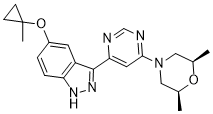
MLi-2 (MLi2) is a novel, highly potent, orally bioactive, and selective LRRK2 (Leucine-Rich Repeat Kinase 2) kinase inhibitor (IC50 = 0.76 nM) with CNS (central nervous system) activity, and thus has the potential for treating Parkinson's disease. MLi-2 exhibits exceptional potency in a purified LRRK2 kinase assay in vitro (IC50 = 0.76 nM), a cellular assay monitoring dephosphorylation of LRRK2 pSer935 LRRK2 (IC50 = 1.4 nM), and a radioligand competition binding assay (IC50 = 3.4 nM). MLi-2 has greater than 295-fold selectivity for over 300 kinases in addition to a diverse panel of receptors and ion channels.
Physicochemical Properties
| Molecular Formula | C21H25N5O2 |
| Molecular Weight | 379.4555 |
| Exact Mass | 379.2 |
| Elemental Analysis | C, 66.47; H, 6.64; N, 18.46; O, 8.43 |
| CAS # | 1627091-47-7 |
| PubChem CID | 78319901 |
| Appearance | White to off-white solid powder |
| Density | 1.3±0.1 g/cm3 |
| Boiling Point | 625.8±55.0 °C at 760 mmHg |
| Flash Point | 332.3±31.5 °C |
| Vapour Pressure | 0.0±1.8 mmHg at 25°C |
| Index of Refraction | 1.628 |
| LogP | 3.42 |
| Hydrogen Bond Donor Count | 1 |
| Hydrogen Bond Acceptor Count | 6 |
| Rotatable Bond Count | 4 |
| Heavy Atom Count | 28 |
| Complexity | 549 |
| Defined Atom Stereocenter Count | 2 |
| SMILES | O(C1C([H])=C([H])C2=C(C(C3=C([H])C(=NC([H])=N3)N3C([H])([H])[C@@]([H])(C([H])([H])[H])O[C@@]([H])(C([H])([H])[H])C3([H])[H])=NN2[H])C=1[H])C1(C([H])([H])[H])C([H])([H])C1([H])[H] |
| InChi Key | ATUUNJCZCOMUKD-OKILXGFUSA-N |
| InChi Code | InChI=1S/C21H25N5O2/c1-13-10-26(11-14(2)27-13)19-9-18(22-12-23-19)20-16-8-15(28-21(3)6-7-21)4-5-17(16)24-25-20/h4-5,8-9,12-14H,6-7,10-11H2,1-3H3,(H,24,25)/t13-,14+ |
| Chemical Name | (2S,6R)-2,6-dimethyl-4-(6-(5-(1-methylcyclopropoxy)-1H-indazol-3-yl)pyrimidin-4-yl)morpholine |
| Synonyms | MLi-2 MLi 2 MLi2. |
| HS Tariff Code | 2934.99.9001 |
| Storage |
Powder-20°C 3 years 4°C 2 years In solvent -80°C 6 months -20°C 1 month |
| Shipping Condition | Room temperature (This product is stable at ambient temperature for a few days during ordinary shipping and time spent in Customs) |
Biological Activity
| Targets |
|
|
| ln Vitro | MLi-2 demonstrates remarkable efficacy in three different assays: radioligand competition Binding (IC50=3.4 nM), cellular test monitoring LRRK2 pSer935 LRRK2 dephosphorylation (IC50=1.4 nM), and purified LRRK2 kinase assay in vitro (IC50=0.76 nM). Over 300 kinases, as well as a range of receptors and ion channels, are more than 295-fold selective for MLi-2 [1]. | |
| ln Vivo | Dephosphorylation of pSer935 LRRK2 was used to measure the dose-dependent suppression of central and peripheral targets in MLi-2 mice treated acutely or subchronically over a 24-hour period. Over a period of 15 weeks, MLi-2 treatment in MitoPark mice resulted in well-tolerated brain and plasma exposure. MitoPark mice treated with MLi-2 showed alterations in lung morphology that were in line with increased type II pneumocytes [1]. | |
| References |
[1]. MLi-2, a Potent, Selective, and Centrally Active Compound for Exploring the Therapeutic Potential and Safety of LRRK2 Kinase Inhibition. J Pharmacol Exp Ther. 2015 Dec;355(3):397-409. |
|
| Additional Infomation | MLI-2 is a member of the class of indazoles that is 1H-indazole that is substituted at position 3 by a 6-(cis-2,6-dimethylmorpholin-4-yl)pyrimidin-4-yl group and at position 5 by a (1-methylcyclopropoxy)group. It is an inhibitor of leucine-rich repeat kinase 2 (LRRK2). It has a role as an EC 2.7.11.1 (non-specific serine/threonine protein kinase) inhibitor. It is a member of indazoles, a member of pyrimidines, a member of morpholines, a member of cyclopropanes, an aromatic ether and a tertiary amino compound. |
Solubility Data
| Solubility (In Vitro) | DMSO : ~50 mg/mL (~131.77 mM) |
| Solubility (In Vivo) |
Solubility in Formulation 1: 2.87 mg/mL (7.56 mM) in 5% DMSO + 40% PEG300 + 5% Tween80 + 50% Saline (add these co-solvents sequentially from left to right, and one by one), suspension solution; with sonication. Preparation of saline: Dissolve 0.9 g of sodium chloride in 100 mL ddH₂ O to obtain a clear solution. Solubility in Formulation 2: ≥ 2.87 mg/mL (7.56 mM) (saturation unknown) in 5% DMSO + 95% (20% SBE-β-CD in Saline) (add these co-solvents sequentially from left to right, and one by one), clear solution. Preparation of 20% SBE-β-CD in Saline (4°C,1 week): Dissolve 2 g SBE-β-CD in 10 mL saline to obtain a clear solution. Solubility in Formulation 3: ≥ 2.5 mg/mL (6.59 mM) (saturation unknown) in 10% DMSO + 40% PEG300 + 5% Tween80 + 45% Saline (add these co-solvents sequentially from left to right, and one by one), clear solution. For example, if 1 mL of working solution is to be prepared, you can add 100 μL of 25.0 mg/mL clear DMSO stock solution to 400 μL PEG300 and mix evenly; then add 50 μL Tween-80 to the above solution and mix evenly; then add 450 μL normal saline to adjust the volume to 1 mL. Preparation of saline: Dissolve 0.9 g of sodium chloride in 100 mL ddH₂ O to obtain a clear solution. Solubility in Formulation 4: ≥ 2.5 mg/mL (6.59 mM) (saturation unknown) in 10% DMSO + 90% Corn Oil (add these co-solvents sequentially from left to right, and one by one), clear solution. For example, if 1 mL of working solution is to be prepared, you can add 100 μL of 25.0 mg/mL clear DMSO stock solution to 900 μL corn oil and mix evenly. Solubility in Formulation 5: 5 mg/mL (13.18 mM) in 30 % SBE-β-CD (add these co-solvents sequentially from left to right, and one by one), Suspension solution; with ultrasonication. (Please use freshly prepared in vivo formulations for optimal results.) |
| Preparing Stock Solutions | 1 mg | 5 mg | 10 mg | |
| 1 mM | 2.6353 mL | 13.1766 mL | 26.3532 mL | |
| 5 mM | 0.5271 mL | 2.6353 mL | 5.2706 mL | |
| 10 mM | 0.2635 mL | 1.3177 mL | 2.6353 mL |