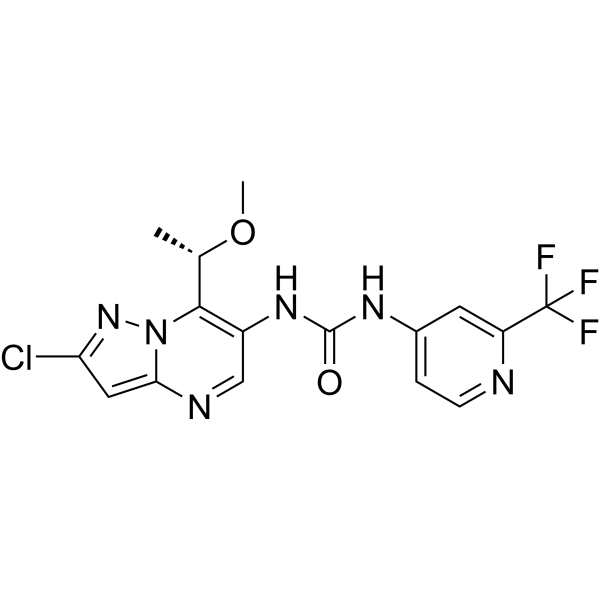
Physicochemical Properties
| Molecular Formula | C16H14CLF3N6O2 |
| Molecular Weight | 414.7696 |
| Exact Mass | 414.081 |
| CAS # | 1832576-04-1 |
| PubChem CID | 118540057 |
| Appearance | White to off-white solid powder |
| LogP | 1.8 |
| Hydrogen Bond Donor Count | 2 |
| Hydrogen Bond Acceptor Count | 8 |
| Rotatable Bond Count | 4 |
| Heavy Atom Count | 28 |
| Complexity | 557 |
| Defined Atom Stereocenter Count | 1 |
| SMILES | ClC1C([H])=C2N=C([H])C(=C([C@]([H])(C([H])([H])[H])OC([H])([H])[H])N2N=1)N([H])C(N([H])C1C([H])=C([H])N=C(C(F)(F)F)C=1[H])=O |
| InChi Key | ZMPUACZRXUZAJD-QMMMGPOBSA-N |
| InChi Code | InChI=1S/C16H14ClF3N6O2/c1-8(28-2)14-10(7-22-13-6-12(17)25-26(13)14)24-15(27)23-9-3-4-21-11(5-9)16(18,19)20/h3-8H,1-2H3,(H2,21,23,24,27)/t8-/m0/s1 |
| Chemical Name | 1-[2-chloro-7-[(1S)-1-methoxyethyl]pyrazolo[1,5-a]pyrimidin-6-yl]-3-[2-(trifluoromethyl)pyridin-4-yl]urea |
| HS Tariff Code | 2934.99.9001 |
| Storage |
Powder-20°C 3 years 4°C 2 years In solvent -80°C 6 months -20°C 1 month |
| Shipping Condition | Room temperature (This product is stable at ambient temperature for a few days during ordinary shipping and time spent in Customs) |
Biological Activity
| ln Vitro | In vitro, MLT-943 exhibits strong potency and selectivity. With comparable cross-species IC50s (0.07-0.09 μM in PBMC and 0.6-0.8 μM in whole blood), MLT-943 suppresses stimulated IL-2 secretion in both PBMC and whole blood [1]. |
| ln Vivo | In a rat model of collagen-induced arthritis, prophylactic administration of MLT-943 (oral gavage; 10 mg/kg; QD) inhibits the generation of anti-collagen antibodies, completely prevents paw swelling, and enhances joint stability in the rat model. Scores based on histology were normalized[1]. MLT-943 (oral gavage; 5 mg/kg; QD; 10 days) reaches a maximum after 7 days of treatment and efficiently decreases MALT1 protease activity as well as the frequency of Foxp3+CD25+ Treg cells in circulating CD4+ T cells. After stopping MLT-943 treatment on day 10, Treg frequencies took four days to progressively recover to their initial levels. Treg frequency remained unaffected by suboptimal dosages of MLT-943 (0.1 and 0.5 mg/kg QD; po)[1]. In 4- and 13-week rat toxicity trials, MLT-943 (oral gavage; 0, 5, 20, or 80 mg/kg/day; 4–13 weeks) led to decreased Treg and total T cell counts at all treatment levels. Rats have a clinical onset of about 9 weeks, despite the fact that 4-Longer therapy promotes significant immune-mediated disease in several organs[1]. In vivo, MLT-943 (oral administration; 3 mg/kg; single dosage) shows positive PK characteristics. Rats and mice have Cmax values of 0.7 nM and 0.5 nM, respectively. Rats and mice have F%s of 86% and 50%, respectively[1]. Note: MC:Tween 80:Water (0.5:0.5:99) solution (from the literature, for reference only) is the solvent for oral administration, and NMP:PEG200 (30/70) solution is the solvent for intravenous administration[1]. |
| Animal Protocol |
Animal/Disease Models: Naïve rats[1] Doses: 5 mg/kg Route of Administration: Oral gavage; 5 mg/kg, 10 days or 0.1 mg/kg MLT-943 Experimental Results: Induced a severe immune-mediated pathology after a prolonged treatment |
| References |
[1]. Pharmacological Inhibition of MALT1 Protease Leads to a Progressive IPEX-Like Pathology. Front Immunol. [2]. Optimization of the In Vivo Potency of Pyrazolopyrimidine MALT1 Protease Inhibitors by Reducing Metabolism and Increasing Potency in Whole Blood. J Med Chem. 2020 Dec 10;63(23):14594-14608. |
Solubility Data
| Solubility (In Vitro) | DMSO: 250 mg/mL (602.74 mM) |
| Solubility (In Vivo) |
Solubility in Formulation 1: ≥ 2.08 mg/mL (5.01 mM) (saturation unknown) in 10% DMSO + 40% PEG300 + 5% Tween80 + 45% Saline (add these co-solvents sequentially from left to right, and one by one), clear solution. For example, if 1 mL of working solution is to be prepared, you can add 100 μL of 20.8 mg/mL clear DMSO stock solution to 400 μL PEG300 and mix evenly; then add 50 μL Tween-80 to the above solution and mix evenly; then add 450 μL normal saline to adjust the volume to 1 mL. Preparation of saline: Dissolve 0.9 g of sodium chloride in 100 mL ddH₂ O to obtain a clear solution. Solubility in Formulation 2: ≥ 2.08 mg/mL (5.01 mM) (saturation unknown) in 10% DMSO + 90% Corn Oil (add these co-solvents sequentially from left to right, and one by one), clear solution. For example, if 1 mL of working solution is to be prepared, you can add 100 μL of 20.8 mg/mL clear DMSO stock solution to 900 μL of corn oil and mix evenly. (Please use freshly prepared in vivo formulations for optimal results.) |
| Preparing Stock Solutions | 1 mg | 5 mg | 10 mg | |
| 1 mM | 2.4110 mL | 12.0549 mL | 24.1097 mL | |
| 5 mM | 0.4822 mL | 2.4110 mL | 4.8219 mL | |
| 10 mM | 0.2411 mL | 1.2055 mL | 2.4110 mL |