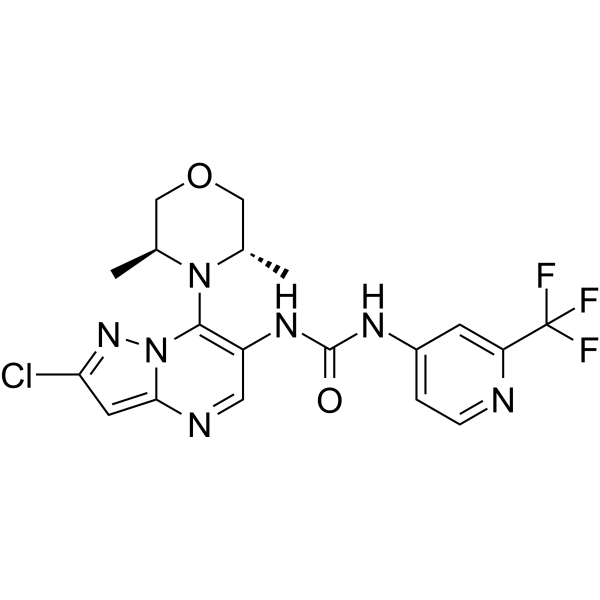
Physicochemical Properties
| Molecular Formula | C19H19CLF3N7O2 |
| Molecular Weight | 469.848072290421 |
| Exact Mass | 469.124 |
| CAS # | 2682102-10-7 |
| PubChem CID | 146680905 |
| Appearance | White to off-white solid powder |
| LogP | 2.6 |
| Hydrogen Bond Donor Count | 2 |
| Hydrogen Bond Acceptor Count | 9 |
| Rotatable Bond Count | 3 |
| Heavy Atom Count | 32 |
| Complexity | 665 |
| Defined Atom Stereocenter Count | 2 |
| SMILES | C[C@H]1COC[C@@H](N1C2=C(C=NC3=CC(=NN32)Cl)NC(=O)NC4=CC(=NC=C4)C(F)(F)F)C |
| InChi Key | BFPCFGGFGQMJQG-QWRGUYRKSA-N |
| InChi Code | InChI=1S/C19H19ClF3N7O2/c1-10-8-32-9-11(2)29(10)17-13(7-25-16-6-15(20)28-30(16)17)27-18(31)26-12-3-4-24-14(5-12)19(21,22)23/h3-7,10-11H,8-9H2,1-2H3,(H2,24,26,27,31)/t10-,11-/m0/s1 |
| Chemical Name | 1-[2-chloro-7-[(3S,5S)-3,5-dimethylmorpholin-4-yl]pyrazolo[1,5-a]pyrimidin-6-yl]-3-[2-(trifluoromethyl)pyridin-4-yl]urea |
| HS Tariff Code | 2934.99.9001 |
| Storage |
Powder-20°C 3 years 4°C 2 years In solvent -80°C 6 months -20°C 1 month |
| Shipping Condition | Room temperature (This product is stable at ambient temperature for a few days during ordinary shipping and time spent in Customs) |
Biological Activity
| ln Vitro | MLT-231 (19.5–10,000 nM) prevents OCI-Ly3 cells from proliferating. MLT-231 (50-5000 nM; 24 hours) suppresses the expression of the NF-κB target gene IRF4 while causing the uncleaved forms of its substrates, CYLD, BCL10, and RELB, to accumulate[1]. |
| ln Vivo | In the ABC-DLBCL xenograft model, MLT-231 (10-100 mg/kg; po; bid schedule for 2 weeks) exhibits in vivo efficacy[1]. Following IV administration of MLT-231 (1 mg/kg) to BALB/c mice, the CL, t1/2, and Vss are, respectively, 11 mL/min/kg, 1.9 hours, and 1.5 L/kg[1]. Following intravenous administration of MLT-231 (1 mg/kg) to Sprague-Dawley rats, the CL, t1/2, and Vss are 41 mL/min/kg, 3.2 hours, and 9.4 L/kg, respectively[1]. The AUC0-24, Cmax, and F values for MLT-231 (3 mg/kg; po; BALB/c mice) are 3096 nM/h, 549 nM, and 99%, respectively[1]. The AUC0-24, Cmax, and F values for MLT-231 (3 mg/kg; po; Sprague-Dawley rats) are 547 nM/h, 46 nM, and 61%, correspondingly. |
| Cell Assay |
Western Blot Analysis[1] Cell Types: OCI-Ly3 cells Tested Concentrations: 50-5000 nM Incubation Duration: 24 hrs (hours) Experimental Results: NF-κB target gene IRF4 was suppressed. |
| Animal Protocol |
Animal/Disease Models: Scid-beige mice (OCI-Ly10 ABC-DLBCL type xenograft model)[1] Doses: 10, 30, and 100 mg/kg Route of Administration: Po; bid schedule for 2 weeks Experimental Results: Led to tumor stasis, while being well tolerated. |
| References |
[1]. Discovery of Potent, Highly Selective, and In Vivo Efficacious, Allosteric MALT1 Inhibitors by Iterative Scaffold Morphing [published online ahead of print, 2020 Nov 30]. J Med Chem. 2020;10.1021/acs.jmedchem.0c01245. |
Solubility Data
| Solubility (In Vitro) | DMSO: 110 mg/mL (234.12 mM) |
| Solubility (In Vivo) |
Solubility in Formulation 1: ≥ 6 mg/mL (12.77 mM) (saturation unknown) in 10% DMSO + 40% PEG300 + 5% Tween80 + 45% Saline (add these co-solvents sequentially from left to right, and one by one), clear solution. For example, if 1 mL of working solution is to be prepared, you can add 100 μL of 60.0 mg/mL clear DMSO stock solution to 400 μL PEG300 and mix evenly; then add 50 μL Tween-80 to the above solution and mix evenly; then add 450 μL normal saline to adjust the volume to 1 mL. Preparation of saline: Dissolve 0.9 g of sodium chloride in 100 mL ddH₂ O to obtain a clear solution. Solubility in Formulation 2: ≥ 5.5 mg/mL (11.71 mM) (saturation unknown) in 10% DMSO + 90% Corn Oil (add these co-solvents sequentially from left to right, and one by one), clear solution. For example, if 1 mL of working solution is to be prepared, you can add 100 μL of 55.0 mg/mL clear DMSO stock solution to 900 μL of corn oil and mix evenly. (Please use freshly prepared in vivo formulations for optimal results.) |
| Preparing Stock Solutions | 1 mg | 5 mg | 10 mg | |
| 1 mM | 2.1283 mL | 10.6417 mL | 21.2834 mL | |
| 5 mM | 0.4257 mL | 2.1283 mL | 4.2567 mL | |
| 10 mM | 0.2128 mL | 1.0642 mL | 2.1283 mL |