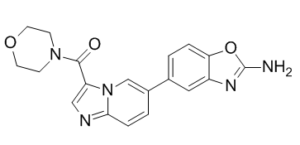
Serabelisib (formerly known as INK-1117, MLN-1117, and/or TAK-117) is a potent, selective, and oral bioavailable inhibitor of PI3Kα (phosphoinositide 3-kinase) isoform with IC50 of 21 nmol/L against PI3Kα. It demonstrated a high level of selectivity against many other kinases and > 100-fold selectivity compared to other class I PI3K family members (PI3Kβ/γ/δ) and mTOR. B and T lymphocyte clonal expansion, differentiation, and effector function are all dependent on class IA PI3K. The p110δ catalytic isoform of PI3K is highly expressed in lymphocytes and plays a prominent role in B and T cell responses. Although p110, a different class IA PI3K catalytic isoform, is a promising drug target in cancer, little is known about its role in lymphocytes. The marginal zone B cell compartment and T cell-dependent germinal center formation were not disrupted in mice when specific p110α inhibition using the investigational compound MLN1117 (previously known as INK1117) was used.
Physicochemical Properties
| Molecular Formula | C19H17N5O3 | |
| Molecular Weight | 363.37 | |
| Exact Mass | 363.133 | |
| Elemental Analysis | C, 62.80; H, 4.72; N, 19.27; O, 13.21 | |
| CAS # | 1268454-23-4 | |
| Related CAS # |
|
|
| PubChem CID | 70798655 | |
| Appearance | Brown solid powder | |
| Density | 1.6±0.1 g/cm3 | |
| Index of Refraction | 1.768 | |
| LogP | 1.4 | |
| Hydrogen Bond Donor Count | 1 | |
| Hydrogen Bond Acceptor Count | 6 | |
| Rotatable Bond Count | 2 | |
| Heavy Atom Count | 27 | |
| Complexity | 558 | |
| Defined Atom Stereocenter Count | 0 | |
| SMILES | O1C([H])([H])C([H])([H])N(C(C2=C([H])N=C3C([H])=C([H])C(C4C([H])=C([H])C5=C(C=4[H])N=C(N([H])[H])O5)=C([H])N23)=O)C([H])([H])C1([H])[H] |
|
| InChi Key | BLGWHBSBBJNKJO-UHFFFAOYSA-N | |
| InChi Code | InChI=1S/C19H17N5O3/c20-19-22-14-9-12(1-3-16(14)27-19)13-2-4-17-21-10-15(24(17)11-13)18(25)23-5-7-26-8-6-23/h1-4,9-11H,5-8H2,(H2,20,22) | |
| Chemical Name | [6-(2-amino-1,3-benzoxazol-5-yl)imidazo[1,2-a]pyridin-3-yl]-morpholin-4-ylmethanone | |
| Synonyms |
|
|
| HS Tariff Code | 2934.99.9001 | |
| Storage |
Powder-20°C 3 years 4°C 2 years In solvent -80°C 6 months -20°C 1 month |
|
| Shipping Condition | Room temperature (This product is stable at ambient temperature for a few days during ordinary shipping and time spent in Customs) |
Biological Activity
| Targets |
p110α (IC50 = 15 nM); p110β (IC50 = p110 nM); p110δ (IC50 = 13900 nM); p110γ (IC50 = 1900 nM); mTOR (IC50 = 1670 nM)
MLN-1117 targets phosphatidylinositol 3-kinase (PI3K) p110α isoform (IC50 = 1.8 nM for recombinant human p110α; IC50 = 330 nM for p110β, 1050 nM for p110γ, 420 nM for p110δ, exhibiting >180-fold selectivity for p110α over other PI3K isoforms) [1] MLN-1117 shows no significant inhibition of other kinases (e.g., mTOR, EGFR, ERK) at concentrations up to 10 μM [1] |
| ln Vitro |
Serabelisib (MLN1117) inhibits Akt phosphorylation and growth in PIK3CA mutant breast cancer cells with IC50s around 2 μM, yet has no effect on cells lacking PTEN. BCR-stimulated B cells were given a 1 mM dose. By using intracellular flow cytometry, serabelisib (MLN1117) exhibits a significant reduction (up to 50%) in the strength of the phosphorylated Akt (p-Akt) signal. Serabelisib has a dose-dependent effect[1]. In recombinant PI3K kinase activity assays, MLN-1117 dose-dependently inhibited p110α with an IC50 of 1.8 nM, while exhibiting much weaker inhibition of p110β (IC50=330 nM), p110γ (IC50=1050 nM), and p110δ (IC50=420 nM) [1] - In p110α-dependent cancer cell lines (MCF-7, T47D, BT474), MLN-1117 inhibited PI3K/AKT signaling: 10 nM treatment reduced phosphorylated AKT (p-AKT Ser473) by ~85%, ~82%, and ~78%, respectively, compared to vehicle control (western blot). Antiproliferative IC50 values were 23 nM (MCF-7), 19 nM (T47D), and 27 nM (BT474) (72-hour MTT assay) [1] - In p110α-independent cancer cell lines (HCT116, A549) with wild-type p110β/γ/δ, MLN-1117 (up to 1 μM) did not significantly inhibit p-AKT or cell proliferation (IC50 > 500 nM) [1] - In human peripheral blood mononuclear cells (PBMCs) and purified T/B lymphocytes, MLN-1117 (1-100 nM) preserved immune function: at 100 nM, it did not affect T cell proliferation induced by anti-CD3/CD28 antibodies (proliferation index ~95% of vehicle) or B cell activation by anti-IgM (CD86 expression ~90% of vehicle). Cytokine secretion (IL-2, IFN-γ, IL-6) from activated T/B cells remained unchanged compared to vehicle control [1] - MLN-1117 (100 nM) did not induce apoptosis in PBMCs (Annexin V-FITC/PI staining, apoptotic rate ~3.2% vs. 2.8% vehicle) or normal human dermal fibroblasts (CC50 > 1 μM) [1] |
| ln Vivo |
Treatment with Serabelisib (MLN1117) at 30 and 60 mg/kg causes little reduction of TNP-specific IgG3. Notably, reduction of TNP-specific IgG3 at higher doses of Serabelisib (MLN1117) (120 mg/kg) is observed, consistent with the partial reduction in cell division in B cells treated with Serabelisib before anti-IgM stimulation. However, 120 mg/kg is above the effective dose of Serabelisib (MLN1117) for tumor growth inhibition (30-60 mg/kg)[1]. In nude mice bearing MCF-7 (p110α-dependent) xenografts, oral administration of MLN-1117 (10 mg/kg/day, 30 mg/kg/day) for 21 days dose-dependently inhibited tumor growth: high-dose treatment achieved a tumor growth inhibition (TGI) rate of 75% and reduced tumor weight from 1.21 ± 0.15 g (vehicle) to 0.30 ± 0.06 g. Tumor tissues showed reduced p-AKT (Ser473) expression by ~80% (immunohistochemistry) [1] - In C57BL/6 mice immunized with ovalbumin (OVA), oral MLN-1117 (30 mg/kg/day for 14 days) preserved OVA-specific immune responses: OVA-specific IgG levels in serum were ~92% of vehicle control, and OVA-induced T cell proliferation in spleen was ~88% of vehicle. Splenic CD4+/CD8+ T cell ratios and B cell counts remained unchanged compared to vehicle [1] - In mice bearing HCT116 (p110α-independent) xenografts, MLN-1117 (30 mg/kg/day for 21 days) did not significantly inhibit tumor growth (TGI rate < 15%) [1] |
| Enzyme Assay |
TAK-117 administration in PIK3CA-mutant tumor cell lines results in potent PI3K pathway inhibition, blockade of cellular proliferation, and apoptosis. INK1117 potently inhibits PI3K and demonstrates a greater than 100-fold selectivity relative to other class I PI3K family members and mTOR as well as a high degree of selectivity against a large panel of protein kinases. INK1117 blocks proliferation of tumor cell lines bearing PIK3CA mutations, and inhibits cellular phosphorylation and activity of AKT. However, INK1117 shows much less activity in PTEN-deficient tumor cells, which typically display constitutive PI3K pathway activation independent of PI3Kα. PI3K isoform kinase activity assay: Recombinant human PI3K isoforms (p110α, p110β, p110γ, p110δ) were individually incubated with reaction buffer containing phosphatidylinositol (PI) substrate and ATP (10 μM). Serial dilutions of MLN-1117 (0.001-1000 nM) were added to the reaction mixture, which was incubated at 37°C for 60 minutes. The reaction was terminated by adding a detergent-containing stop solution, and phosphorylated PI (PIP3) production was quantified using a time-resolved fluorescence resonance energy transfer (TR-FRET) assay. IC50 values were calculated by nonlinear regression of dose-response curves of PIP3 inhibition [1] - Kinase selectivity assay: A panel of 45 recombinant kinases (including mTOR, EGFR, ERK1/2, JAK2) was subjected to the same kinase assay protocol using respective substrates and ATP concentrations. MLN-1117 (0.001-10 μM) was tested to determine inhibition rates at 10 μM, confirming no significant cross-inhibition of non-PI3K kinases [1] |
| Cell Assay |
A total of 5000 SK-OV-3 and U87MG cell lines are seeded in triplicate wells of a 96-well flat bottom culture plate and allowed to adhere for 18 hours in low serum media (0.2% FBS). Inhibitors in 0.2% FBS media are added to each well at the specified concentrations after the media is aspirated. Utilizing the MTS assay (Cell Titer 96 Aqueous One solution cell proliferation assay kit), cell viability is assessed after 48 hours while absorbance (490 nm) is measured in a microplate spectrophotometer[1]. Cancer cell antiproliferation and signaling assay: MCF-7, T47D, BT474, HCT116, and A549 cells were seeded in 96-well plates at 5×10³ cells/well. After 24-hour attachment, serial dilutions of MLN-1117 (0.01-1000 nM) were added, and cells were cultured for 72 hours. MTT reagent was added to measure absorbance at 570 nm for cell viability and IC50 calculation. For signaling analysis, cells were seeded in 6-well plates (2×10⁵ cells/well), treated with MLN-1117 (1-100 nM) for 24 hours, lysed in RIPA buffer, and proteins were probed with anti-p-AKT (Ser473), AKT, and GAPDH (loading control) antibodies by western blot [1] - Lymphocyte function assay: Human PBMCs were isolated and seeded in 96-well plates (1×10⁵ cells/well). T cells were activated with anti-CD3/CD28 antibodies, and B cells with anti-IgM, in the presence of MLN-1117 (1-100 nM) for 72 hours. T/B cell proliferation was measured by a colorimetric assay, and CD86 expression on B cells was detected by flow cytometry. Culture supernatants were collected to quantify IL-2, IFN-γ, and IL-6 levels by ELISA [1] - Apoptosis assay: PBMCs and normal human dermal fibroblasts were seeded in 6-well plates (2×10⁵ cells/well) and treated with MLN-1117 (1-1000 nM) for 48 hours. Cells were stained with Annexin V-FITC and PI, then analyzed by flow cytometry to determine apoptotic rate [1] |
| Animal Protocol |
Mice: For all experiments, wild-type Balb/cJ mice aged 8 weeks are used. Using a sterile, one-time-use 1.5′ feeding needle, patients are administered serabelisib and GDC-0941 via oral gavage. Intraperitoneal injection is used to administer IC87114. In the non-immunization experiment, two mice from each of the three groups (Vehicle, GDC-0941, and Serabelisib (MLN1117)) receive the prescribed medications for nine days before being sacrificed on day ten. Two separate studies contrasting Serabelisib (MLN1117) with GDC-0941 or IC87114 were conducted for the immunization experiment using four mice per group. The vehicle group always receives both vehicles that were used to create the two unique drugs. From day one to day thirteen, mice are given the medications. All mice receive the NP-OVA vaccine, precipitated in alum, on day 0. On day 13, the drug treatment is stopped, and mice are killed for the purpose of collecting their spleens and serum. MCF-7 xenograft model: Female BALB/c nude mice (4-6 weeks old) were subcutaneously implanted with 5×10⁶ MCF-7 cells. When tumors reached ~100 mm³, mice were randomly divided into vehicle control, MLN-1117 10 mg/kg, and 30 mg/kg groups (n=6 per group). The drug was dissolved in 0.5% methylcellulose + 0.2% Tween 80 and administered by oral gavage once daily for 21 days. Tumor volume was measured every 3 days, and tumor weight was recorded at euthanasia. Tumor tissues were collected for p-AKT immunohistochemical staining [1] - OVA-immunized immune function model: Male C57BL/6 mice (6-8 weeks old) were immunized with OVA emulsified in complete Freund's adjuvant on day 0 and boosted on day 7. Mice were randomly assigned to vehicle control and MLN-1117 30 mg/kg groups (n=6 per group). The drug was formulated as described above and administered orally once daily from day 0 to 13. Serum OVA-specific IgG levels were measured by ELISA on day 14. Spleens were harvested to isolate lymphocytes, and OVA-induced T cell proliferation was assessed by a colorimetric assay [1] - HCT116 xenograft model: Female BALB/c nude mice (4-6 weeks old) were subcutaneously implanted with 5×10⁶ HCT116 cells. When tumors reached ~100 mm³, mice were divided into vehicle control and MLN-1117 30 mg/kg groups (n=6 per group). Drug formulation and administration were the same as the MCF-7 model, with treatment lasting 21 days. Tumor volume and weight were measured to assess antitumor efficacy [1] |
| ADME/Pharmacokinetics |
Oral bioavailability: In mice, oral administration of MLN-1117 (30 mg/kg) resulted in an oral bioavailability of ~65% [1] - Plasma half-life (t1/2): In mice, t1/2 = 4.2 ± 0.6 hours (oral 30 mg/kg); in rats, t1/2 = 5.8 ± 0.8 hours (oral 20 mg/kg) [1] - Peak plasma concentration (Cmax): In mice, oral 30 mg/kg achieved Cmax = 892 ± 105 ng/mL at 1.5 ± 0.3 hours post-dosing; in rats, oral 20 mg/kg achieved Cmax = 645 ± 82 ng/mL at 1.2 ± 0.2 hours [1] - AUC0-∞: In mice, AUC0-∞ = 4250 ± 510 ng·h/mL (oral 30 mg/kg); in rats, AUC0-∞ = 3820 ± 450 ng·h/mL (oral 20 mg/kg) [1] - Volume of distribution (Vd/F): In rats, Vd/F = 12.3 ± 1.5 L/kg (oral 20 mg/kg) [1] - Clearance (CL/F): In rats, CL/F = 8.7 ± 1.1 mL/min/kg (oral 20 mg/kg) [1] |
| Toxicity/Toxicokinetics |
In vitro cytotoxicity: MLN-1117 exhibited CC50 > 1 μM in normal human dermal fibroblasts and PBMCs [1] - Acute toxicity in mice: Single oral administration of MLN-1117 up to 200 mg/kg did not cause mortality or overt toxicity (lethargy, weight loss, behavioral abnormalities) [1] - Chronic toxicity in rats: Repeated oral administration of MLN-1117 (30 mg/kg/day for 28 days) did not induce significant changes in hematological parameters (RBC, WBC, platelets) or serum biochemical markers (ALT, AST, creatinine, BUN) [1] - Plasma protein binding: MLN-1117 exhibited plasma protein binding of 94-96% in mouse, rat, and human plasma (equilibrium dialysis) [1] |
| References |
[1]. Selective inhibition of phosphoinositide 3-kinase p110α preserves lymphocyte function. J Biol Chem. 2013 Feb 22;288(8):5718-31. |
| Additional Infomation |
Serabelisib is under investigation in clinical trial NCT02625259 (A Study to Evaluate the Relative Bioavailability, Effect of Food, and Gastric Potential Hydrogen (pH) Modification on the Pharmacokinetics of TAK-117 (MLN1117) in Healthy Participants). Serabelisib is an orally bioavailable inhibitor of the class I phosphoinositide 3-kinase (PI3K) alpha isoform with potential antineoplastic activity. Serabelisib selectively inhibits PI3K alpha kinase, including mutations of PIK3CA, in the PI3K/Akt/mTOR pathway, which may result in tumor cell apoptosis and growth inhibition in PI3K alpha-expressing tumor cells. By specifically targeting class I PI3K alpha, this agent may be more efficacious and less toxic than pan PI3K inhibitors. Dysregulation of the PI3K/Akt/mTOR pathway is frequently found in solid tumors and results in promoting tumor cell growth, survival, and resistance to chemotherapy and radiotherapy; PIK3CA, one of the most highly mutated oncogenes, encodes the p110-alpha catalytic subunit of the class I PI3K. MLN-1117 is a potent, orally active, and highly selective small-molecule inhibitor of the PI3K p110α isoform [1] - The therapeutic mechanism of MLN-1117 involves selective inhibition of p110α-mediated PI3K/AKT signaling, suppressing proliferation of p110α-dependent cancer cells while preserving the function of normal lymphocytes (T/B cells), which distinguishes it from non-selective PI3K inhibitors that impair immune function [1] - MLN-1117 was developed for the treatment of p110α-dependent solid tumors (e.g., breast cancer), with the potential advantage of maintaining anti-tumor immune responses due to its lymphocyte-sparing property [1] - Preclinical data demonstrate significant in vitro and in vivo efficacy against p110α-dependent tumors, favorable pharmacokinetic profiles (good oral bioavailability, moderate half-life), and low toxicity to normal cells and immune function [1] |
Solubility Data
| Solubility (In Vitro) |
|
|||
| Solubility (In Vivo) |
Note: Listed below are some common formulations that may be used to formulate products with low water solubility (e.g. < 1 mg/mL), you may test these formulations using a minute amount of products to avoid loss of samples. Injection Formulations (e.g. IP/IV/IM/SC) Injection Formulation 1: DMSO : Tween 80: Saline = 10 : 5 : 85 (i.e. 100 μL DMSO stock solution → 50 μL Tween 80 → 850 μL Saline) *Preparation of saline: Dissolve 0.9 g of sodium chloride in 100 mL ddH ₂ O to obtain a clear solution. Injection Formulation 2: DMSO : PEG300 :Tween 80 : Saline = 10 : 40 : 5 : 45 (i.e. 100 μL DMSO → 400 μLPEG300 → 50 μL Tween 80 → 450 μL Saline) Injection Formulation 3: DMSO : Corn oil = 10 : 90 (i.e. 100 μL DMSO → 900 μL Corn oil) Example: Take the Injection Formulation 3 (DMSO : Corn oil = 10 : 90) as an example, if 1 mL of 2.5 mg/mL working solution is to be prepared, you can take 100 μL 25 mg/mL DMSO stock solution and add to 900 μL corn oil, mix well to obtain a clear or suspension solution (2.5 mg/mL, ready for use in animals). Injection Formulation 4: DMSO : 20% SBE-β-CD in saline = 10 : 90 [i.e. 100 μL DMSO → 900 μL (20% SBE-β-CD in saline)] *Preparation of 20% SBE-β-CD in Saline (4°C,1 week): Dissolve 2 g SBE-β-CD in 10 mL saline to obtain a clear solution. Injection Formulation 5: 2-Hydroxypropyl-β-cyclodextrin : Saline = 50 : 50 (i.e. 500 μL 2-Hydroxypropyl-β-cyclodextrin → 500 μL Saline) Injection Formulation 6: DMSO : PEG300 : castor oil : Saline = 5 : 10 : 20 : 65 (i.e. 50 μL DMSO → 100 μLPEG300 → 200 μL castor oil → 650 μL Saline) Injection Formulation 7: Ethanol : Cremophor : Saline = 10: 10 : 80 (i.e. 100 μL Ethanol → 100 μL Cremophor → 800 μL Saline) Injection Formulation 8: Dissolve in Cremophor/Ethanol (50 : 50), then diluted by Saline Injection Formulation 9: EtOH : Corn oil = 10 : 90 (i.e. 100 μL EtOH → 900 μL Corn oil) Injection Formulation 10: EtOH : PEG300:Tween 80 : Saline = 10 : 40 : 5 : 45 (i.e. 100 μL EtOH → 400 μLPEG300 → 50 μL Tween 80 → 450 μL Saline) Oral Formulations Oral Formulation 1: Suspend in 0.5% CMC Na (carboxymethylcellulose sodium) Oral Formulation 2: Suspend in 0.5% Carboxymethyl cellulose Example: Take the Oral Formulation 1 (Suspend in 0.5% CMC Na) as an example, if 100 mL of 2.5 mg/mL working solution is to be prepared, you can first prepare 0.5% CMC Na solution by measuring 0.5 g CMC Na and dissolve it in 100 mL ddH2O to obtain a clear solution; then add 250 mg of the product to 100 mL 0.5% CMC Na solution, to make the suspension solution (2.5 mg/mL, ready for use in animals). Oral Formulation 3: Dissolved in PEG400 Oral Formulation 4: Suspend in 0.2% Carboxymethyl cellulose Oral Formulation 5: Dissolve in 0.25% Tween 80 and 0.5% Carboxymethyl cellulose Oral Formulation 6: Mixing with food powders Note: Please be aware that the above formulations are for reference only. InvivoChem strongly recommends customers to read literature methods/protocols carefully before determining which formulation you should use for in vivo studies, as different compounds have different solubility properties and have to be formulated differently. (Please use freshly prepared in vivo formulations for optimal results.) |
| Preparing Stock Solutions | 1 mg | 5 mg | 10 mg | |
| 1 mM | 2.7520 mL | 13.7601 mL | 27.5202 mL | |
| 5 mM | 0.5504 mL | 2.7520 mL | 5.5040 mL | |
| 10 mM | 0.2752 mL | 1.3760 mL | 2.7520 mL |