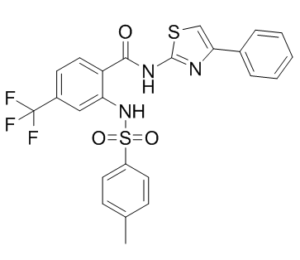
ML364 is a small molecule inhibitor of ubiquitin specific peptidase 2 (USP2, a deubiquitinase) with an IC50 of 1.1 μm in a biochemical assay. ML364 was used to interrogate the biology of USP2 and its putative substrate cyclin D1. ML364 induced an increase in cellular cyclin D1 degradation and caused cell cycle arrest as shown in Western blottings and flow cytometry assays utilizing both Mino and HCT116 cancer cell lines. ML364 was antiproliferative in cancer cell lines. Consistent with the role of cyclin D1 in DNA damage response, ML364 also caused a decrease in homologous recombination-mediated DNA repair. These effects by ML364 support a key role for USP2 as a regulator of cell cycle, DNA repair, and tumor cell growth and that ML364 may be used for the research of breast cancer.
Physicochemical Properties
| Molecular Formula | C24H18F3N3O3S2 | |
| Molecular Weight | 517.54 | |
| Exact Mass | 517.074 | |
| Elemental Analysis | C, 55.70; H, 3.51; F, 11.01; N, 8.12; O, 9.27; S, 12.39 | |
| CAS # | 1991986-30-1 | |
| Related CAS # |
|
|
| PubChem CID | 70789348 | |
| Appearance | Light yellow to yellow solid powder | |
| LogP | 6.1 | |
| Hydrogen Bond Donor Count | 2 | |
| Hydrogen Bond Acceptor Count | 9 | |
| Rotatable Bond Count | 6 | |
| Heavy Atom Count | 35 | |
| Complexity | 822 | |
| Defined Atom Stereocenter Count | 0 | |
| SMILES | S(C1C([H])=C([H])C(C([H])([H])[H])=C([H])C=1[H])(N([H])C1C([H])=C(C(F)(F)F)C([H])=C([H])C=1C(N([H])C1=NC(=C([H])S1)C1C([H])=C([H])C([H])=C([H])C=1[H])=O)(=O)=O |
|
| InChi Key | QZUGMNXETPARLI-UHFFFAOYSA-N | |
| InChi Code | InChI=1S/C24H18F3N3O3S2/c1-15-7-10-18(11-8-15)35(32,33)30-20-13-17(24(25,26)27)9-12-19(20)22(31)29-23-28-21(14-34-23)16-5-3-2-4-6-16/h2-14,30H,1H3,(H,28,29,31) | |
| Chemical Name | 2-[(4-Methylphenyl)sulfonylamino]-N-(4-phenyl-1,3-thiazol-2-yl)-4-(trifluoromethyl)benzamide | |
| Synonyms |
|
|
| HS Tariff Code | 2934.99.9001 | |
| Storage |
Powder-20°C 3 years 4°C 2 years In solvent -80°C 6 months -20°C 1 month |
|
| Shipping Condition | Room temperature (This product is stable at ambient temperature for a few days during ordinary shipping and time spent in Customs) |
Biological Activity
| Targets | USP2(IC50= 1.1 μM);USP2(Kd= 5.2 μM) | ||
| ln Vitro | ML364 is a small molecule inhibitor of ubiquitin specific peptidase 2 (USP2, a deubiquitinase) with an IC50 of 1.1 μm in a biochemical assay. ML364 was used to interrogate the biology of USP2 and its putative substrate cyclin D1. ML364 induced an increase in cellular cyclin D1 degradation and caused cell cycle arrest as shown in Western blottings and flow cytometry assays utilizing both Mino and HCT116 cancer cell lines. ML364 was antiproliferative in cancer cell lines. Consistent with the role of cyclin D1 in DNA damage response, ML364 also caused a decrease in homologous recombination-mediated DNA repair. These effects by ML364 support a key role for USP2 as a regulator of cell cycle, DNA repair, and tumor cell growth and that ML364 may be used for the research of breast cancer. | ||
| ln Vivo |
|
||
| Enzyme Assay | Using Kinomescan (DiscoveRx, Fremont, CA), 102 kinases were tested for inhibition by 10 μm ML364. MMP1 and MMP9 data were obtained from Reaction Biology (Malvern, PA) using their standard conditions (5 μm of the FRET peptide). Caspase 6 and caspase 7 assays were run using the caspase 6 and Caspase 3/7 Glo kits from Promega (Madison, WI). This kit couples the activity of the cysteine-aspartic acid protease, i.e. the caspase, to luciferase. First, 2.5 μl of caspase 6 (0.5 units/ml; Enzo Life Sciences, Farmingdale, NY) and of caspase 7 (0.5 units/ml; Enzo Life Sciences) in 10 mm Hepes, pH 7.2, 2 mm DTT, 10% glycerol and 0.05% CHAPS was dispensed into a white 1536-well plate. The substrate is at 5 μm in this assay, which is the Km for the substrate per the manufacturer. Then, 23 nl of compounds were dispensed using the pin tool and incubated for 30 min at room temperature. Finally, 2.5 μl of caspase Glo reagent (either caspase Glo 6 or caspase Glo 3/7) was added, and the luminescence was monitored kinetically using a Viewlux for a total of 50 min (1 s exposure). | ||
| Cell Assay | HCT116 cells were seeded into clear 96-well plates (Costar, Corning, Tewksbury, MA) at a density of 25,000 cells/well and treated with compounds for 24 h. The cells were then fixed with 4% paraformaldehyde for 15 min, permeabilized with PBS, 0.1% Triton X-100 for 30 min, and blocked with 2× Blocking Buffer (Sigma) for 2 h at room temperature. After each step, the cells were washed extensively with PBS using the BioTek Elx406 Microplate Washer. To quantify cyclin D1 protein levels, the cells were incubated with mouse anti-cyclin D1 (DCS6, Cell Signaling, 1:500 dilution) in 1× Blocking Buffer (Sigma) overnight at 4 °C and then incubated with HRP-conjugated anti-mouse IgG (Cell Signaling,1:500 dilution) in 1× Blocking Buffer (Sigma) for 2 h at room temperature. After each incubation, the cells were washed with PBS, 0.1% Tween 20 using the BioTek Elx406 Microplate Washer. 100 μl of TMB Liquid Substrate System for ELISA (Sigma) was then added to each well, and after allowing the color to develop for 5 min, the reaction was terminated through the addition of an equal volume of 1 m HCl. Absorbance at 450 nm was quantified on an Envision Multilabel Plate Reader. | ||
| Animal Protocol |
|
||
| References | J Biol Chem.2016 Nov 18;291(47):24628-24640;http://www.freepatentsonline.com/WO2016134026A1.html |
Solubility Data
| Solubility (In Vitro) |
DMSO : 33~60 mg/mL ( 63.76~115.93 mM ) Ethanol : ~15 mg/mL |
| Solubility (In Vivo) |
Solubility in Formulation 1: ≥ 2.5 mg/mL (4.83 mM) (saturation unknown) in 10% DMSO + 40% PEG300 + 5% Tween80 + 45% Saline (add these co-solvents sequentially from left to right, and one by one), clear solution. For example, if 1 mL of working solution is to be prepared, you can add 100 μL of 25.0 mg/mL clear DMSO stock solution to 400 μL PEG300 and mix evenly; then add 50 μL Tween-80 to the above solution and mix evenly; then add 450 μL normal saline to adjust the volume to 1 mL. Preparation of saline: Dissolve 0.9 g of sodium chloride in 100 mL ddH₂ O to obtain a clear solution. Solubility in Formulation 2: ≥ 2.5 mg/mL (4.83 mM) (saturation unknown) in 10% DMSO + 90% Corn Oil (add these co-solvents sequentially from left to right, and one by one), clear solution. For example, if 1 mL of working solution is to be prepared, you can add 100 μL of 25.0 mg/mL clear DMSO stock solution to 900 μL of corn oil and mix evenly. Solubility in Formulation 3: 5% DMSO + Corn oil: 3mg/ml Solubility in Formulation 4: 20 mg/mL (38.64 mM) in 0.5% CMC-Na/saline water (add these co-solvents sequentially from left to right, and one by one), suspension solution; with ultrasonication. Preparation of saline: Dissolve 0.9 g of sodium chloride in 100 mL ddH₂ O to obtain a clear solution. (Please use freshly prepared in vivo formulations for optimal results.) |
| Preparing Stock Solutions | 1 mg | 5 mg | 10 mg | |
| 1 mM | 1.9322 mL | 9.6611 mL | 19.3222 mL | |
| 5 mM | 0.3864 mL | 1.9322 mL | 3.8644 mL | |
| 10 mM | 0.1932 mL | 0.9661 mL | 1.9322 mL |