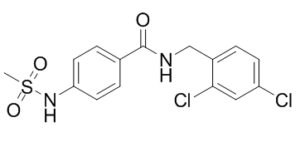
ML335 (ML-335) is a potent and selective activator of TREK-1/-2 and an agonist for OPRM1-OPRD1 (OPRM1: opioid receptor mu 1; OPRD1: delta opioid receptor) heterdimerization. ML335 selectively activates OPRM1-OPRD1 heterodimerization which may have potential use in the treatment of pain and alleviate unwanted effects associated with opiate use. The Scripps Research Institute Molecular Screening Center (SRIMSC) discovered ML335 as an agonist for OPRM1-OPRD1 heterdimerization with an EC50 of 403 nM, and selectivities vs. OPRM1, OPRD1, and HTR5A of 37, 2.7, and >99, respectively. Heteromerization of OPRM1 with OPRD1 leads to the modulation of receptor binding and signaling properties. It has further been shown that the selective activation of the OPRM1-OPRD1 heteromer by a combination of OPRM1 agonist with OPRD1 antagonist can be blocked by antibodies that selectively recognize the heteromer.
Physicochemical Properties
| Molecular Formula | C15H14CL2N2O3S | |
| Molecular Weight | 373.25 | |
| Exact Mass | 372.01 | |
| CAS # | 825658-06-8 | |
| Related CAS # |
|
|
| PubChem CID | 1243054 | |
| Appearance | White to off-white solid powder | |
| Density | 1.5±0.1 g/cm3 | |
| Index of Refraction | 1.635 | |
| LogP | 3.31 | |
| Hydrogen Bond Donor Count | 2 | |
| Hydrogen Bond Acceptor Count | 4 | |
| Rotatable Bond Count | 5 | |
| Heavy Atom Count | 23 | |
| Complexity | 501 | |
| Defined Atom Stereocenter Count | 0 | |
| InChi Key | RDFIQTZRJRVFHK-UHFFFAOYSA-N | |
| InChi Code | InChI=1S/C15H14Cl2N2O3S/c1-23(21,22)19-13-6-3-10(4-7-13)15(20)18-9-11-2-5-12(16)8-14(11)17/h2-8,19H,9H2,1H3,(H,18,20) | |
| Chemical Name |
|
|
| Synonyms |
|
|
| HS Tariff Code | 2934.99.9001 | |
| Storage |
Powder-20°C 3 years 4°C 2 years In solvent -80°C 6 months -20°C 1 month |
|
| Shipping Condition | Room temperature (This product is stable at ambient temperature for a few days during ordinary shipping and time spent in Customs) |
Biological Activity
| Targets |
K₂P2.1 (TREK-1) (EC₅₀=14.3 ± 2.7 μM in Xenopus oocytes; EC₅₀=10.5 ± 2.7 μM for K₂P2.1(TREK-1)cryst in Xenopus oocytes; EC₅₀=5.2 ± 0.8 μM in HEK293 cells) [1] K₂P10.1 (TREK-2) (EC₅₀=5.2 ± 0.5 μM in Xenopus oocytes) [1] K₂P4.1 (TRAAK) Q258K mutant (EC₅₀=16.2 ± 3.0 μM in Xenopus oocytes) [1] |
| ln Vitro |
Xenopus laevis oocytes were used for two-electrode voltage-clamp measurements. The results indicated that ML335 and ML402 activated K2P2.1 and K2P10.1, but not K2P4.1 (14.3±2.7 μM, K2P2.1-ML335; 13.7±7.0 μM, K2P2.1-ML402; 13.7±7.0 μM, K2P2.1-ML402; 13.7±7.0 μM, K2P2.1-ML402; 13.7±7.0 μM, K2P2.1-ML402; 13.7±7.0 μM, K2P2.1-ML402). 5.9±1.6μM, K2P10.1-ML402; and 5.2±0.5μM, K2P10.1-ML335). A substantial phenotypic reversal of ML335 and M402 activation is caused by the exchange of Lys271 equivalents between K2P2.1 and K2P4.1. Similar to their actions in Xenopus laevis oocytes (ML335 and ML402, 5.2±0.8 μM and 5.9±1.6 μM, respectively (n≥3)), ML335 and ML402 activate K2P2.1 in HEK293 cells [1]. Activated K₂P2.1 (TREK-1) channels expressed in Xenopus oocytes: Exemplar current traces showed enhanced current after treatment with 20 μM ML335, and dose-response analysis yielded an EC₅₀ of 14.3 ± 2.7 μM (n≥5). For K₂P2.1(TREK-1)cryst, the EC₅₀ was 10.5 ± 2.7 μM (n≥3) [1] - Activated K₂P10.1 (TREK-2) channels in Xenopus oocytes: 20 μM ML335 significantly increased channel current, with an EC₅₀ of 5.2 ± 0.5 μM (n>3) [1] - Showed no significant activation on K₂P2.1 (TREK-1) K271Q mutant in Xenopus oocytes, even at 20 μM concentration [1] - Activated K₂P4.1 (TRAAK) Q258K mutant in Xenopus oocytes: 50 μM ML335 induced current enhancement, with an EC₅₀ of 16.2 ± 3.0 μM (n≥4) [1] - Activated K₂P2.1 (TREK-1) channels in HEK293 cells: Whole-cell patch clamp recordings showed dose-dependent activation, with an EC₅₀ of 5.2 ± 0.8 μM (n≥3). Inside-out patches of HEK293 cells expressing K₂P2.1 (TREK-1) showed increased current and altered rectification coefficient (I₊₁₀₀mV/I₋₁₀₀mV) after treatment with 5 μM ML335 [1] - Bound to a cryptic pocket of K₂P2.1 (TREK-1) behind the selectivity filter, forming electrostatic, hydrogen bond, and cation-π interactions with channel residues. This binding restricted interdomain interface movement, stabilized the C-type gate in "leak mode", and directly stimulated channel gating [1] |
| ln Vivo | Once-daily, intra-tracheal injections of HO-exposed mice with ML335 or BL1249 improved lung compliance, histological lung injury scores, broncho-alveolar lavage protein levels and cell counts, and IL-6 and IP-10 concentrations. [3] |
| Cell Assay |
K₂P channel current recording in Xenopus oocytes: Xenopus oocytes were transfected to express target K₂P channels (K₂P2.1(TREK-1), K₂P2.1(TREK-1)cryst, K₂P10.1(TREK-2), K₂P2.1(TREK-1) K271Q, K₂P4.1(TRAAK) Q258K). After expression, currents were elicited from a -80 mV holding potential followed by a 500 ms ramp from -150 mV to +50 mV. Different concentrations of ML335 were applied, and current traces were recorded to generate dose-response curves and calculate EC₅₀ values. Each experiment was repeated with n≥3 samples, and data were presented as mean ± SEM [1] - Whole-cell patch clamp assay in HEK293 cells: HEK293 cells were transfected to express K₂P2.1 (TREK-1) channels. Whole-cell patch clamp recordings were performed to measure channel currents in the presence of different concentrations of ML335. Dose-response relationships were analyzed to determine EC₅₀ values, with n≥3 replicates per concentration [1] - Inside-out patch clamp assay in HEK293 cells: HEK293 cells expressing K₂P2.1 (TREK-1) or K₂P4.1 (TRAAK) channels were used to prepare inside-out patches. Patches were exposed to 5 μM ML335 (for K₂P2.1) or other concentrations (for K₂P4.1-related experiments) in a solution containing 150 mM K⁺ [out]/150 mM Rb⁺ [in]. A 350 ms voltage step protocol from -100 mV to +100 mV was used to elicit currents, and voltage-current relationships and rectification coefficients were calculated. Each experiment included n≥3 replicates [1] - K₂P2.1 (TREK-1) complex crystallization and structural analysis: K₂P2.1 (TREK-1) channels were co-crystallized with ML335. X-ray diffraction data were collected, and electron density maps (2Fₒ-Fc and Fₒ-Fc) were generated to identify the binding pocket of ML335. Structural superpositions with other K₂P channel structures were performed to analyze interactions between ML335 and channel residues (electrostatic, hydrogen bond, cation-π interactions) and the impact on channel conformation [1] |
| Animal Protocol |
Intra-tracheal injections Mice |
| References |
[1]. K2P2.1 (TREK-1)-activator complexes reveal a cryptic selectivity filter binding site. Nature. 2017 Jul 20;547(7663):364-368. |
| Additional Infomation |
ML335 is a small-molecule activator of K₂P channels, belonging to the N-aryl-sulfonamide class [1] - It exhibits selectivity for K₂P2.1 (TREK-1) and K₂P10.1 (TREK-2) channels, with no significant activation on K₂P2.1 (TREK-1) K271Q mutant. The selectivity is controlled by a cation-π interaction between the drug and channel residues [1] - The binding site of ML335 on K₂P2.1 (TREK-1) is a cryptic pocket unlike other ion channel small-molecule binding sites, located behind the selectivity filter [1] - ML335 acts as a molecular wedge to stabilize the C-type gate of K₂P channels in the "leak mode", providing direct evidence for K₂P selectivity filter gating and serving as a tool compound for studying K₂P channel function [1] |
Solubility Data
| Solubility (In Vitro) |
|
|||
| Solubility (In Vivo) |
Solubility in Formulation 1: ≥ 2.5 mg/mL (6.70 mM) (saturation unknown) in 10% DMSO + 90% Corn Oil (add these co-solvents sequentially from left to right, and one by one), clear solution. For example, if 1 mL of working solution is to be prepared, you can add 100 μL of 25.0 mg/mL clear DMSO stock solution to 900 μL of corn oil and mix evenly. (Please use freshly prepared in vivo formulations for optimal results.) |
| Preparing Stock Solutions | 1 mg | 5 mg | 10 mg | |
| 1 mM | 2.6792 mL | 13.3958 mL | 26.7917 mL | |
| 5 mM | 0.5358 mL | 2.6792 mL | 5.3583 mL | |
| 10 mM | 0.2679 mL | 1.3396 mL | 2.6792 mL |