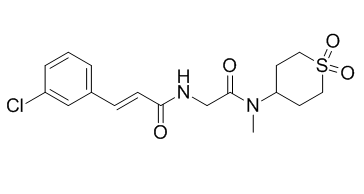
Physicochemical Properties
| Molecular Formula | C17H21CLN2O4S | |
| Molecular Weight | 384.88 | |
| Exact Mass | 384.091 | |
| Elemental Analysis | C, 53.05; H, 5.50; Cl, 9.21; N, 7.28; O, 16.63; S, 8.33 | |
| CAS # | 1550008-55-3 | |
| Related CAS # |
|
|
| PubChem CID | 51003603 | |
| Appearance | White to off-white solid powder | |
| Density | 1.4±0.1 g/cm3 | |
| Boiling Point | 701.0±60.0 °C at 760 mmHg | |
| Flash Point | 377.7±32.9 °C | |
| Vapour Pressure | 0.0±2.2 mmHg at 25°C | |
| Index of Refraction | 1.599 | |
| LogP | 0.46 | |
| Hydrogen Bond Donor Count | 1 | |
| Hydrogen Bond Acceptor Count | 4 | |
| Rotatable Bond Count | 5 | |
| Heavy Atom Count | 25 | |
| Complexity | 601 | |
| Defined Atom Stereocenter Count | 0 | |
| SMILES | ClC1=CC=CC(=C1)/C=C/C(NCC(N(C)C1CCS(CC1)(=O)=O)=O)=O |
|
| InChi Key | AJCDZIDKYKCOMZ-AATRIKPKSA-N | |
| InChi Code | InChI=1S/C17H21ClN2O4S/c1-20(15-7-9-25(23,24)10-8-15)17(22)12-19-16(21)6-5-13-3-2-4-14(18)11-13/h2-6,11,15H,7-10,12H2,1H3,(H,19,21)/b6-5+ | |
| Chemical Name | (E)-3-(3-chlorophenyl)-N-[2-[(1,1-dioxothian-4-yl)-methylamino]-2-oxoethyl]prop-2-enamide | |
| Synonyms |
|
|
| HS Tariff Code | 2934.99.9001 | |
| Storage |
Powder-20°C 3 years 4°C 2 years In solvent -80°C 6 months -20°C 1 month |
|
| Shipping Condition | Room temperature (This product is stable at ambient temperature for a few days during ordinary shipping and time spent in Customs) |
Biological Activity
| Targets | KLF5 (IC50 = 29 nM) |
| ln Vitro | ML264 potently halts DLD-1 viability (IC50 = 29 nM) with high maximal effect (>90%). Human colorectal adenocarcinoma cells are DLD-1 cells. Other cell types, such as HCT116 (human colorectal carcinoma), HT29 (human colorectal adenocarcinoma), and SW620 (human colorectal adenocarcinoma), are also significantly affected by ML264 at submicromolar doses. With inhibition below 50% at the highest dose, the IEC-6 anti-target (a nontransformed rat intestinal epithelial cell line) is largely unaffected[1]. Through changes to the cell cycle profile, this substance effectively prevents the proliferation of CRC cells in vitro[2]. |
| ln Vivo | In a well-established mouse xenograft model of colon cancer, ML264 effectively inhibits tumor growth five days after administration. Since ML264 potently inhibits the expression of KLF5 and EGR1, a transcriptional activator of KLF5, this effect is brought on by a significant decrease in proliferation[2]. |
| Enzyme Assay | ML264 is highly active (IC50=29 nM is a cell-based assay for proliferation of DLD-1 cells, IC50=81 nM in a cell-based luciferase assay). ML264 lacks cytotoxicity in the IEC-6 control cell line (IC50>50 μM,<50% inhibition is observed at 100 μM). Robust activity is also seen in several other KLF5-expressing cell types as well (e.g., HCT116, IC50=560 nM; HT29, IC50=130 nM; SW620, IC50=430 nM). Western blot analysis shows that ML264 significantly reduces KLF5 expression. |
| Cell Assay | DLD-1 and HCT116 cells are treated with 10 μM ML264 or DMSO in experiments testing cell proliferation. Live cells are collected 24, 48, and 72 hours after treatment, and the number of each are counted using a Coulter counter. DLD-1 and HCT116 cells are treated with 10 μM ML264 or with the control (DMSO) in the MTS assay. Each well receives 20 μL of MTS solution following incubations of 24, 48, and 72 hours. An analysis is then carried out in accordance with the manufacturer's instructions. |
| Animal Protocol | Mice: In ventilated, filtered cages with positive pressure, naked mice are kept in a pathogen-free environment. The right flank of 6-7 week old male nude mice is injected subcutaneously with 5×10⁶ DLD-1 human colorectal cells to produce xenograft tumors. By measuring with a caliper and using established formulas, tumor volume is calculated. Mice are treated intraperitoneally (i.p.) with ML264 at doses of 10 mg/kg daily, 10 mg/kg twice daily, and 25 mg/kg twice daily for a total of 10 days when tumor volumes reach approximately 100 mm6. The control treatment is the vehicle solution. Each and every two days, mice are observed and weighed. When the tumor's largest measurement reaches 2 cm, the experiment is over. Tumors are removed and saved for additional research[2]. |
| References |
[1]. ML264: An Antitumor Agent that Potently and Selectively Inhibits Krüppel-like Factor Five (KLF5) Expression: A Probe for Studying Colon Cancer Development and Progression. [2]. ML264, A Novel Small-Molecule Compound That Potently Inhibits Growth of Colorectal Cancer. Mol Cancer Ther. 2016 Jan;15(1):72-83. |
Solubility Data
| Solubility (In Vitro) |
|
|||
| Solubility (In Vivo) |
Solubility in Formulation 1: ≥ 3.25 mg/mL (8.44 mM) (saturation unknown) in 10% DMSO + 90% Corn Oil (add these co-solvents sequentially from left to right, and one by one), clear solution. For example, if 1 mL of working solution is to be prepared, you can add 100 μL of 32.5 mg/mL clear DMSO stock solution to 900 μL of corn oil and mix evenly. (Please use freshly prepared in vivo formulations for optimal results.) |
| Preparing Stock Solutions | 1 mg | 5 mg | 10 mg | |
| 1 mM | 2.5982 mL | 12.9911 mL | 25.9821 mL | |
| 5 mM | 0.5196 mL | 2.5982 mL | 5.1964 mL | |
| 10 mM | 0.2598 mL | 1.2991 mL | 2.5982 mL |