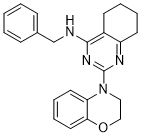
ML241 is a novel and potent p97 inhibitor which inhibits p97 ATPase with an IC50 value of 100 nM. ML241 inhibited degradation of a p97-dependent but not a p97-independent proteasome substrate in a dual-reporter cell line. ML241 also impaired the endoplasmic-reticulum-associated degradation (ERAD) pathway. The AAA ATPase p97 is a critical factor in maintaining protein homeostasis in eukaryotic cells, through its roles in promoting degradation of ubiquinated proteins by the proteasome and in maturation of autophagosomes. ML241 has the potential for treating cancer.
Physicochemical Properties
| Molecular Formula | C23H24N4O | |
| Molecular Weight | 372.46 | |
| Exact Mass | 372.195 | |
| CAS # | 1346528-06-0 | |
| Related CAS # | ML241 hydrochloride;2070015-13-1 | |
| PubChem CID | 49830260 | |
| Appearance | White to off-white solid powder | |
| Density | 1.3±0.1 g/cm3 | |
| Boiling Point | 600.3±65.0 °C at 760 mmHg | |
| Flash Point | 316.9±34.3 °C | |
| Vapour Pressure | 0.0±1.7 mmHg at 25°C | |
| Index of Refraction | 1.669 | |
| LogP | 3.45 | |
| Hydrogen Bond Donor Count | 1 | |
| Hydrogen Bond Acceptor Count | 5 | |
| Rotatable Bond Count | 4 | |
| Heavy Atom Count | 28 | |
| Complexity | 497 | |
| Defined Atom Stereocenter Count | 0 | |
| InChi Key | RMZPVQQGYVSLAP-UHFFFAOYSA-N | |
| InChi Code | InChI=1S/C23H24N4O/c1-2-8-17(9-3-1)16-24-22-18-10-4-5-11-19(18)25-23(26-22)27-14-15-28-21-13-7-6-12-20(21)27/h1-3,6-9,12-13H,4-5,10-11,14-16H2,(H,24,25,26) | |
| Chemical Name |
|
|
| Synonyms |
|
|
| HS Tariff Code | 2934.99.9001 | |
| Storage |
Powder-20°C 3 years 4°C 2 years In solvent -80°C 6 months -20°C 1 month |
|
| Shipping Condition | Room temperature (This product is stable at ambient temperature for a few days during ordinary shipping and time spent in Customs) |
Biological Activity
| Targets |
Human p97 ATPase (IC50 = 11 nM, determined by ATPase activity assay) [1] - Other ATPases (VCP-like 1, Hsp90, N-ethylmaleimide-sensitive factor, etc.) (IC50 > 1000 nM, no significant inhibition) [1] |
| ln Vitro |
To discover more potent p97 inhibitors, we carried out a structure-activity relationship study of the quinazoline scaffold previously identified from our HTS campaigns. Two improved inhibitors, ML240 and ML241, inhibit p97 ATPase with IC(50) values of 100 nM.[1] Potently inhibited recombinant human p97 ATPase activity in a concentration-dependent manner: 100 nM ML241 reduced ATP hydrolysis by ~92% compared to vehicle control [1] - Exhibited high selectivity for p97: >90-fold selectivity over 15 other tested ATPases (e.g., Hsp90, VCP-like 1, NSF), with no significant inhibition at concentrations up to 1 μM [1] - Inhibited proliferation of various human cancer cell lines: IC50 values of 0.6 μM (HCT116 colon cancer), 0.9 μM (HeLa cervical cancer), and 1.8 μM (A549 lung cancer) after 72-hour treatment [1] - Induced cancer cell apoptosis: 1 μM ML241 increased caspase-3/7 activity by ~3.5 fold and cleaved PARP levels by ~2.8 fold in HeLa cells after 24 hours [1] - Accumulated ubiquitinated proteins and activated endoplasmic reticulum (ER) stress: 0.5 μM ML241 upregulated ubiquitinated protein levels by ~4.0 fold and ER stress markers (CHOP, GRP78) by ~2.5-3.0 fold in HCT116 cells [1] - Blocked autophagic flux: 1 μM ML241 increased LC3-II accumulation by ~3.2 fold in GFP-LC3-expressing HeLa cells, indicating impaired autophagosome degradation [1] |
| Enzyme Assay |
p97 ATPase activity assay: Recombinant human wild-type p97 protein was incubated with ATP (including a fluorescently labeled ATP analog) and serial dilutions of ML241 (0.001-10 μM) in reaction buffer containing MgCl2. The mixture was incubated at 37°C for 60 minutes, and the reaction was stopped by adding an EDTA-containing stop solution. Unhydrolyzed ATP was detected by fluorescence polarization, and the inhibition rate was calculated based on the fluorescence signal. IC50 was determined from the concentration-response curve [1] - ATPase selectivity assay: Recombinant proteins of 15 different ATPases (e.g., Hsp90, VCP-like 1, N-ethylmaleimide-sensitive factor, ATP synthase) were individually incubated with their respective substrates, ATP, and ML241 (0.001-10 μM) under optimal reaction conditions. ATPase activity was measured using the same fluorescence polarization method as the p97 assay, and IC50 values were compared to assess selectivity [1] |
| Cell Assay |
Cancer cell proliferation assay: HCT116, HeLa, and A549 cells were seeded in 96-well plates at a density of 5×10³ cells/well and allowed to adhere overnight. Serial dilutions of ML241 (0.01-50 μM) were added, and cells were cultured for 72 hours at 37°C. A cell viability reagent was added, and absorbance was measured to calculate cell viability and IC50 values [1] - Apoptosis and ER stress assay: HeLa cells were seeded in 6-well plates (2×10⁵ cells/well) and treated with ML241 (0.1-2 μM) for 24 hours. Apoptosis was detected by Annexin V-FITC/PI double staining and flow cytometry. For ER stress analysis, HCT116 cells were treated with 0.5 μM ML241 for 16 hours, lysed, and western blot was performed to detect ubiquitinated proteins, CHOP, and GRP78 [1] - Autophagic flux assay: HeLa cells stably expressing GFP-LC3 were seeded on coverslips and treated with 1 μM ML241 for 24 hours. Cells were fixed, and GFP-LC3 puncta were visualized by fluorescence microscopy. LC3-I/II protein levels were also detected by western blot to confirm autophagic flux blockage [1] |
| Toxicity/Toxicokinetics |
In vitro cytotoxicity: No significant toxicity to normal human foreskin fibroblasts (NHF) at concentrations up to 5 μM (cell viability > 85%), with a therapeutic index > 8 (vs. HCT116 IC50) [1] |
| References |
[1]. Structure-activity relationship study reveals ML240 and ML241 as potent and selective inhibitors of p97 ATPase. ChemMedChem. 2013 Feb;8(2):297-312. |
| Additional Infomation |
ML241 is a potent and selective small-molecule inhibitor of p97 ATPase, identified through structure-activity relationship (SAR) studies [1] - Core mechanism of action: Binds to the D2 ATP-binding domain of p97, inhibiting its ATPase activity and blocking the p97-mediated ubiquitin-proteasome system (UPS) and autophagic degradation pathways. This leads to accumulation of misfolded/ubiquitinated proteins, ER stress, and ultimately cancer cell apoptosis [1] - Belongs to the oxazolidinone-pyridone class of compounds, characterized by high affinity and selectivity for p97 over other ATPases [1] - Potential therapeutic application in cancer treatment, particularly for tumors dependent on the UPS or autophagy for survival [1] - Serves as a valuable chemical tool for studying p97 biological functions and validating p97 as a therapeutic target [1] |
Solubility Data
| Solubility (In Vitro) |
|
|||
| Solubility (In Vivo) |
Note: Listed below are some common formulations that may be used to formulate products with low water solubility (e.g. < 1 mg/mL), you may test these formulations using a minute amount of products to avoid loss of samples. Injection Formulations (e.g. IP/IV/IM/SC) Injection Formulation 1: DMSO : Tween 80: Saline = 10 : 5 : 85 (i.e. 100 μL DMSO stock solution → 50 μL Tween 80 → 850 μL Saline) *Preparation of saline: Dissolve 0.9 g of sodium chloride in 100 mL ddH ₂ O to obtain a clear solution. Injection Formulation 2: DMSO : PEG300 :Tween 80 : Saline = 10 : 40 : 5 : 45 (i.e. 100 μL DMSO → 400 μLPEG300 → 50 μL Tween 80 → 450 μL Saline) Injection Formulation 3: DMSO : Corn oil = 10 : 90 (i.e. 100 μL DMSO → 900 μL Corn oil) Example: Take the Injection Formulation 3 (DMSO : Corn oil = 10 : 90) as an example, if 1 mL of 2.5 mg/mL working solution is to be prepared, you can take 100 μL 25 mg/mL DMSO stock solution and add to 900 μL corn oil, mix well to obtain a clear or suspension solution (2.5 mg/mL, ready for use in animals). Injection Formulation 4: DMSO : 20% SBE-β-CD in saline = 10 : 90 [i.e. 100 μL DMSO → 900 μL (20% SBE-β-CD in saline)] *Preparation of 20% SBE-β-CD in Saline (4°C,1 week): Dissolve 2 g SBE-β-CD in 10 mL saline to obtain a clear solution. Injection Formulation 5: 2-Hydroxypropyl-β-cyclodextrin : Saline = 50 : 50 (i.e. 500 μL 2-Hydroxypropyl-β-cyclodextrin → 500 μL Saline) Injection Formulation 6: DMSO : PEG300 : castor oil : Saline = 5 : 10 : 20 : 65 (i.e. 50 μL DMSO → 100 μLPEG300 → 200 μL castor oil → 650 μL Saline) Injection Formulation 7: Ethanol : Cremophor : Saline = 10: 10 : 80 (i.e. 100 μL Ethanol → 100 μL Cremophor → 800 μL Saline) Injection Formulation 8: Dissolve in Cremophor/Ethanol (50 : 50), then diluted by Saline Injection Formulation 9: EtOH : Corn oil = 10 : 90 (i.e. 100 μL EtOH → 900 μL Corn oil) Injection Formulation 10: EtOH : PEG300:Tween 80 : Saline = 10 : 40 : 5 : 45 (i.e. 100 μL EtOH → 400 μLPEG300 → 50 μL Tween 80 → 450 μL Saline) Oral Formulations Oral Formulation 1: Suspend in 0.5% CMC Na (carboxymethylcellulose sodium) Oral Formulation 2: Suspend in 0.5% Carboxymethyl cellulose Example: Take the Oral Formulation 1 (Suspend in 0.5% CMC Na) as an example, if 100 mL of 2.5 mg/mL working solution is to be prepared, you can first prepare 0.5% CMC Na solution by measuring 0.5 g CMC Na and dissolve it in 100 mL ddH2O to obtain a clear solution; then add 250 mg of the product to 100 mL 0.5% CMC Na solution, to make the suspension solution (2.5 mg/mL, ready for use in animals). Oral Formulation 3: Dissolved in PEG400 Oral Formulation 4: Suspend in 0.2% Carboxymethyl cellulose Oral Formulation 5: Dissolve in 0.25% Tween 80 and 0.5% Carboxymethyl cellulose Oral Formulation 6: Mixing with food powders Note: Please be aware that the above formulations are for reference only. InvivoChem strongly recommends customers to read literature methods/protocols carefully before determining which formulation you should use for in vivo studies, as different compounds have different solubility properties and have to be formulated differently. (Please use freshly prepared in vivo formulations for optimal results.) |
| Preparing Stock Solutions | 1 mg | 5 mg | 10 mg | |
| 1 mM | 2.6849 mL | 13.4243 mL | 26.8485 mL | |
| 5 mM | 0.5370 mL | 2.6849 mL | 5.3697 mL | |
| 10 mM | 0.2685 mL | 1.3424 mL | 2.6849 mL |