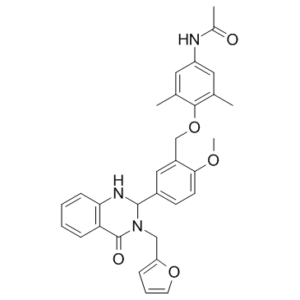
ML224, also known as NCGC00242364 and ANTAG3, is a selective and inverse agonist of Thyroid Stimulating Hormone Receptor(TSHR). It suppresses the synthesis of cAMP stimulated by TSH with an IC50 of 2.3 μM. With a half-maximum inhibitory dose of 2.1 μM for TSHR and more than 30 μM for LH and FSH receptors, ANTAG3 was selectively inhibiting TSHR. ANTAG3 reduced sodium-iodide cotransporter and thyroperoxidase mRNAs by 75% and 83%, respectively, and serum free T4 by 44% in mice receiving TRH treatment. ANTAG3 reduced serum free T4 by 38% and thyroperoxidase and sodium-iodide cotransporter mRNAs by 73% and 40%, respectively, in mice administered M22. We have, in summary, created a selective TSHR antagonist that works well in vivo in mice. This could result in the development of a medication to treat Graves' disease, as it is the first report of a small-molecule TSHR antagonist that is active in vivo. Additionally, ML224 may provide a path for the creation of medications to treat TSHR-mediated hyperthyroidism, which is brought on by constitutively activating mutations or inducing auto-antibodies linked to Graves' disease.
Physicochemical Properties
| Molecular Formula | C31H31N3O5 | |
| Molecular Weight | 525.59 | |
| Exact Mass | 525.226 | |
| Elemental Analysis | C, 70.84; H, 5.95; N, 7.99; O, 15.22 | |
| CAS # | 1338824-21-7 | |
| Related CAS # |
|
|
| PubChem CID | 50897809 | |
| Appearance | White to off-white solid powder | |
| Density | 1.3±0.1 g/cm3 | |
| Boiling Point | 752.3±60.0 °C at 760 mmHg | |
| Flash Point | 408.8±32.9 °C | |
| Vapour Pressure | 0.0±2.5 mmHg at 25°C | |
| Index of Refraction | 1.626 | |
| LogP | 2.92 | |
| Hydrogen Bond Donor Count | 2 | |
| Hydrogen Bond Acceptor Count | 6 | |
| Rotatable Bond Count | 8 | |
| Heavy Atom Count | 39 | |
| Complexity | 829 | |
| Defined Atom Stereocenter Count | 0 | |
| SMILES | CC(NC1=CC(C)=C(OCC2=CC(C(N3CC4=CC=CO4)NC5=C(C=CC=C5)C3=O)=CC=C2OC)C(C)=C1)=O |
|
| InChi Key | BFTSWGYWHRJVNI-UHFFFAOYSA-N | |
| InChi Code | InChI=1S/C31H31N3O5/c1-19-14-24(32-21(3)35)15-20(2)29(19)39-18-23-16-22(11-12-28(23)37-4)30-33-27-10-6-5-9-26(27)31(36)34(30)17-25-8-7-13-38-25/h5-16,30,33H,17-18H2,1-4H3,(H,32,35) | |
| Chemical Name | N-[4-[[5-[3-(furan-2-ylmethyl)-4-oxo-1,2-dihydroquinazolin-2-yl]-2-methoxyphenyl]methoxy]-3,5-dimethylphenyl]acetamide | |
| Synonyms |
|
|
| HS Tariff Code | 2934.99.03.00 | |
| Storage |
Powder-20°C 3 years 4°C 2 years In solvent -80°C 6 months -20°C 1 month |
|
| Shipping Condition | Room temperature (This product is stable at ambient temperature for a few days during ordinary shipping and time spent in Customs) |
Biological Activity
| Targets | TSHR ( IC50 = 2.1 μM ); LHR ( IC50 > 30 μM ); FSHR ( IC50 > 30 μM ) | |
| ln Vitro |
|
|
| ln Vivo |
|
|
| Enzyme Assay | ML224, also known as NCGC00242364 and ANTAG3, is a selective and inverse agonist of Thyroid Stimulating Hormone Receptor(TSH)R). With an IC50 of 2.3 μM, it suppresses the production of cAMP stimulated by TSH. TSHR inhibition was the only pathway that ANTAG3 was selective for, with half-maximum inhibitory doses for TSHR being 2.1 μM and for LH and FSH receptors being greater than 30 μM. | |
| Cell Assay |
Cell Line: Human embryonic kidney 293 cells (stably expressing TSHRs, LHRs, or FSHRs) Concentration: 0.001-100 µM Incubation Time: 20 min Result: Showed the IC50 for stimulation by bovine TSH (1.8 nM) was 2.1 µM. Showed inhibition of LH and FSH stimulation was less than 15% for LH (1 nM) and less than 30% for FSH (1 nM) at 30 µM. |
|
| Animal Protocol |
Female BALB/c mice (8 to 13-week-old; ~18.7 g) Dosage: 2 mg/mice Intraperitoneal injection via osmotic pump; single daily for 3 days |
|
| References |
[1]. A selective TSH receptor antagonist inhibits stimulation of thyroid function in female mice. Endocrinology. 2014 Jan;155(1):310-4. |
|
| Additional Infomation | N-[4-[[5-[3-(2-furanylmethyl)-4-oxo-1,2-dihydroquinazolin-2-yl]-2-methoxyphenyl]methoxy]-3,5-dimethylphenyl]acetamide is a member of quinazolines. |
Solubility Data
| Solubility (In Vitro) |
|
|||
| Solubility (In Vivo) |
Solubility in Formulation 1: ≥ 2.5 mg/mL (4.76 mM) (saturation unknown) in 10% DMSO + 40% PEG300 + 5% Tween80 + 45% Saline (add these co-solvents sequentially from left to right, and one by one), clear solution. For example, if 1 mL of working solution is to be prepared, you can add 100 μL of 25.0 mg/mL clear DMSO stock solution to 400 μL PEG300 and mix evenly; then add 50 μL Tween-80 to the above solution and mix evenly; then add 450 μL normal saline to adjust the volume to 1 mL. Preparation of saline: Dissolve 0.9 g of sodium chloride in 100 mL ddH₂ O to obtain a clear solution. Solubility in Formulation 2: ≥ 2.5 mg/mL (4.76 mM) (saturation unknown) in 10% DMSO + 90% Corn Oil (add these co-solvents sequentially from left to right, and one by one), clear solution. For example, if 1 mL of working solution is to be prepared, you can add 100 μL of 25.0 mg/mL clear DMSO stock solution to 900 μL of corn oil and mix evenly. (Please use freshly prepared in vivo formulations for optimal results.) |
| Preparing Stock Solutions | 1 mg | 5 mg | 10 mg | |
| 1 mM | 1.9026 mL | 9.5131 mL | 19.0262 mL | |
| 5 mM | 0.3805 mL | 1.9026 mL | 3.8052 mL | |
| 10 mM | 0.1903 mL | 0.9513 mL | 1.9026 mL |