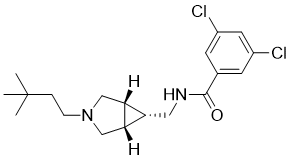
ML218 (CID-45115620; ML-218; CID45115620) is a novel, potent and selective T-Type Ca(2+) (Ca(v)3.1, Ca(v)3.2, Ca(v)3.3) inhibitor (Ca(v)3.2, IC(50) = 150 nM in Ca(2+) flux; Ca(v)3.2 IC(50) = 310 nM and Ca(v)3.3 IC(50) = 270 nM, respectively in patch clamp electrophysiology) with good DMPK properties, it displayed acceptable in vivo rat PK and excellent brain levels. Electrophysiology studies in subthalamic nucleus (STN) neurons demonstrated robust effects of ML218 on the inhibition of T-Type calcium current, inhibition of low threshold spike and rebound burst activity. Based on the basal ganglia circuitry in Parkinson's disease (PD), the effects of ML218 in STN neurons suggest a therapeutic role for T-type Ca(2+) channel inhibitors, and ML218 was found to be orally efficacious in haloperidol-induced catalepsy, a preclinical PD model, with comparable efficacy to an A(2A) antagonist, a clinically validated PD target. ML218 proves to be a powerful new probe to study T-Type Ca(2+) function in vitro and in vivo, and freely available.
Physicochemical Properties
| Molecular Formula | C19H26CL2N2O | |
| Molecular Weight | 369.328543186188 | |
| Exact Mass | 368.142 | |
| CAS # | 1346233-68-8 | |
| Related CAS # | ML218 hydrochloride;2319922-08-0;ML218-d9 | |
| PubChem CID | 45115620 | |
| Appearance | White to off-white solid powder | |
| LogP | 4.9 | |
| Hydrogen Bond Donor Count | 1 | |
| Hydrogen Bond Acceptor Count | 2 | |
| Rotatable Bond Count | 6 | |
| Heavy Atom Count | 24 | |
| Complexity | 443 | |
| Defined Atom Stereocenter Count | 2 | |
| SMILES | ClC1C=C(C=C(C=1)C(NCC1[C@@H]2CN(CCC(C)(C)C)C[C@@H]21)=O)Cl |
|
| InChi Key | GSJIGYLGKSBYBC-ALOPSCKCSA-N | |
| InChi Code | InChI=1S/C19H26Cl2N2O/c1-19(2,3)4-5-23-10-16-15(17(16)11-23)9-22-18(24)12-6-13(20)8-14(21)7-12/h6-8,15-17H,4-5,9-11H2,1-3H3,(H,22,24)/t15?,16-,17+ | |
| Chemical Name |
|
|
| Synonyms |
|
|
| HS Tariff Code | 2934.99.9001 | |
| Storage |
Powder-20°C 3 years 4°C 2 years In solvent -80°C 6 months -20°C 1 month |
|
| Shipping Condition | Room temperature (This product is stable at ambient temperature for a few days during ordinary shipping and time spent in Customs) |
Biological Activity
| Targets | ML218 demonstrated good free fractions in both rats and humans in plasma protein binding experiments (equilibrium dialysis). ML218 is highly cleared in rats (CLint = 115 mL/min/kg) according to investigations on intrinsic clearance in liver microsomes, whereas it is only weakly to moderately cleared in human liver microsomes (CLint = 12.7 mL/min/kg)[1]. |
| ln Vitro |
ML218 demonstrated good free fractions in both rats and humans in plasma protein binding experiments (equilibrium dialysis). ML218 is highly cleared in rats (CLint = 115 mL/min/kg) according to investigations on intrinsic clearance in liver microsomes, whereas it is only weakly to moderately cleared in human liver microsomes (CLint = 12.7 mL/min/kg)[1]. ML218 selectively inhibits T-type calcium currents in subthalamic nucleus (STN) neurons, with approximately 45% inhibition at 3 µM in voltage clamp experiments. In current clamp mode, 3 µM ML218 inhibits >50% of low-threshold spike (LTS) amplitude and >60% of rebound burst activity in STN neurons.[1] |
| ln Vivo |
Rats that have been exposed to a 0.75 mg/kg dosage of haloperidol exhibit cataleptic behavior that is reversed by ML218 (0.03-30 mg/kg; oral administration; once; male Sprague-Dawley rats)[1]. Over the whole dose range, the concentrations of ML218 in the free brain and plasma increase in a dose-proportional manner (3 mg/kg: [plasma] = 98 nM, [brain] = 1.66 μM; 10 mg/kg: [plasma] = 282 nM, [brain] = 5.03 μM; 30 mg/kg: 1.2 μM, [brain] = 17.7 μM)[1]. According to noncompartmental pharmacokinetic analysis, the mean residence time (MRT) of ML218 (1 mg/kg, IV) is almost 7 hours, which is in line with its terminal half-life (t1/2 = 7 hours)[1]. ML218 dose-dependently reverses haloperidol-induced catalepsy in rats (a preclinical Parkinson’s disease model) at oral doses of 1, 3, 10, and 30 mg/kg, with efficacy comparable to an A₂ₐ antagonist at 56.6 mg/kg.[1] |
| Enzyme Assay |
A calcium mobilization assay was performed using a FLIPR-based Ca²⁺ flux assay. HEK293 cells expressing CaV3.2 channels were loaded with Fluo-4 AM dye and exposed to test compounds. Fluorescence was measured before and after stimulus addition to determine inhibition of calcium influx.[1] |
| Cell Assay |
Electrophysiological assessment of CaV3.2 and CaV3.3 channels was conducted using the IonWorks Quattro automated patch clamp system. HEK293 cells stably expressing these channels were plated in a 384-well plate, perforated with amphotericin B, and currents were recorded in response to depolarizing steps. Compound effects were calculated as percentage inhibition of inward currents.[1] |
| Animal Protocol |
Animal/Disease Models: Male SD (Sprague-Dawley) rats (275-299 g) induced by haloperidol[1] Doses: 0.03 mg/kg, 0.1 mg/kg, 0.3 mg/kg , 1 mg/kg, 3 mg/kg, 10 mg/kg, 30 mg/kg Route of Administration: Oral administration; once Experimental Results: Reversed cataleptic behavior in rats induced by a 0.75 mg/kg dose of haloperidol. For the haloperidol-induced catalepsy model, rats were administered haloperidol (0.75 mg/kg, i.p.) 60 minutes before vehicle or ML218 (0.1–30 mg/kg, p.o.). Catalepsy was assessed 30 minutes later by measuring the latency to remove forepaws from a horizontal bar (cutoff 30 s).[1] For pharmacokinetic studies, ML218 was administered intravenously (1 mg/kg) or orally (10 mg/kg) to rats, and blood/brain samples were collected at various time points for LC/MS/MS analysis.[1] |
| ADME/Pharmacokinetics |
Plasma protein binding of ML218 showed a free fraction of 9.1% in rat and 3.3% in human. Inhibition of cytochrome P450 enzymes: 3A4 IC₅₀ >30 µM, 2C9 IC₅₀ >30 µM, 1A2 IC₅₀ = 10.8 µM, 2D6 IC₅₀ = 1.7 µM. Intrinsic clearance in rat liver microsomes was 115 mL/min/kg, and in human liver microsomes was 12.7 mL/min/kg. In rats, plasma clearance was 56 mL/min/kg, mean residence time was ~7 h, terminal half-life was 7 h, and brain-to-plasma AUC ratio was 7.4–16.9.[1] |
| Toxicity/Toxicokinetics |
ML218 was tested in a panel of 68 GPCRs, ion channels, and transporters at 10 µM. It showed significant binding only to sodium channel site 2 and sigma 1 receptor, with no inhibition >50% at 10 µM for other targets including L-type and N-type calcium channels, KATP, and HERG.[1] |
| References |
[1]. The Discovery and Characterization of ML218: A Novel, Centrally Active T-Type Calcium Channel Inhibitor with Robust Effects in STN Neurons and in a Rodent Model of Parkinson's Disease. ACS Chem Neurosci. 2011 Dec 21;2(12):730-742. |
| Additional Infomation |
3,5-dichloro-N-[[(1S,5R)-3-(3,3-dimethylbutyl)-3-azabicyclo[3.1.0]hexan-6-yl]methyl]benzamide is an organohalogen compound and a carbonyl compound. ML218 was developed as a probe molecule free from intellectual property constraints through the MLPCN program. It exhibits excellent brain penetration and is intended for studying T-type calcium channel function in central nervous system disorders such as Parkinson’s disease, essential tremor, epilepsy, and pain.[1] |
Solubility Data
| Solubility (In Vitro) |
|
|||
| Solubility (In Vivo) |
Solubility in Formulation 1: ≥ 6.25 mg/mL (16.92 mM) (saturation unknown) in 10% DMSO + 90% Corn Oil (add these co-solvents sequentially from left to right, and one by one), clear solution. For example, if 1 mL of working solution is to be prepared, you can add 100 μL of 62.5 mg/mL clear DMSO stock solution to 900 μL corn oil and mix evenly. (Please use freshly prepared in vivo formulations for optimal results.) |
| Preparing Stock Solutions | 1 mg | 5 mg | 10 mg | |
| 1 mM | 2.7076 mL | 13.5380 mL | 27.0761 mL | |
| 5 mM | 0.5415 mL | 2.7076 mL | 5.4152 mL | |
| 10 mM | 0.2708 mL | 1.3538 mL | 2.7076 mL |