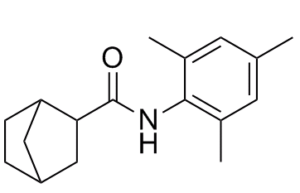
ML213 (formerly known as CID-3111211) is a potent and selective activator/opener of Kv7.2 (KCNQ2) and Kv7.4 (KCNQ4) channels which enhances Kv7.2 and Kv7.4 channels with EC50 of 230 and 510 nM, respectively. ML213 shows more than 80-fold selectivity for Kv7.2 (KCNQ2) and Kv7.4 (KCNQ4) versus a large battery of related potassium channels such as KV7.1, KV7.3 and KV7.5 in a thallium-based fluorescence assay, it also can afford modest brain levels. ML213, as a potent vasorelaxant in different blood vessels, may have the potential to be developed as therapeutics for various smooth muscle disorders.
Physicochemical Properties
| Molecular Formula | C17H23NO | |
| Molecular Weight | 257.38 | |
| Exact Mass | 257.177 | |
| CAS # | 489402-47-3 | |
| Related CAS # |
|
|
| PubChem CID | 3111211 | |
| Appearance | White to off-white solid powder | |
| Density | 1.1±0.1 g/cm3 | |
| Boiling Point | 398.8±11.0 °C at 760 mmHg | |
| Flash Point | 243.4±4.2 °C | |
| Vapour Pressure | 0.0±0.9 mmHg at 25°C | |
| Index of Refraction | 1.591 | |
| LogP | 4.38 | |
| Hydrogen Bond Donor Count | 1 | |
| Hydrogen Bond Acceptor Count | 1 | |
| Rotatable Bond Count | 2 | |
| Heavy Atom Count | 19 | |
| Complexity | 341 | |
| Defined Atom Stereocenter Count | 0 | |
| InChi Key | SIQGKPGBLYKQBB-UHFFFAOYSA-N | |
| InChi Code | InChI=1S/C17H23NO/c1-10-6-11(2)16(12(3)7-10)18-17(19)15-9-13-4-5-14(15)8-13/h6-7,13-15H,4-5,8-9H2,1-3H3,(H,18,19) | |
| Chemical Name |
|
|
| Synonyms |
|
|
| HS Tariff Code | 2934.99.9001 | |
| Storage |
Powder-20°C 3 years 4°C 2 years In solvent -80°C 6 months -20°C 1 month |
|
| Shipping Condition | Room temperature (This product is stable at ambient temperature for a few days during ordinary shipping and time spent in Customs) |
Biological Activity
| Targets |
Human KCNQ2 (Kv7.2) channel: EC₅₀ = 230 nM [3] - Human KCNQ4 (Kv7.4) channel: EC₅₀ = 510 nM [3] - Human Kv7.5 channel [1] - Heteromeric human Kv7.4/7.5 channel [1] |
|
| ln Vitro |
With an EC50 of 0.8 ± 0.3 µM, ML213 (100 nM-30 µM) raises maximum conductance to a peak of 212% ± 27% of control. The deactivation rates of Kv7.4 currents are 4.6 times lower at 10 µM of ML213 in the voltage range of -130 mV to -90 mV. Strong and efficient homomeric Kv7.5 channel activator ML213 is overexpressed in A7r5 cells. With an EC50 of 0.7 ± 0.2 µM, ML213 increases the maximal conductance of Kv7.5 channels. Additionally, Kv7.5 current deactivation rates are averagely reduced by 5.9 times by ML213 (10 µM). On heteromeric Kv7.4/7.5 channels, ML213 had comparable effects: a maximal conductance increase of 204% ± 11% with an EC50 of 1.1 ± 0.6 µM and a maximal negative shift of the activation curve of 34.2 ± 3.3 mV with an EC50 of 3.8 ± 1.2 µM[1]. Vasorelaxation is induced by ML213 in various precontracted rat blood arteries. Additionally, mesenteric artery smooth muscle cells are hyperpolarized by ML213 (10 μM)[2]. For KCNQ2 activation, ML213 generates a concentration-dependent change in the V1/2 with a peak shift of 37.4 mV and an EC50 of 340 ± 70 nM[3]. 1. Activation of Kv7 channels in A7r5 cells: ML213 (10 μM) significantly increases the maximum conductance of homomeric Kv7.4, Kv7.5, and heteromeric Kv7.4/7.5 channels exogenously expressed in A7r5 vascular smooth muscle cells. It induces a concentration-dependent negative shift of their activation curves and decreases current deactivation rates for all three channel combinations. Retigabine-insensitive mutants Kv7.4 (W242L) and Kv7.5 (W235L) are also insensitive to ML213 (10 μM) [1] 2. Vasorelaxant effects on rat blood vessels: ML213 causes concentration-dependent relaxation of precontracted rat thoracic aorta, renal artery, and mesenteric artery segments. In mesenteric arteries, its EC₅₀ is significantly lower than other tested Kv7 enhancers (S-1, BMS204352, retigabine). The vasorelaxant effect is abolished by the Kv7 channel blocker linopirdine (10 μM) [2] 3. Hyperpolarization of mesenteric artery smooth muscle cells: At low concentrations, ML213 significantly hyperpolarizes the resting membrane potential of smooth muscle cells isolated from rat mesenteric arteries, as measured by current-clamp recordings [2] 4. Activation of KCNQ2 channels: ML213 produces a concentration-dependent increase in Tl⁺ influx in KCNQ2-expressing cells, with an EC₅₀ of 359 nM and a maximal 56% increase in a 10-point concentration-response curve. It induces a voltage-dependent activation of KCNQ2 channels, shifting the conductance-voltage curve to the left without altering the maximal conductance [3] 5. Selectivity for KCNQ channels: ML213 is selective for KCNQ2 and KCNQ4 channels over other KCNQ subtypes (KCNQ1/3/5) and a panel of related potassium channels [3] |
|
| ln Vivo |
|
|
| Enzyme Assay |
1. Kv7 channel current recording (patch-clamp technique): A7r5 cells or HEK293 cells are transfected with plasmids encoding Kv7.4, Kv7.5, Kv7.4/7.5, KCNQ2, or their mutant forms (e.g., Kv7.4 W242L, Kv7.5 W235L). After transfection, cells are cultured for a specific period to allow channel expression. The patch-clamp technique is used to record channel currents before and after treatment with ML213 at different concentrations (e.g., 1–10 μM). Voltage-step protocols are applied to elicit currents, and parameters such as current amplitude, activation curve (V₀.₅), and deactivation time constant (τ) are analyzed. The effect of ML213 is evaluated by comparing these parameters with the control group (without ML213 treatment) [1][2][3] 2. Tl⁺ influx assay for KCNQ2 activation: Cells expressing KCNQ2 channels are seeded in 96-well plates and loaded with a Tl⁺-sensitive fluorescent dye. ML213 is added at increasing concentrations, and Tl⁺ influx is measured as a surrogate for channel activation. Fluorescence intensity is recorded over time, and the EC₅₀ value is calculated from the concentration-response curve [3] |
|
| Cell Assay |
1. Vascular smooth muscle cell membrane potential measurement: Smooth muscle cells are isolated from rat mesenteric arteries and plated on glass coverslips. Current-clamp recordings are performed using microelectrodes to measure the resting membrane potential. ML213 is applied at different concentrations, and changes in membrane potential are recorded and analyzed. The hyperpolarizing effect of ML213 is quantified by comparing the membrane potential before and after drug treatment [2] 2. Kv7 mutant channel activity assay: HEK293 cells are transiently transfected with plasmids encoding mutant Kv7 channels (e.g., Kv7.4 W242L, Kv7.5 W235L). Patch-clamp recordings are conducted to measure channel currents in the presence and absence of ML213 (10 μM). Activation curves and deactivation time constants are compared with wild-type channels to determine the sensitivity of mutant channels to ML213 [1][2] 3. Concentration-response curve for Kv7 activation: Cells expressing target Kv7/KCNQ channels are treated with a series of ML213 concentrations (e.g., 0.1 μM–10 μM). Channel activity (current amplitude or Tl⁺ influx) is measured, and concentration-response curves are constructed. EC₅₀ values and maximal effect are calculated by fitting the data to the Hill equation [1][3] |
|
| Animal Protocol |
1. Vasorelaxation assay in isolated rat blood vessels: Male Wistar rats are euthanized, and thoracic aorta, renal artery, and mesenteric artery segments are dissected. Vessel segments are mounted in a wire myograph and precontracted with methoxamine (10 μM). ML213 is added cumulatively at increasing concentrations, and the tension of the vessel segments is recorded. The relaxation percentage is calculated relative to the precontraction level. For antagonism studies, linopirdine (10 μM) is added 30 minutes before ML213 treatment [2] |
|
| ADME/Pharmacokinetics |
Brain penetration: ML213 affords modest brain levels in animal models [3] |
|
| References |
[1]. Differential activation of vascular smooth muscle Kv7.4, Kv7.5, and Kv7.4/7.5 channels by ML213 and ICA-069673. Mol Pharmacol. 2014 Sep;86(3):330-41. [2]. Vasorelaxant effects of novel Kv 7.4 channel enhancers ML213 and NS15370. Br J Pharmacol. 2014 Oct;171(19):4413-24. [3]. Discovery, Synthesis, and Structure Activity Relationship of a Series of N-Aryl- bicyclo[2.2.1]heptane-2-carboxamides: Characterization of ML213 as a Novel KCNQ2 and KCNQ4 Potassium Channel Opener. ACS Chem Neurosci. 2011 Oct 19;2(10):572-577. |
|
| Additional Infomation |
N-(2,4,6-trimethylphenyl)-3-bicyclo[2.2.1]heptanecarboxamide is a monoterpenoid. 1. Binding site on Kv7 channels: The stimulatory effect of ML213 relies on a tryptophan residue located in the S5 domain of Kv7 channels, which is the same binding site for other Kv7 enhancers such as retigabine, S-1, and BMS204352 [2] 2. Potential therapeutic application: ML213 is a novel Kv7 channel opener with potent vasorelaxant effects, highlighting its potential as a therapeutic agent for smooth muscle disorders (e.g., hypertension, vascular spasm) and neuronal disorders regulated by KCNQ2/KCNQ4 channels [2][3] 3. Chemical class: ML213 belongs to the N-aryl-bicyclo[2.2.1]heptane-2-carboxamide series, and its structure-activity relationship has been characterized for KCNQ channel activation [3] |
Solubility Data
| Solubility (In Vitro) |
|
|||
| Solubility (In Vivo) |
Solubility in Formulation 1: ≥ 2.75 mg/mL (10.69 mM) (saturation unknown) in 10% DMSO + 40% PEG300 + 5% Tween80 + 45% Saline (add these co-solvents sequentially from left to right, and one by one), clear solution. For example, if 1 mL of working solution is to be prepared, you can add 100 μL of 27.5 mg/mL clear DMSO stock solution to 400 μL PEG300 and mix evenly; then add 50 μL Tween-80 to the above solution and mix evenly; then add 450 μL normal saline to adjust the volume to 1 mL. Preparation of saline: Dissolve 0.9 g of sodium chloride in 100 mL ddH₂ O to obtain a clear solution. Solubility in Formulation 2: ≥ 2.75 mg/mL (10.69 mM) (saturation unknown) in 10% DMSO + 90% (20% SBE-β-CD in Saline) (add these co-solvents sequentially from left to right, and one by one), clear solution. For example, if 1 mL of working solution is to be prepared, you can add 100 μL of 27.5 mg/mL clear DMSO stock solution to 900 μL of 20% SBE-β-CD physiological saline solution and mix evenly. Preparation of 20% SBE-β-CD in Saline (4°C,1 week): Dissolve 2 g SBE-β-CD in 10 mL saline to obtain a clear solution. Solubility in Formulation 3: ≥ 2.75 mg/mL (10.69 mM) (saturation unknown) in 10% DMSO + 90% Corn Oil (add these co-solvents sequentially from left to right, and one by one), clear solution. For example, if 1 mL of working solution is to be prepared, you can add 100 μL of 27.5 mg/mL clear DMSO stock solution to 900 μL of corn oil and mix evenly. (Please use freshly prepared in vivo formulations for optimal results.) |
| Preparing Stock Solutions | 1 mg | 5 mg | 10 mg | |
| 1 mM | 3.8853 mL | 19.4265 mL | 38.8531 mL | |
| 5 mM | 0.7771 mL | 3.8853 mL | 7.7706 mL | |
| 10 mM | 0.3885 mL | 1.9427 mL | 3.8853 mL |