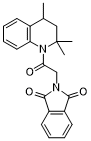
ML-SA1 is a potent agonist of TRPML1 (transient receptor potential mucolipin 1) with broad spectrum of antiviral activity. It can inhibit Dengue virus 2 (DENV2) and Zika virus (ZIKV) by promoting lysosomal acidification and protease activity.
Physicochemical Properties
| Molecular Formula | C22H22N2O3 |
| Molecular Weight | 362.4217 |
| Exact Mass | 362.163 |
| CAS # | 332382-54-4 |
| PubChem CID | 2880983 |
| Appearance | White to off-white solid powder |
| Density | 1.226±0.06 g/cm3 |
| Boiling Point | 546.7±43.0 °C |
| LogP | 3.604 |
| Hydrogen Bond Donor Count | 0 |
| Hydrogen Bond Acceptor Count | 3 |
| Rotatable Bond Count | 2 |
| Heavy Atom Count | 27 |
| Complexity | 620 |
| Defined Atom Stereocenter Count | 0 |
| InChi Key | KDDHBJICVBONAX-UHFFFAOYSA-N |
| InChi Code | InChI=1S/C22H22N2O3/c1-14-12-22(2,3)24(18-11-7-6-8-15(14)18)19(25)13-23-20(26)16-9-4-5-10-17(16)21(23)27/h4-11,14H,12-13H2,1-3H3 |
| Chemical Name | 2-[2-oxo-2-(2,2,4-trimethyl-3,4-dihydroquinolin-1-yl)ethyl]isoindole-1,3-dione |
| HS Tariff Code | 2934.99.9001 |
| Storage |
Powder-20°C 3 years 4°C 2 years In solvent -80°C 6 months -20°C 1 month |
| Shipping Condition | Room temperature (This product is stable at ambient temperature for a few days during ordinary shipping and time spent in Customs) |
Biological Activity
| ln Vitro | It is possible that ML-SA1 (25 μM; 0–14 hours; A549 cells) will directly impact DENV2 entrance into cells [1]. Even at concentrations as high as 200 μM, ML-SA1 (0~200 μM; A549 cells) did not exhibit any cytotoxicity in cell lines. With an IC50 of 8.93 μM, ML-SA1 (0~50 μM; A549 cells) strongly suppresses DENV2 at the RNA level[1]. In A549 cells, the ML-SA1 dose model decreased ZIKV RNA and protein levels; its IC50 value for ZIKV RNA was 52.99 μM. In vitro, ML-SA1 appears to be a useful dye for DENV2 and ZIKV and functions as an activator of TRPML. In order to prevent viral infection, ML-SA1 stimulates lysosomal acidification and staining activity. ML-SA1 prevents the spread of viruses. |
| Cell Assay |
Western Blot analysis [1] Cell Types: A549 cells Tested Concentrations: 25μM Incubation Duration: 0~14 hrs (hours) Experimental Results: May affect DENV2 entry into host cells. Induces autophagy in Huh7 cells or A549 cells [1]. |
| References |
[1]. ML-SA1, a selective TRPML agonist, inhibits DENV2 and ZIKV by promoting lysosomal acidification and protease activity. Antiviral Res. 2020;182:104922. |
Solubility Data
| Solubility (In Vitro) | DMSO : ~20.83 mg/mL (~57.47 mM) |
| Solubility (In Vivo) |
Solubility in Formulation 1: ≥ 2.08 mg/mL (5.74 mM) (saturation unknown) in 10% DMSO + 40% PEG300 + 5% Tween80 + 45% Saline (add these co-solvents sequentially from left to right, and one by one), clear solution. For example, if 1 mL of working solution is to be prepared, you can add 100 μL of 20.8 mg/mL clear DMSO stock solution to 400 μL PEG300 and mix evenly; then add 50 μL Tween-80 to the above solution and mix evenly; then add 450 μL normal saline to adjust the volume to 1 mL. Preparation of saline: Dissolve 0.9 g of sodium chloride in 100 mL ddH₂ O to obtain a clear solution. Solubility in Formulation 2: ≥ 2.08 mg/mL (5.74 mM) (saturation unknown) in 10% DMSO + 90% Corn Oil (add these co-solvents sequentially from left to right, and one by one), clear solution. For example, if 1 mL of working solution is to be prepared, you can add 100 μL of 20.8 mg/mL clear DMSO stock solution to 900 μL of corn oil and mix evenly. (Please use freshly prepared in vivo formulations for optimal results.) |
| Preparing Stock Solutions | 1 mg | 5 mg | 10 mg | |
| 1 mM | 2.7592 mL | 13.7961 mL | 27.5923 mL | |
| 5 mM | 0.5518 mL | 2.7592 mL | 5.5185 mL | |
| 10 mM | 0.2759 mL | 1.3796 mL | 2.7592 mL |