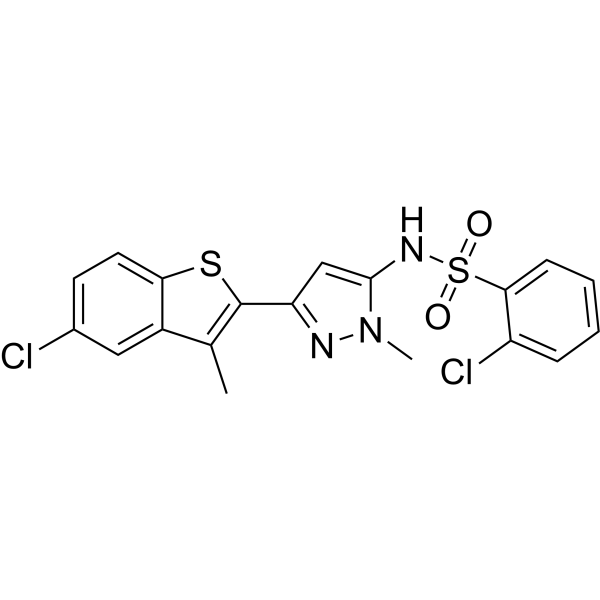
Physicochemical Properties
| Molecular Formula | C19H15CL2N3O2S2 |
| Molecular Weight | 452.37 |
| Exact Mass | 450.998 |
| CAS # | 577784-91-9 |
| PubChem CID | 2824289 |
| Appearance | Colorless to light yellow liquid |
| Density | 1.5±0.1 g/cm3 |
| Boiling Point | 632.3±65.0 °C at 760 mmHg |
| Flash Point | 336.2±34.3 °C |
| Vapour Pressure | 0.0±1.9 mmHg at 25°C |
| Index of Refraction | 1.715 |
| LogP | 6.83 |
| Hydrogen Bond Donor Count | 1 |
| Hydrogen Bond Acceptor Count | 5 |
| Rotatable Bond Count | 4 |
| Heavy Atom Count | 28 |
| Complexity | 662 |
| Defined Atom Stereocenter Count | 0 |
| SMILES | CC1=C(C2=NN(C)C(=C2)NS(=O)(=O)C3=CC=CC=C3Cl)SC4=C1C=C(C=C4)Cl |
| InChi Key | BVBDTTLISMIOJY-UHFFFAOYSA-N |
| InChi Code | InChI=1S/C19H15Cl2N3O2S2/c1-11-13-9-12(20)7-8-16(13)27-19(11)15-10-18(24(2)22-15)23-28(25,26)17-6-4-3-5-14(17)21/h3-10,23H,1-2H3 |
| Chemical Name | 2-chloro-N-[5-(5-chloro-3-methyl-1-benzothiophen-2-yl)-2-methylpyrazol-3-yl]benzenesulfonamide |
| Synonyms | ML 60218; ML60218; ML-60218 |
| HS Tariff Code | 2934.99.9001 |
| Storage |
Powder-20°C 3 years 4°C 2 years In solvent -80°C 6 months -20°C 1 month |
| Shipping Condition | Room temperature (This product is stable at ambient temperature for a few days during ordinary shipping and time spent in Customs) |
Biological Activity
| ln Vitro | Combining SAHA with ML-60218 inhibits cycle cell processes and induces cell switching, which improves the inhibition of human pancreatic cancer cell proliferation. In PANC-1 and BxPC-3 cells, ML-60218 reverses SAHA-stimulated tRNA expression. HDACs' capacity to produce cytokines and cell cycle factors is improved by ML-60218 [2]. Using blocked tyrosine kinase (DLP) in an in vitro stress assay, ML-60218 demonstrated cytokine-inducing activity, suggesting that its target is viral. It was discovered that ML-60218 hinders VP6's capacity to form higher-order structures, which produces the protein's DLP outer layer without compromising its ability to trimerize. Electron examination of DLP treated with ML-60218 revealed structures that were dangerously damaged. NSP5 was dephosphorylated as a result of viroplasm destruction (10 μM) mediated by ML-60218 [3]. |
| References |
[1]. Novel small-molecule inhibitors of RNA polymerase III. Eukaryot Cell. 2003;2(2):256-264. [2]. Targeting developmental regulators of zebrafish exocrine pancreas as a therapeutic approach in human pancreatic cancer. Biol Open. 2012;1(4):295-307. [3]. Identification of a Small Molecule That Compromises the Structural Integrity of Viroplasms and Rotavirus Double-Layered Particles. J Virol. 2018;92(3):e01943-17. Published 2018 Jan 17. |
Solubility Data
| Solubility (In Vitro) | DMSO : ~100 mg/mL (~221.05 mM) |
| Solubility (In Vivo) |
Solubility in Formulation 1: ≥ 2.5 mg/mL (5.53 mM) (saturation unknown) in 10% DMSO + 40% PEG300 + 5% Tween80 + 45% Saline (add these co-solvents sequentially from left to right, and one by one), clear solution. For example, if 1 mL of working solution is to be prepared, you can add 100 μL of 25.0 mg/mL clear DMSO stock solution to 400 μL PEG300 and mix evenly; then add 50 μL Tween-80 to the above solution and mix evenly; then add 450 μL normal saline to adjust the volume to 1 mL. Preparation of saline: Dissolve 0.9 g of sodium chloride in 100 mL ddH₂ O to obtain a clear solution. Solubility in Formulation 2: ≥ 2.5 mg/mL (5.53 mM) (saturation unknown) in 10% DMSO + 90% Corn Oil (add these co-solvents sequentially from left to right, and one by one), clear solution. For example, if 1 mL of working solution is to be prepared, you can add 100 μL of 25.0 mg/mL clear DMSO stock solution to 900 μL of corn oil and mix evenly. (Please use freshly prepared in vivo formulations for optimal results.) |
| Preparing Stock Solutions | 1 mg | 5 mg | 10 mg | |
| 1 mM | 2.2106 mL | 11.0529 mL | 22.1058 mL | |
| 5 mM | 0.4421 mL | 2.2106 mL | 4.4212 mL | |
| 10 mM | 0.2211 mL | 1.1053 mL | 2.2106 mL |