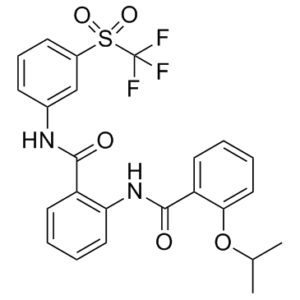
ML-290, a 2-acetamido-N-phenylbenzamide analog, is a novel potent, selective and orally bioactive agonist of the relaxin/insulin-like family peptide receptor (RXFP1) and an activator of anti-fibrotic genes with an EC50 of 94 nM. It was identified from a dose responsive quantitative high throughput screen (qHTS) of >350,000 compounds against a human relaxin/insulin-like family peptide receptor (RXFP1) transfected HEK293 cell line. ML-290 has excellent in vivo PK properties with high levels of systemic exposure. ML-290 represents the first-in-class small-molecule agonists of RXFP1 and is a potent activator of anti-fibrotic genes.
Physicochemical Properties
| Molecular Formula | C24H21F3N2O5S | |
| Molecular Weight | 506.5 | |
| Exact Mass | 506.112 | |
| CAS # | 1482500-76-4 | |
| Related CAS # |
|
|
| PubChem CID | 56593349 | |
| Appearance | White to off-white solid powder | |
| Density | 1.4±0.1 g/cm3 | |
| Boiling Point | 523.5±50.0 °C at 760 mmHg | |
| Flash Point | 270.4±30.1 °C | |
| Vapour Pressure | 0.0±1.4 mmHg at 25°C | |
| Index of Refraction | 1.590 | |
| LogP | 5 | |
| Hydrogen Bond Donor Count | 2 | |
| Hydrogen Bond Acceptor Count | 8 | |
| Rotatable Bond Count | 7 | |
| Heavy Atom Count | 35 | |
| Complexity | 843 | |
| Defined Atom Stereocenter Count | 0 | |
| InChi Key | RSYHJSDOGMSLDH-UHFFFAOYSA-N | |
| InChi Code | InChI=1S/C24H21F3N2O5S/c1-15(2)34-21-13-6-4-11-19(21)23(31)29-20-12-5-3-10-18(20)22(30)28-16-8-7-9-17(14-16)35(32,33)24(25,26)27/h3-15H,1-2H3,(H,28,30)(H,29,31) | |
| Chemical Name |
|
|
| Synonyms |
|
|
| HS Tariff Code | 2934.99.9001 | |
| Storage |
Powder-20°C 3 years 4°C 2 years In solvent -80°C 6 months -20°C 1 month |
|
| Shipping Condition | Room temperature (This product is stable at ambient temperature for a few days during ordinary shipping and time spent in Customs) |
Biological Activity
| Targets | At 94 nM, ML-290 is a powerful agonist of the relaxin/insulin-like family peptide receptor (RXFP1) and an anti-fibrotic gene activator, making it the first of its kind in the field[1]. After 24 and 72 hours of activation, human hepatic stellate cells that have been exposed to ML290 (5 μM) exhibit relaxin-like, anti-fibrotic gene expression [1]. |
| ln Vitro |
At 94 nM, ML-290 is a powerful agonist of the relaxin/insulin-like family peptide receptor (RXFP1) and an anti-fibrotic gene activator, making it the first of its kind in the field[1]. After 24 and 72 hours of activation, human hepatic stellate cells that have been exposed to ML290 (5 μM) exhibit relaxin-like, anti-fibrotic gene expression [1]. ML-290 (compound 65) is a potent and selective small-molecule agonist of the human RXFP1 receptor. In a cAMP functional assay using HEK293 cells transfected with human RXFP1, ML-290 exhibited an EC₅₀ of 0.094 µM with 98% maximal efficacy relative to forskolin. It showed selectivity over the related RXFP2 receptor and the AVPR1B receptor. [1] In primary human hepatic stellate cells (HSCs) cultured on plastic to induce activation, treatment with 5 µM ML-290 for 24 and 72 hours induced a gene expression profile characteristic of relaxin's anti-fibrotic effects. This included significant downregulation of pro-fibrotic genes (ACTA2, TGFB1, CTGF) and upregulation of matrix metalloproteinase 1 (MMP1) and peroxisome proliferator-activated receptor gamma (PPARG). [1] |
| ln Vivo |
The pharmacokinetic profile of ML-290 was evaluated in male C57/BL6 mice. After intravenous (IV) administration (3 mg/kg), it showed a plasma half-life of 6.6 hours and a high volume of distribution (24.5 L/kg), indicating good tissue penetration. Heart tissue exposure was approximately 6 times higher than plasma exposure after IV dosing. Oral administration (30 mg/kg) resulted in a plasma half-life of 5.5 hours and a bioavailability of 14%. [1] |
| Cell Assay |
cAMP Assay: Cyclic AMP levels were measured to assess RXFP1 activation. HEK293 cells (or THP1 cells) stably or transiently transfected with human RXFP1, RXFP2, or AVPR1B receptors were stimulated with relaxin, test compounds, or forskolin for 30 minutes at 37°C under 5% CO₂. Cellular cAMP was quantified using a homogeneous time-resolved fluorescence (HTRF) detection kit. The assay signal was read on a compatible plate reader. Concentration-response curves were generated, and EC₅₀ values were determined by nonlinear regression analysis. [1] Gene Expression Modulation in HSCs: Primary human hepatic stellate cells were seeded in poly-L-lysine-coated dishes and grown in specific growth media. Cells were treated in triplicate with either 5 µM ML-290 dissolved in DMSO or DMSO vehicle alone (control) for 24 or 72 hours. Total RNA was extracted, and cDNA was synthesized. Quantitative PCR was performed using gene-specific primers and a master mix. Gene expression levels were normalized to GAPDH, and relative fold changes were calculated using the comparative Ct method. Statistical significance was determined using Student's t-test. [1] |
| Animal Protocol |
Pharmacokinetic Study in Mice: Male C57/BL6 mice were administered ML-290 via intravenous injection (3 mg/kg) or oral gavage (30 mg/kg). For the IV study, the compound was formulated in a suitable vehicle (details of formulation not specified in the main text). Blood samples were collected at various time points post-dose to obtain plasma. In a separate experiment, heart tissues were also collected after IV and oral dosing. Drug concentrations in plasma and heart homogenates were determined to calculate pharmacokinetic parameters such as clearance, volume of distribution, half-life, area under the curve, and bioavailability. [1] Maximum Tolerated Dose Study: A maximum tolerated dose study was conducted in C57/BL6 mice. ML-290 was administered orally once daily for 5 consecutive days at doses of 90, 300, and 3000 mg/kg, followed by a 5-day observation period. No mortality was observed at any dose level. Necropsy after the in vivo studies did not reveal any obvious abnormalities. [1] |
| ADME/Pharmacokinetics |
In mice, ML-290 demonstrated favorable pharmacokinetic properties. After IV administration (3 mg/kg), plasma clearance was 67.2 mL/min/kg, terminal half-life was 6.6 hours, and volume of distribution at steady state was 24.5 L/kg. [1] Oral administration (30 mg/kg) resulted in a maximum plasma concentration (Cmax) of 0.30 µg/mL, an AUCinf of 1.00 µg·h/mL, a half-life of 5.5 hours, and an estimated oral bioavailability of 14%. [1] Heart tissue exposure was significantly higher than plasma exposure, with an AUCinf of 5.69 µg·h/mL after IV dosing, indicating good distribution to a target organ for fibrosis. [1] The compound showed excellent stability in both rat and mouse liver microsomes (e.g., mouse microsomal t₁/₂ > 100 minutes for several analogs including ML-290). [1] Kinetic solubility in PBS for ML-290 was 7.0 µM. [1] |
| Toxicity/Toxicokinetics |
In a 5-day maximum tolerated dose study in mice, oral administration of ML-290 at doses up to 3000 mg/kg did not cause mortality. [1] No obvious abnormalities were noted upon necropsy in any of the in vivo mammalian studies conducted. [1] The compound showed low cytotoxicity in an ATP-based cell viability assay (EC₅₀ = 18.8 µM). [1] |
| References |
[1]. Optimization of the first small-molecule relaxin/insulin-like family peptide receptor (RXFP1) agonists: Activation results in an antifibrotic gene expression profile. Eur J Med Chem. 2018 Aug 5;156:79-92. |
| Additional Infomation |
ML-290 represents the first-in-class small-molecule agonist for the relaxin hormone receptor RXFP1, discovered through optimization of a hit from a quantitative high-throughput screen of over 350,000 compounds. [1] Its activation of RXFP1 leads to an anti-fibrotic gene expression signature, supporting its potential therapeutic utility in treating fibrotic diseases of organs such as the heart, liver, and lungs. [1] A predicted binding model suggests ML-290 binds within the transmembrane domain of RXFP1, forming a critical hydrogen bond between its sulfonyl oxygen and threonine 660 (T660) on extracellular loop 3, which is essential for receptor activation. [1] |
Solubility Data
| Solubility (In Vitro) |
|
|||
| Solubility (In Vivo) |
Solubility in Formulation 1: ≥ 2.08 mg/mL (4.11 mM) (saturation unknown) in 10% DMSO + 90% Corn Oil (add these co-solvents sequentially from left to right, and one by one), clear solution. For example, if 1 mL of working solution is to be prepared, you can add 100 μL of 20.8 mg/mL clear DMSO stock solution to 900 μL of corn oil and mix evenly. (Please use freshly prepared in vivo formulations for optimal results.) |
| Preparing Stock Solutions | 1 mg | 5 mg | 10 mg | |
| 1 mM | 1.9743 mL | 9.8717 mL | 19.7433 mL | |
| 5 mM | 0.3949 mL | 1.9743 mL | 3.9487 mL | |
| 10 mM | 0.1974 mL | 0.9872 mL | 1.9743 mL |