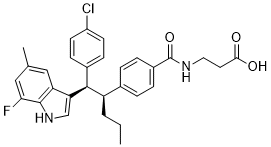
MK3577 (MK 3577; MK-3577) is a novel, oral and potent glucagon receptor antagonist with anti-diabetic effects (T2DM).
Physicochemical Properties
| Molecular Formula | C30H30CLFN2O3 |
| Molecular Weight | 521.0294 |
| Exact Mass | 520.192 |
| Elemental Analysis | C, 69.16; H, 5.80; Cl, 6.80; F, 3.65; N, 5.38; O, 9.21 |
| CAS # | 1019112-29-8 |
| PubChem CID | 46240797 |
| Appearance | Typically exists as solid at room temperature |
| Density | 1.3±0.1 g/cm3 |
| Boiling Point | 702.4±60.0 °C at 760 mmHg |
| Flash Point | 378.6±32.9 °C |
| Vapour Pressure | 0.0±2.3 mmHg at 25°C |
| Index of Refraction | 1.626 |
| LogP | 7.03 |
| Hydrogen Bond Donor Count | 3 |
| Hydrogen Bond Acceptor Count | 4 |
| Rotatable Bond Count | 10 |
| Heavy Atom Count | 37 |
| Complexity | 753 |
| Defined Atom Stereocenter Count | 2 |
| SMILES | ClC1C=CC(=CC=1)[C@H](C1=CNC2C(=CC(C)=CC1=2)F)[C@@H](C1C=CC(C(NCCC(=O)O)=O)=CC=1)CCC |
| InChi Key | FYRJJCYFYLLOSC-LXFBAYGMSA-N |
| InChi Code | InChI=1S/C30H30ClFN2O3/c1-3-4-23(19-5-7-21(8-6-19)30(37)33-14-13-27(35)36)28(20-9-11-22(31)12-10-20)25-17-34-29-24(25)15-18(2)16-26(29)32/h5-12,15-17,23,28,34H,3-4,13-14H2,1-2H3,(H,33,37)(H,35,36)/t23-,28+/m1/s1 |
| Chemical Name | 3-[[4-[(1R,2S)-1-(4-chlorophenyl)-1-(7-fluoro-5-methyl-1H-indol-3-yl)pentan-2-yl]benzoyl]amino]propanoic acid |
| Synonyms | MK-3577; MK-3577; 1019112-29-8; 03TW1410NL; UNII-03TW1410NL; CHEMBL1933350; N-(4-((1S)-1-((R)-(4-Chlorophenyl)(7-fluoro-5-methyl-1H-indol-3-yl)methyl)butyl)benzoyl)-beta-alanine; beta-Alanine, N-(4-((1S)-1-((R)-(4-chlorophenyl)(7-fluoro-5-methyl-1H-indol-3-yl)methyl)butyl)benzoyl)-; beta-Alanine, N-[4-[(1S)-1-[(R)-(4-chlorophenyl)(7-fluoro-5-methyl-1H-indol-3-yl)methyl]butyl]benzoyl]-; MK 3577; MK3577 |
| HS Tariff Code | 2934.99.9001 |
| Storage |
Powder-20°C 3 years 4°C 2 years In solvent -80°C 6 months -20°C 1 month |
| Shipping Condition | Room temperature (This product is stable at ambient temperature for a few days during ordinary shipping and time spent in Customs) |
Biological Activity
| Targets | GR/Glucagon receptor (GCGR) |
| ln Vivo | The role of glucagon disturbances in diabetes mellitus is increasingly recognized and, hence, glucagon antagonism might aid in treatment of hyperglycemia and other metabolic disturbances. The aim of this study was to assess the pharmacokinetics of the glucagon receptor antagonist MK-3577 and its effect on plasma glucose, insulin, and glucagon concentrations in healthy cats. In a cross-over placebo-controlled study, 5 purpose-bred cats were treated with either Placebo, MK-3577 (1 mg/kg), or MK-3577 (3 mg/kg). Glucose, insulin and glucagon concentrations were measured at 0, 15, 225, 240 min post-treatment administration. Glucagon (20 mcg/kg, IM) was administered at 240 min and glucose and insulin were measured at 255, 265, 275, 285 and 300 min. Plasma MK-3577 concentrations peaked at 4.2 and 3.2 hours after 1 and 3 mg/kg dosing with a half-life of 14.8h and 15.5h respectively. Baseline glucose, insulin and glucagon concentrations did not differ significantly between treatment groups. At a dose of 3 mg/kg, MK-3577 blunted the glucagon-stimulated rise of glucose (p=0.0089) and insulin (p=0.02). Similar trends were observed with MK-3577 at the 1 mg/kg dose but the effect was smaller, and not significant. In conclusion, the GRA MK-3577 has a pharmacokinetic profile suitable for diminishing the glucagon-induced rise of glucose and insulin in healthy cats [1]. |
| Animal Protocol | Following a modified repeated measures two-way crossover design, all cats were administered a vehicle placebo run-in phase (0.1 ml/kg, PO) first, and then either 1 mg/kg (1 %, 0.1 ml/kg, PO) or 3 mg/kg (3 %, 0.1 ml/Kg, PO) of the MK-3577 at a random order (Fig. 1A). At least one week was allowed between the crossover of various treatments. Cats were fasted overnight for 16 hours prior to each experiment. On the day of experimentation, cats received their predetermined treatments at time 0, followed four hours later by a glucagon challenge (20 mcg/kg IM, GlucaGen®). Blood samples (1 ml) for plasma glucose (PG) and insulin concentration were collected at 0 min, just prior to treatment with MK-3577, and then 15, 225, 240 (prior to glucagon administration), 255, 265, 275, 285, 300 min. In the placebo group, plasma was not collected at zero and 15 min but otherwise the same procedure was followed. Samples obtained prior to glucagon administration, i.e., at 0, 15, 225 and 240 min, were also used for measurement of plasma glucagon concentrations (Fig. 1B). Additional samples (1.5 ml) for drug concentration measurements were collected at time zero (just before drug administration) and at 15 min, 30 min, 1 h, 2 h, 4 h, 7 h, 8 h, 10 h, 24 h, 48 h, 72 h, and 96 h post administration.[1] |
| ADME/Pharmacokinetics |
Results of pharmacokinetic data of MK-3577 at 1mg/kg and 3 mg/kg are listed in Table 1 and graphed in Fig 2. Body weight was stable in all cats during the entire study.[1] AUC(0-x) µM·h 34.0 81.2 AUC(0-∞) µM·h 34.6 82.6 %AUC Extrapolated % 1.85 1.66 C max µM 2.79 5.37 t max hr 4.20 3.20 t½ h 14.8 15.5 |
| Additional Infomation |
MK-3577 is under investigation in clinical trial NCT00868790 (A Study of the Safety and Efficacy of MK-3577 in Participants With Type 2 Diabetes Mellitus (MK-3577-009)). Our study had several limitations including small sample size and non-diverse population. The small sample size may have impaired our ability to detect significant effects or associations and not been representative of general feline population. This limits our ability to extrapolate our findings. Our healthy research cat population was homogeneous and lacked genetic diversity. Thus, potential confounders like body weight, sex, breed or age on response to drug could not be identified. The limited variability in the cats may have restricted the study's ability to detect potential variations in drug response. The protocols for placebo and MK-3577 treatment arms were slightly different with the MK-3577 groups receiving 2 additional time points for blood sampling. Theoretically, the stress of additional sampling could have elevated hormone and blood glucose concentrations in drug treated groups. Yet, the MK-3577 treated groups exhibited a greater decrease in blood glucose levels than placebo followed by a more blunted rise with glucagon stimulation. As well, these cats were well acclimatized to repeated sampling from their VAPs. Thus, stress from additional sampling did not appear to have a clinically significant impact on the results. Finally, the results of our study cannot be extrapolated to chronic administration of GRAs in cats. 5. Conclusions In conclusion, MK-3577 peaks at 3 to 4 h post oral administration and has a half-life of approximately 15 hours. Healthy cats treated with MK-3577 exhibited decreased glucose, decreased insulin secretion and increased glucagon levels. The rise of insulin and glucagon during glucagon stimulation were diminished after oral administration of MK-3577.[1] |
Solubility Data
| Solubility (In Vitro) | May dissolve in DMSO (in most cases), if not, try other solvents such as H2O, Ethanol, or DMF with a minute amount of products to avoid loss of samples |
| Solubility (In Vivo) |
Note: Listed below are some common formulations that may be used to formulate products with low water solubility (e.g. < 1 mg/mL), you may test these formulations using a minute amount of products to avoid loss of samples. Injection Formulations (e.g. IP/IV/IM/SC) Injection Formulation 1: DMSO : Tween 80: Saline = 10 : 5 : 85 (i.e. 100 μL DMSO stock solution → 50 μL Tween 80 → 850 μL Saline) *Preparation of saline: Dissolve 0.9 g of sodium chloride in 100 mL ddH ₂ O to obtain a clear solution. Injection Formulation 2: DMSO : PEG300 :Tween 80 : Saline = 10 : 40 : 5 : 45 (i.e. 100 μL DMSO → 400 μLPEG300 → 50 μL Tween 80 → 450 μL Saline) Injection Formulation 3: DMSO : Corn oil = 10 : 90 (i.e. 100 μL DMSO → 900 μL Corn oil) Example: Take the Injection Formulation 3 (DMSO : Corn oil = 10 : 90) as an example, if 1 mL of 2.5 mg/mL working solution is to be prepared, you can take 100 μL 25 mg/mL DMSO stock solution and add to 900 μL corn oil, mix well to obtain a clear or suspension solution (2.5 mg/mL, ready for use in animals). Injection Formulation 4: DMSO : 20% SBE-β-CD in saline = 10 : 90 [i.e. 100 μL DMSO → 900 μL (20% SBE-β-CD in saline)] *Preparation of 20% SBE-β-CD in Saline (4°C,1 week): Dissolve 2 g SBE-β-CD in 10 mL saline to obtain a clear solution. Injection Formulation 5: 2-Hydroxypropyl-β-cyclodextrin : Saline = 50 : 50 (i.e. 500 μL 2-Hydroxypropyl-β-cyclodextrin → 500 μL Saline) Injection Formulation 6: DMSO : PEG300 : castor oil : Saline = 5 : 10 : 20 : 65 (i.e. 50 μL DMSO → 100 μLPEG300 → 200 μL castor oil → 650 μL Saline) Injection Formulation 7: Ethanol : Cremophor : Saline = 10: 10 : 80 (i.e. 100 μL Ethanol → 100 μL Cremophor → 800 μL Saline) Injection Formulation 8: Dissolve in Cremophor/Ethanol (50 : 50), then diluted by Saline Injection Formulation 9: EtOH : Corn oil = 10 : 90 (i.e. 100 μL EtOH → 900 μL Corn oil) Injection Formulation 10: EtOH : PEG300:Tween 80 : Saline = 10 : 40 : 5 : 45 (i.e. 100 μL EtOH → 400 μLPEG300 → 50 μL Tween 80 → 450 μL Saline) Oral Formulations Oral Formulation 1: Suspend in 0.5% CMC Na (carboxymethylcellulose sodium) Oral Formulation 2: Suspend in 0.5% Carboxymethyl cellulose Example: Take the Oral Formulation 1 (Suspend in 0.5% CMC Na) as an example, if 100 mL of 2.5 mg/mL working solution is to be prepared, you can first prepare 0.5% CMC Na solution by measuring 0.5 g CMC Na and dissolve it in 100 mL ddH2O to obtain a clear solution; then add 250 mg of the product to 100 mL 0.5% CMC Na solution, to make the suspension solution (2.5 mg/mL, ready for use in animals). Oral Formulation 3: Dissolved in PEG400 Oral Formulation 4: Suspend in 0.2% Carboxymethyl cellulose Oral Formulation 5: Dissolve in 0.25% Tween 80 and 0.5% Carboxymethyl cellulose Oral Formulation 6: Mixing with food powders Note: Please be aware that the above formulations are for reference only. InvivoChem strongly recommends customers to read literature methods/protocols carefully before determining which formulation you should use for in vivo studies, as different compounds have different solubility properties and have to be formulated differently. (Please use freshly prepared in vivo formulations for optimal results.) |
| Preparing Stock Solutions | 1 mg | 5 mg | 10 mg | |
| 1 mM | 1.9193 mL | 9.5964 mL | 19.1928 mL | |
| 5 mM | 0.3839 mL | 1.9193 mL | 3.8386 mL | |
| 10 mM | 0.1919 mL | 0.9596 mL | 1.9193 mL |