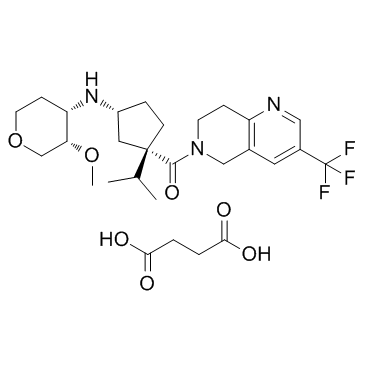
MK0812 Succinate (MK-0812) is a novel, potent and selective small molecule CCR2 antagonist with anti-Inflammatory and immunomodulatory activity. MK0812 caused an increase in the CCR2 ligand CCL2 and a selective decrease in the frequency of peripheral blood monocytes. The therapeutic potential for targeting CXCR2/CXCR1 in human arthritides is highlighted by the significantly greater impact of CXCR2/CXCR1 antagonism in this model of arthritis compared to CCR2 antagonism. In the tissue and synovial fluid of rheumatoid arthritis patients, neutrophils and monocytes are highly prevalent. It was investigated how small molecule chemokine receptor antagonists, like MK-0812, might prevent these cells from migrating in arthritis caused by anti-collagen antibodies.
Physicochemical Properties
| Molecular Formula | C28H40F3N3O7 |
| Molecular Weight | 587.628318786621 |
| Exact Mass | 587.28 |
| Elemental Analysis | C, 57.23; H, 6.86; F, 9.70; N, 7.15; O, 19.06 |
| CAS # | 851916-42-2 |
| Related CAS # | MK-0812; 624733-88-6 |
| PubChem CID | 60196412 |
| Appearance | White to off-white solid powder |
| Hydrogen Bond Donor Count | 2 |
| Hydrogen Bond Acceptor Count | 11 |
| Rotatable Bond Count | 7 |
| Heavy Atom Count | 41 |
| Complexity | 793 |
| Defined Atom Stereocenter Count | 4 |
| SMILES | CC(C)[C@@]1(CC[C@H](C1)[NH2+][C@H]2CCOC[C@H]2OC)C(=O)N3CCC4=C(C3)C=C(C=N4)C(F)(F)F.C(CC(=O)[O-])C(=O)O |
| InChi Key | WPPJJJUIDYHHSM-PXUYIWLPSA-N |
| InChi Code | InChI=1S/C24H34F3N3O3.C4H6O4/c1-15(2)23(7-4-18(11-23)29-20-6-9-33-14-21(20)32-3)22(31)30-8-5-19-16(13-30)10-17(12-28-19)24(25,26)27;5-3(6)1-2-4(7)8/h10,12,15,18,20-21,29H,4-9,11,13-14H2,1-3H3;1-2H2,(H,5,6)(H,7,8)/t18-,20+,21-,23+;/m1./s1 |
| Chemical Name | butanedioic acid;[(1S,3R)-3-[[(3S,4S)-3-methoxyoxan-4-yl]amino]-1-propan-2-ylcyclopentyl]-[3-(trifluoromethyl)-7,8-dihydro-5H-1,6-naphthyridin-6-yl]methanone |
| Synonyms | MK-0812 Succinate; MK0812 Succinate; MK-0812; MK 0812 Succinate |
| HS Tariff Code | 2934.99.9001 |
| Storage |
Powder-20°C 3 years 4°C 2 years In solvent -80°C 6 months -20°C 1 month Note: Please store this product in a sealed and protected environment, avoid exposure to moisture. |
| Shipping Condition | Room temperature (This product is stable at ambient temperature for a few days during ordinary shipping and time spent in Customs) |
Biological Activity
| Targets | CCR2 | |
| ln Vitro |
|
|
| ln Vivo |
|
|
| Animal Protocol |
|
|
| References |
[1]. Pharmacological targeting reveals distinct roles for CXCR2/CXCR1 and CCR2 in a mouse model of arthritis.Biochem Biophys Res Commun. 2010 Jan 1;391(1):1080-6. [2]. Assessment of chemokine receptor function on monocytes in whole blood: In vitro and ex vivo evaluations of a CCR2 antagonist.J Immunol Methods. 2010 Jan 31;352(1-2):101-10. |
Solubility Data
| Solubility (In Vitro) | DMSO: ≥ 32 mg/mL (~54.5 mM) |
| Solubility (In Vivo) |
Solubility in Formulation 1: ≥ 2.5 mg/mL (4.25 mM) (saturation unknown) in 10% DMSO + 40% PEG300 + 5% Tween80 + 45% Saline (add these co-solvents sequentially from left to right, and one by one), clear solution. For example, if 1 mL of working solution is to be prepared, you can add 100 μL of 25.0 mg/mL clear DMSO stock solution to 400 μL PEG300 and mix evenly; then add 50 μL Tween-80 to the above solution and mix evenly; then add 450 μL normal saline to adjust the volume to 1 mL. Preparation of saline: Dissolve 0.9 g of sodium chloride in 100 mL ddH₂ O to obtain a clear solution. Solubility in Formulation 2: ≥ 2.5 mg/mL (4.25 mM) (saturation unknown) in 10% DMSO + 90% (20% SBE-β-CD in Saline) (add these co-solvents sequentially from left to right, and one by one), clear solution. For example, if 1 mL of working solution is to be prepared, you can add 100 μL of 25.0 mg/mL clear DMSO stock solution to 900 μL of 20% SBE-β-CD physiological saline solution and mix evenly. Preparation of 20% SBE-β-CD in Saline (4°C,1 week): Dissolve 2 g SBE-β-CD in 10 mL saline to obtain a clear solution. Solubility in Formulation 3: ≥ 2.5 mg/mL (4.25 mM) (saturation unknown) in 10% DMSO + 90% Corn Oil (add these co-solvents sequentially from left to right, and one by one), clear solution. For example, if 1 mL of working solution is to be prepared, you can add 100 μL of 25.0 mg/mL clear DMSO stock solution to 900 μL of corn oil and mix evenly. (Please use freshly prepared in vivo formulations for optimal results.) |
| Preparing Stock Solutions | 1 mg | 5 mg | 10 mg | |
| 1 mM | 1.7018 mL | 8.5088 mL | 17.0175 mL | |
| 5 mM | 0.3404 mL | 1.7018 mL | 3.4035 mL | |
| 10 mM | 0.1702 mL | 0.8509 mL | 1.7018 mL |