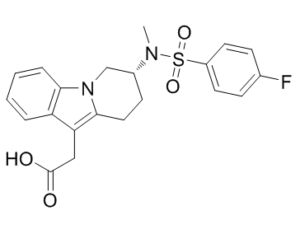
MK-7246 is a novel, potent and selective CRTH2 antagonist with Ki of 2.5±0.5 nM. MK-7246 exhibits high selectivity over all prostanoid receptors as well as 157 other receptors and enzymes. It also acts as a full antagonist on recombinant and endogenously expressed CRTH2, has high affinity for the CRTH2 found in humans, monkeys, dogs, rats, and mice, produces ex vivo blockade of CRTH2 on eosinophils in monkeys and sheep, and significantly blocks antigen-induced late-phase bronchoconstriction and airway hyper-responsiveness in sheep. Additionally, MK-7246 demonstrates good oral bioavailability and metabolic stability in a variety of animal species. MK-7246 is a powerful and targeted tool to learn more about CRTH2's in vivo role.
Physicochemical Properties
| Molecular Formula | C21H21FN2O4S |
| Molecular Weight | 416.4658 |
| Exact Mass | 416.121 |
| Elemental Analysis | C, 60.56; H, 5.08; F, 4.56; N, 6.73; O, 15.37; S, 7.70 |
| CAS # | 1218918-62-7 |
| Related CAS # | MK-7246 S enantiomer; 2310135-53-4 |
| PubChem CID | 45268455 |
| Appearance | White to off-white solid powder |
| LogP | 4.123 |
| Hydrogen Bond Donor Count | 1 |
| Hydrogen Bond Acceptor Count | 6 |
| Rotatable Bond Count | 5 |
| Heavy Atom Count | 29 |
| Complexity | 704 |
| Defined Atom Stereocenter Count | 1 |
| SMILES | S(C1C([H])=C([H])C(=C([H])C=1[H])F)(N(C([H])([H])[H])[C@]1([H])C([H])([H])C([H])([H])C2=C(C([H])([H])C(=O)O[H])C3=C([H])C([H])=C([H])C([H])=C3N2C1([H])[H])(=O)=O |
| InChi Key | JTCAGRAKUAAYDY-OAHLLOKOSA-N |
| InChi Code | InChI=1S/C21H21FN2O4S/c1-23(29(27,28)16-9-6-14(22)7-10-16)15-8-11-20-18(12-21(25)26)17-4-2-3-5-19(17)24(20)13-15/h2-7,9-10,15H,8,11-13H2,1H3,(H,25,26)/t15-/m1/s1 |
| Chemical Name | 2-[(7R)-7-[(4-fluorophenyl)sulfonyl-methylamino]-6,7,8,9-tetrahydropyrido[1,2-a]indol-10-yl]acetic acid |
| Synonyms | MK7246; MK 7246; MK-7246 |
| HS Tariff Code | 2934.99.9001 |
| Storage |
Powder-20°C 3 years 4°C 2 years In solvent -80°C 6 months -20°C 1 month |
| Shipping Condition | Room temperature (This product is stable at ambient temperature for a few days during ordinary shipping and time spent in Customs) |
Biological Activity
| Targets | DP ( Ki = 2.5 nM ); TP ( Ki = 3804 nM ) |
| ln Vitro | Equilibrium competition analysis, employing pertinent radioligands and cell membranes expressing the different receptors, is used to determine the affinity and selectivity of MK-7246 for human CRTH2 and recombinant human prostanoid receptors. High-affinity [3H]PGD2 specific binding is competitively bound (Ki, 2.5 nM) by MK-7246 to cell membranes expressing recombinant human CRTH2. MK-7246 exhibits a relatively high selectivity for CRTH2 with an affinity 149-fold lower for the DP receptor (Ki, 373±96 nM) and ≥1500-fold lower for the other prostanoid receptors (Ki, 7668±2169 nM for EP2, 3804±1290 nM for TP). Additionally, MK-7246 is examined in a panel of 157 enzyme and receptor tests at concentrations up to 100 μM; only phosphodiesterase 1 (PDE1, IC50=33.2 μM) and MAPK3 (ERK1, IC50=49.4 μM) exhibit slight but noteworthy activity[1]. |
| ln Vivo | The purpose of this study is to determine whether reducing inflammatory responses in A. alternata-challenged Brown Norway rats (n = 8 per group) results from blocKing a clinically-relevant mechanism of allergic lung inflammation, such as CRTH2. One major theory for the cause of allergic inflammation is the production of prostaglandin D2 (PGD2) by mast cells. Since CRTH2 plays an important role in the early aspects of the allergic inflammation cascade, the effect of the CRTH2 antagonist is examined on A. alternate elicited pulmonary inflammatory responses. Oral CRTH2 inhibitor MK-7246 is given one hour prior to and twenty-three hours following the A. alternata's intratracheal instillation. The number of eosinophils is reduced in a dose-dependent manner by MK-7246, with a maximum inhibition of 74±5% in the 100 mg/kg group (P<0.05), and a dose-dependent decrease in IL-5 (80±12%) and IL-13 (76±14%) cytoKine levels (P<0.05) [2]. |
| Enzyme Assay | Recombinant HEK293E cell membranes are used to characterize the binding Kinetics of [3H]MK-7246 (specific activity, 41 Ci/mmol) at human CRTH2. The incubation mixture contains 10 mM MgCl2 instead of MnCl2, 10 nM [3H]MK-7246, and 1.25 μg of membrane protein. These are the radioligand binding experimental conditions for CRTH2. Specific binding at equilibrium correlated with 85–95% of total binding, while total binding accounts for 10% of the radioligand additions to the incubation media. The membranes are first incubated with 10 μM MK-7246 for 120 min, either in the presence (nonspecific binding) or absence (total binding) of [3H]MK-7246. To start the dissociation of the radioligand from the receptor, add 10 μM MK-7246 or 100 μM PGD2 to one series of total binding incubation tubes. Allow the reaction to continue for up to 300 minutes. After that, the samples are collected and handled as previously mentioned. The observed on rate (Kobs) and dissociation rate (Koff) constants, as well as the t1/2 of on and off rates, are found by nonlinear regression curve-fitting with Prism software for the analysis of the association and dissociation Kinetic data[1]. |
| Animal Protocol | Rats: Oral Budesonide (3 mg/kg) is given 2 hours before and 22 hours after the A. alternata extract instillation, while intratracheal Budesonide is dosed 1 hour before and 23 hours after the A. alternate intratracheal dose. Budesonide administered intratracheally is prepared. To investigate the impact of the CRTH2 antagonist on A. alternata elicited pulmonary inflammatory responses, MK-7246 (3, 10, 30, and 100 mg/kg) is given orally 1 hour prior to and 23 hours following an A. alternata extract instillation. In both experiments, an oral dose of budesonide is used as a positive control. The animals are given a 3% isoflurane mild anesthesia (supplemented with 100% oxygen) either two hours after an oral dose or one hour after an intratracheal dose. In order to make it easier to locate the tracheal and larynx apertures, the animals are additionally fastened to a rodent work stand. A microsprayer is used to deliver 0.1 mL of 10,000 μg/mL (1000 μg total) A. alternata extract after inserting the needle into the trachea. After being kept under observation while they recover from anesthesia, the animals are placed back in their cages where they are given unlimited access to food and water. |
| References |
[1]. Pharmacological characterization of MK-7246, a potent and selective CRTH2 (chemoattractant receptor-homologous molecule expressed on T-helper type 2 cells) antagonist. Mol Pharmacol. 2011 Jan;79(1):69-76. [2]. Anti-inflammatory actions of Chemoattractant Receptor-homologous molecule expressed on Th2 by the antagonist MK-7246 in a novel rat model of Alternaria alternata elicited pulmonary inflammation. Eur J Pharmacol. 2014 Nov 15;743:106-16. |
Solubility Data
| Solubility (In Vitro) | DMSO: ~300 mg/mL (~720.3 mM) |
| Solubility (In Vivo) |
Solubility in Formulation 1: 3.75 mg/mL (9.00 mM) in 10% DMSO + 40% PEG300 + 5% Tween80 + 45% Saline (add these co-solvents sequentially from left to right, and one by one), suspension solution; with sonication. For example, if 1 mL of working solution is to be prepared, you can add 100 μL of 37.5 mg/mL clear DMSO stock solution to 400 μL PEG300 and mix evenly; then add 50 μL Tween-80 to the above solution and mix evenly; then add 450 μL normal saline to adjust the volume to 1 mL. Preparation of saline: Dissolve 0.9 g of sodium chloride in 100 mL ddH₂ O to obtain a clear solution. Solubility in Formulation 2: 3.75 mg/mL (9.00 mM) in 10% DMSO + 90% (20% SBE-β-CD in Saline) (add these co-solvents sequentially from left to right, and one by one), suspension solution; with ultrasonication. For example, if 1 mL of working solution is to be prepared, you can add 100 μL of 37.5 mg/mL clear DMSO stock solution to 900 μL of 20% SBE-β-CD physiological saline solution and mix evenly. Preparation of 20% SBE-β-CD in Saline (4°C,1 week): Dissolve 2 g SBE-β-CD in 10 mL saline to obtain a clear solution. Solubility in Formulation 3: 3.75 mg/mL (9.00 mM) in 10% DMSO + 90% Corn Oil (add these co-solvents sequentially from left to right, and one by one), clear solution; with ultrasonication. For example, if 1 mL of working solution is to be prepared, you can add 100 μL of 37.5 mg/mL clear DMSO stock solution to 900 μL of corn oil and mix evenly. (Please use freshly prepared in vivo formulations for optimal results.) |
| Preparing Stock Solutions | 1 mg | 5 mg | 10 mg | |
| 1 mM | 2.4011 mL | 12.0057 mL | 24.0113 mL | |
| 5 mM | 0.4802 mL | 2.4011 mL | 4.8023 mL | |
| 10 mM | 0.2401 mL | 1.2006 mL | 2.4011 mL |