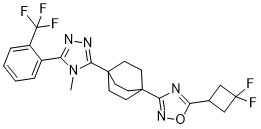
MK-4101 is a novel, potent and selective SMO inhibitor/antagonist of the Hedgehog (Hh) signaling pathway. MK-401 has the potential for the treatment of medulloblastoma and BCC (Basal Cell Carcinoma) as it is highly active against these cells. MK-4101 inhibits Hh signaling both in a reporter gene assay in an engineered mouse cell line (Gli Luc) with IC50 of 1.5 µM and in human KYSE180 oesophageal cancer cells with an IC50 of 1 µM. Furthermore, MK-4101 displaced a fluorescently-labeled cyclopamine derivative from 293 cells expressing recombinant human SMO with an IC50 of 1.1 µM. MK-4101 arrests cells in G1 and G2 phases. Beside antitumor activity on transplanted tumors, MK-4101 was highly efficacious against primary medulloblastoma and BCC developing in the cerebellum and skin of Ptch1(+/-) mice.
Physicochemical Properties
| Molecular Formula | C24H24F5N5O | |
| Molecular Weight | 493.47 | |
| Exact Mass | 493.19 | |
| CAS # | 935273-79-3 | |
| Related CAS # |
|
|
| PubChem CID | 16222379 | |
| Appearance | White to off-white solid powder | |
| Density | 1.5±0.1 g/cm3 | |
| Boiling Point | 606.1±65.0 °C at 760 mmHg | |
| Flash Point | 320.4±34.3 °C | |
| Vapour Pressure | 0.0±1.7 mmHg at 25°C | |
| Index of Refraction | 1.654 | |
| LogP | 4.58 | |
| Hydrogen Bond Donor Count | 0 | |
| Hydrogen Bond Acceptor Count | 10 | |
| Rotatable Bond Count | 4 | |
| Heavy Atom Count | 35 | |
| Complexity | 779 | |
| Defined Atom Stereocenter Count | 0 | |
| SMILES | FC(C1C(C2N(C)C(C34CCC(CC3)(C3N=C(C5CC(F)(F)C5)ON=3)CC4)=NN=2)=CC=CC=1)(F)F |
|
| Synonyms |
|
|
| HS Tariff Code | 2934.99.9001 | |
| Storage |
Powder-20°C 3 years 4°C 2 years In solvent -80°C 6 months -20°C 1 month |
|
| Shipping Condition | Room temperature (This product is stable at ambient temperature for a few days during ordinary shipping and time spent in Customs) |
Biological Activity
| Targets |
MK-4101 is a potent inhibitor of the Hedgehog (Hh) signaling pathway and acts as a novel SMO (Smoothened) antagonist; it exerts the maximum inhibitory effect on Gli1 (a key downstream effector of the Hh pathway). No IC50, Ki, or EC50 values for these targets (SMO or Gli1) were described in the literature. [1] |
| ln Vitro | MK-4101 suppresses Hh signaling in human KYSE180 oesophageal cancer cells at an IC50 of 1 µM and in a reporter gene test using an engineered mouse cell line with an IC50 of 1.5 µM. With an IC50 of 1.1 µM, MK-4101 clears 293 cells expressing recombinant human SMO, suggesting that the molecule binds to SMO. It also displaces a fluorescently-labeled cyclopamine derivative. With an IC50 of 0.3 µM, MK4101 also prevents the growth of medulloblastoma cells obtained from neonatally irradiated Ptch1-/+ mice in vitro[1]. Treatment of MK -4101 (10 µM; 60 hours, 72 hours; medulloblastoma or BCC cells) results in cell cycle arrest with almost no S phase subpopulation remaining, a significant rise in the G1 population, and a little increase in the G2 population[1]. Treatment with MK-4101 (10 µM; medulloblastoma or BCC cells) dramatically decreases the accumulation of cyclin B1 protein and the cyclin D1 protein[1]. |
| ln Vivo |
Tumor growth inhibition is shown at 40 and 80 mg/kg of MK-4101 (oral administration; 3.5 weeks; CD1 nude female mice) and tumor regression is observed at the highest dose (80 mg/kg). Gli1 mRNA is dose-dependently down-regulated in response to MK-4101 therapy; 80 mg/kg produces the greatest tumor inhibition and hedgehog pathway down-regulation[1]. 1. Animal model: Neonatally irradiated Ptch1(+/-) mice were used as a model of Hh-dependent tumors (medulloblastoma and basal cell carcinoma, BCC). [1] 2. Antitumor activity against transplanted tumors: MK-4101 exhibited robust antitumor activity against transplanted Hh-dependent tumors. [1] 3. Antitumor activity against primary tumors: MK-4101 was highly efficacious against primary medulloblastoma developing in the cerebellum and primary BCC developing in the skin of Ptch1(+/-) mice. [1] 4. Mechanism of antitumor action: The antitumor effect of MK-4101 was achieved through two key mechanisms: (i) inhibition of tumor cell proliferation; (ii) induction of extensive apoptosis in tumor cells. Additionally, MK-4101 modulated the gene expression profile of tumors: it targeted the Hh pathway by maximally inhibiting Gli1, induced deregulation of the cell cycle, blocked DNA replication in tumors, and significantly deregulated genes involved in the IGF (Insulin-like Growth Factor) and Wnt signaling pathways—suggesting that the interplay among Hh, IGF, and Wnt pathways is crucial for Hh-dependent tumorigenesis. [1] |
| Cell Assay |
Cell Cycle Analysis[1] Cell Types: Medulloblastoma or BCC cells Tested Concentrations: 10 µM Incubation Duration: 60 hrs (hours), 72 hrs (hours) Experimental Results: demonstrated cell cycle arrest. Western Blot Analysis[1] Cell Types: Medulloblastoma or BCC cells Tested Concentrations: 10 µM Incubation Duration: Experimental Results: Significant reduction of cyclin D1 protein and accumulation of cyclin B1 protein. |
| Animal Protocol |
Animal/Disease Models: 5-weeks old CD1 nude female mice with medulloblastoma /BCC cells[1] Doses: 40 or 80 mg/kg one time/day, 80 mg/kg twice a day Route of Administration: Oral administration; for 3.5 weeks Experimental Results: demonstrated tumor growth inhibition (40 and 80 mg/kg ) and tumor regression at the highest dose (80 mg/kg). MK-4101 was administered orally to neonatally irradiated Ptch1(+/-) mice (used to model Hh-dependent medulloblastoma and BCC). No details on drug dissolution formula, dosage form, administration frequency, or specific dosage were described in the literature. [1] |
| References |
[1]. MK-4101, a Potent Inhibitor of the Hedgehog Pathway, Is Highly Active against Medulloblastoma and Basal Cell Carcinoma. Mol Cancer Ther. 2016 Jun;15(6):1177-89. |
| Additional Infomation |
1. Background: Aberrant activation of the Hedgehog (Hh) signaling pathway is implicated in the pathogenesis of multiple cancers, including medulloblastoma and BCC—two cancers targeted by MK-4101. [1] 2. Drug property: MK-4101 is a novel, orally administrable compound. [1] 3. Therapeutic potential: The preclinical study results support that MK-4101 represents a therapeutic opportunity for the treatment of Hh-driven cancers. [1] 4. Implication for combination therapy: The finding that MK-4101 deregulates genes in the IGF and Wnt signaling pathways provides useful information for the development of combination therapy with drugs targeting pathways that cooperate with the oncogenic activity of the Hh pathway. [1] |
Solubility Data
| Solubility (In Vitro) |
|
|||
| Solubility (In Vivo) |
Solubility in Formulation 1: ≥ 2.5 mg/mL (5.07 mM) (saturation unknown) in 10% DMSO + 40% PEG300 + 5% Tween80 + 45% Saline (add these co-solvents sequentially from left to right, and one by one), clear solution. For example, if 1 mL of working solution is to be prepared, you can add 100 μL of 25.0 mg/mL clear DMSO stock solution to 400 μL PEG300 and mix evenly; then add 50 μL Tween-80 to the above solution and mix evenly; then add 450 μL normal saline to adjust the volume to 1 mL. Preparation of saline: Dissolve 0.9 g of sodium chloride in 100 mL ddH₂ O to obtain a clear solution. Solubility in Formulation 2: ≥ 2.5 mg/mL (5.07 mM) (saturation unknown) in 10% DMSO + 90% (20% SBE-β-CD in Saline) (add these co-solvents sequentially from left to right, and one by one), clear solution. For example, if 1 mL of working solution is to be prepared, you can add 100 μL of 25.0 mg/mL clear DMSO stock solution to 900 μL of 20% SBE-β-CD physiological saline solution and mix evenly. Preparation of 20% SBE-β-CD in Saline (4°C,1 week): Dissolve 2 g SBE-β-CD in 10 mL saline to obtain a clear solution. Solubility in Formulation 3: ≥ 2.5 mg/mL (5.07 mM) (saturation unknown) in 10% DMSO + 90% Corn Oil (add these co-solvents sequentially from left to right, and one by one), clear solution. For example, if 1 mL of working solution is to be prepared, you can add 100 μL of 25.0 mg/mL clear DMSO stock solution to 900 μL of corn oil and mix evenly. (Please use freshly prepared in vivo formulations for optimal results.) |
| Preparing Stock Solutions | 1 mg | 5 mg | 10 mg | |
| 1 mM | 2.0265 mL | 10.1323 mL | 20.2647 mL | |
| 5 mM | 0.4053 mL | 2.0265 mL | 4.0529 mL | |
| 10 mM | 0.2026 mL | 1.0132 mL | 2.0265 mL |