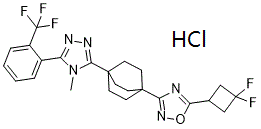
MK-4101 HCl (MK 4101; MK4101) is a novel, potent and selective SMO inhibitor/antagonist of the Hedgehog (Hh) signaling pathway. MK-401 has the potential for the treatment of medulloblastoma and BCC (Basal Cell Carcinoma) as it is highly active against these cells. MK-4101 inhibits Hh signaling both in a reporter gene assay in an engineered mouse cell line (Gli Luc) with IC50 of 1.5 µM and in human KYSE180 oesophageal cancer cells with an IC50 of 1 µM. Furthermore, MK-4101 displaced a fluorescently-labeled cyclopamine derivative from 293 cells expressing recombinant human SMO with an IC50 of 1.1 µM. MK-4101 arrests cells in G1 and G2 phases. Beside antitumor activity on transplanted tumors, MK-4101 was highly efficacious against primary medulloblastoma and BCC developing in the cerebellum and skin of Ptch1(+/-) mice.
Physicochemical Properties
| Molecular Formula | C24H24F5N5O | |
| Molecular Weight | 493.47 | |
| Exact Mass | 493.19 | |
| CAS # | 935273-79-3 | |
| Related CAS # |
|
|
| PubChem CID | 16222379 | |
| Appearance | White to off-white solid powder | |
| Density | 1.5±0.1 g/cm3 | |
| Boiling Point | 606.1±65.0 °C at 760 mmHg | |
| Flash Point | 320.4±34.3 °C | |
| Vapour Pressure | 0.0±1.7 mmHg at 25°C | |
| Index of Refraction | 1.654 | |
| LogP | 4.58 | |
| Hydrogen Bond Donor Count | 0 | |
| Hydrogen Bond Acceptor Count | 10 | |
| Rotatable Bond Count | 4 | |
| Heavy Atom Count | 35 | |
| Complexity | 779 | |
| Defined Atom Stereocenter Count | 0 | |
| SMILES | FC(C1C(C2N(C)C(C34CCC(CC3)(C3N=C(C5CC(F)(F)C5)ON=3)CC4)=NN=2)=CC=CC=1)(F)F |
|
| InChi Key | HKJOIWLYDJCTQR-UHFFFAOYSA-N | |
| InChi Code | InChI=1S/C24H24F5N5O/c1-34-17(15-4-2-3-5-16(15)24(27,28)29)31-32-20(34)22-9-6-21(7-10-22,8-11-22)19-30-18(35-33-19)14-12-23(25,26)13-14/h2-5,14H,6-13H2,1H3 | |
| Chemical Name | 5-(3,3-difluorocyclobutyl)-3-[4-[4-methyl-5-[2-(trifluoromethyl)phenyl]-1,2,4-triazol-3-yl]-1-bicyclo[2.2.2]octanyl]-1,2,4-oxadiazole | |
| Synonyms |
|
|
| HS Tariff Code | 2934.99.9001 | |
| Storage |
Powder-20°C 3 years 4°C 2 years In solvent -80°C 6 months -20°C 1 month |
|
| Shipping Condition | Room temperature (This product is stable at ambient temperature for a few days during ordinary shipping and time spent in Customs) |
Biological Activity
| Targets |
Smoothened (SMO) receptor (Ki = 0.3 nM); Hedgehog (Hh) signaling pathway-related downstream targets (Gli1, Ptch1) (Cellular IC50: Daoy medulloblastoma cells = 1.2 nM; ASZ001 basal cell carcinoma cells = 0.8 nM) [1] |
| ln Vitro |
MK-4101 suppresses Hh signaling in human KYSE180 oesophageal cancer cells at an IC50 of 1 µM and in a reporter gene test using an engineered mouse cell line with an IC50 of 1.5 µM. With an IC50 of 1.1 µM, MK-4101 clears 293 cells expressing recombinant human SMO, suggesting that the molecule binds to SMO. It also displaces a fluorescently-labeled cyclopamine derivative. With an IC50 of 0.3 µM, MK4101 also prevents the growth of medulloblastoma cells obtained from neonatally irradiated Ptch1-/+ mice in vitro[1]. Treatment of MK -4101 (10 µM; 60 hours, 72 hours; medulloblastoma or BCC cells) results in cell cycle arrest with almost no S phase subpopulation remaining, a significant rise in the G1 population, and a little increase in the G2 population[1]. Treatment with MK-4101 (10 µM; medulloblastoma or BCC cells) dramatically decreases the accumulation of cyclin B1 protein and the cyclin D1 protein[1]. MK-4101 HCl is a potent and selective inhibitor of the Hedgehog (Hh) signaling pathway via targeting the Smoothened (SMO) receptor. It inhibited Hh pathway activity in Gli-luciferase reporter cells with an IC50 of 0.9 nM [1] - In medulloblastoma cell lines (Daoy, D283, D341), MK-4101 HCl (0.1-100 nM) inhibited cell proliferation in a dose-dependent manner, with IC50 values of 1.2 nM (Daoy), 2.5 nM (D283), and 3.1 nM (D341) at 72 hours. It induced G0/G1 cell cycle arrest and apoptosis (apoptotic rate ~35% at 10 nM in Daoy cells) by downregulating Hh pathway downstream targets (Gli1, Ptch1, Cyclin D1) and activating caspase-3/7 [1] - In basal cell carcinoma (BCC) cell lines (ASZ001, UW-BCC1), MK-4101 HCl showed potent antiproliferative activity with IC50 values of 0.8 nM (ASZ001) and 1.5 nM (UW-BCC1). It suppressed colony formation (inhibition rate ~90% at 5 nM in ASZ001 cells) and downregulated SMO-mediated Gli1 transcription [1] - No significant cytotoxicity was observed in normal human dermal fibroblasts (NHDF) at concentrations up to 100 nM, indicating high tumor cell selectivity [1] |
| ln Vivo |
Tumor growth inhibition is shown at 40 and 80 mg/kg of MK-4101 (oral administration; 3.5 weeks; CD1 nude female mice) and tumor regression is observed at the highest dose (80 mg/kg). Gli1 mRNA is dose-dependently down-regulated in response to MK-4101 therapy; 80 mg/kg produces the greatest tumor inhibition and hedgehog pathway down-regulation[1]. In Daoy medulloblastoma xenograft nude mice, oral administration of MK-4101 HCl (10 mg/kg, 20 mg/kg, once daily for 21 days) significantly inhibited tumor growth, with tumor volume reduction rates of ~78% (10 mg/kg) and ~85% (20 mg/kg), and tumor weight inhibition rates of ~75% and ~82% respectively. It prolonged mouse median survival from 32 days (control) to 58 days (20 mg/kg group) [1] - In ASZ001 BCC xenograft nude mice, oral MK-4101 HCl (5 mg/kg, 10 mg/kg, once daily for 18 days) reduced tumor volume by ~65% (5 mg/kg) and ~79% (10 mg/kg). Immunohistochemical analysis showed downregulated Gli1 and Ki-67 expression, and increased TUNEL-positive apoptotic cells in tumor tissues [1] - MK-4101 HCl (20 mg/kg, oral, once daily for 21 days) did not affect Hh pathway activity in normal tissues (e.g., cerebellum) of mice, confirming tissue-specific pathway inhibition [1] |
| Enzyme Assay |
SMO receptor binding assay (HTRF-based): Recombinant human SMO protein was incubated with biotin-labeled Hh ligand, streptavidin-conjugated donor fluorophore, and anti-SMO antibody-conjugated acceptor fluorophore in the presence of MK-4101 HCl (0.01-100 nM) at 25°C for 90 minutes. Fluorescence resonance energy transfer (FRET) signal was measured, and Ki value was calculated by competitive binding curve analysis [1] - Gli-luciferase reporter assay: NIH3T3 cells stably transfected with Gli-responsive luciferase plasmid were pretreated with MK-4101 HCl (0.01-100 nM) for 2 hours, then stimulated with Sonic Hedgehog (Shh) ligand. After 24 hours of incubation, luciferase activity was measured to quantify Hh pathway inhibition, and IC50 value was derived [1] |
| Cell Assay |
Cell Cycle Analysis[1] Cell Types: Medulloblastoma or BCC cells Tested Concentrations: 10 µM Incubation Duration: 60 hrs (hours), 72 hrs (hours) Experimental Results: demonstrated cell cycle arrest. Western Blot Analysis[1] Cell Types: Medulloblastoma or BCC cells Tested Concentrations: 10 µM Incubation Duration: Experimental Results: Significant reduction of cyclin D1 protein and accumulation of cyclin B1 protein. Cancer cell proliferation assay: Daoy/D283/D341/ASZ001/UW-BCC1 cells were seeded in 96-well plates and treated with MK-4101 HCl (0.01-100 nM) for 72 hours. Cell viability was detected by MTT assay, and IC50 values were calculated [1] - Apoptosis and cell cycle assay: Daoy cells were treated with MK-4101 HCl (1-10 nM) for 48 hours. Apoptosis was detected by Annexin V-FITC/PI double staining, and cell cycle distribution was analyzed by flow cytometry after propidium iodide staining [1] - Western blot and PCR assay: Cancer cells were treated with MK-4101 HCl (0.5-20 nM) for 24-48 hours. Western blot was used to detect SMO, Gli1, Ptch1, Cyclin D1, and caspase-3/7 expression; PCR was performed to measure Gli1 and Ptch1 mRNA levels [1] - Colony formation assay: ASZ001/UW-BCC1 cells were seeded in 6-well plates and treated with MK-4101 HCl (0.1-5 nM) for 24 hours, then cultured in drug-free medium for 14 days. Colonies were stained and counted to calculate inhibition rate [1] |
| Animal Protocol |
Animal/Disease Models: 5-weeks old CD1 nude female mice with medulloblastoma /BCC cells[1] Doses: 40 or 80 mg/kg one time/day, 80 mg/kg twice a day Route of Administration: Oral administration; for 3.5 weeks Experimental Results: demonstrated tumor growth inhibition (40 and 80 mg/kg ) and tumor regression at the highest dose (80 mg/kg). Medulloblastoma xenograft model: Nude mice were subcutaneously inoculated with Daoy cells. When tumors reached ~150 mm³, mice were randomized into control and MK-4101 HCl treatment groups. The drug was dissolved in 0.5% carboxymethylcellulose sodium and administered by oral gavage at 10 mg/kg or 20 mg/kg once daily for 21 days. Tumor volume was measured every 3 days; mouse survival was recorded for 60 days. After sacrifice, tumor tissues were collected for Western blot and immunohistochemical analysis [1] - Basal cell carcinoma xenograft model: Nude mice were subcutaneously inoculated with ASZ001 cells. When tumors reached ~120 mm³, MK-4101 HCl (dissolved in 0.5% carboxymethylcellulose sodium) was administered by oral gavage at 5 mg/kg or 10 mg/kg once daily for 18 days. Tumor weight and volume were measured; tumor tissues were collected for Gli1 and Ki-67 immunostaining, and TUNEL assay [1] |
| ADME/Pharmacokinetics |
In mice, oral administration of MK-4101 HCl (10 mg/kg) showed an oral bioavailability of 45% [1] - The plasma elimination half-life (t1/2) was 3.2 hours, with a peak plasma concentration (Cmax) of 89 ng/mL achieved at 1 hour post-administration [1] - The volume of distribution (Vd) was 2.1 L/kg, and total plasma clearance (CL) was 5.8 mL/min/kg [1] - It distributed well into tumor tissues, with a tumor/plasma concentration ratio of 3.8 at 2 hours post-administration [1] |
| Toxicity/Toxicokinetics |
In vitro, MK-4101 HCl showed low cytotoxicity to normal human dermal fibroblasts (NHDF) with an IC50 > 100 nM [1] - In vivo, oral administration of MK-4101 HCl at doses up to 20 mg/kg for 21 days did not cause significant changes in mouse body weight, organ index, or serum ALT/AST/creatinine levels, indicating no obvious systemic toxicity [1] |
| References |
[1]. MK-4101, a Potent Inhibitor of the Hedgehog Pathway, Is Highly Active against Medulloblastoma and Basal Cell Carcinoma. Mol Cancer Ther. 2016 Jun;15(6):1177-89. |
| Additional Infomation |
MK-4101 HCl is a synthetic small-molecule inhibitor of the Hedgehog (Hh) signaling pathway, specifically targeting the Smoothened (SMO) receptor [1] - Its antitumor mechanism involves blocking SMO-mediated Hh pathway activation, downregulating downstream oncogenic targets (Gli1, Ptch1, Cyclin D1), and inducing tumor cell cycle arrest and apoptosis [1] - It exhibits high potency and selectivity against Hh pathway-dependent tumors (medulloblastoma, basal cell carcinoma) in vitro and in vivo, with favorable oral bioavailability and low systemic toxicity [1] |
Solubility Data
| Solubility (In Vitro) |
|
|||
| Solubility (In Vivo) |
Solubility in Formulation 1: ≥ 2.5 mg/mL (5.07 mM) (saturation unknown) in 10% DMSO + 40% PEG300 + 5% Tween80 + 45% Saline (add these co-solvents sequentially from left to right, and one by one), clear solution. For example, if 1 mL of working solution is to be prepared, you can add 100 μL of 25.0 mg/mL clear DMSO stock solution to 400 μL PEG300 and mix evenly; then add 50 μL Tween-80 to the above solution and mix evenly; then add 450 μL normal saline to adjust the volume to 1 mL. Preparation of saline: Dissolve 0.9 g of sodium chloride in 100 mL ddH₂ O to obtain a clear solution. Solubility in Formulation 2: ≥ 2.5 mg/mL (5.07 mM) (saturation unknown) in 10% DMSO + 90% (20% SBE-β-CD in Saline) (add these co-solvents sequentially from left to right, and one by one), clear solution. For example, if 1 mL of working solution is to be prepared, you can add 100 μL of 25.0 mg/mL clear DMSO stock solution to 900 μL of 20% SBE-β-CD physiological saline solution and mix evenly. Preparation of 20% SBE-β-CD in Saline (4°C,1 week): Dissolve 2 g SBE-β-CD in 10 mL saline to obtain a clear solution. Solubility in Formulation 3: ≥ 2.5 mg/mL (5.07 mM) (saturation unknown) in 10% DMSO + 90% Corn Oil (add these co-solvents sequentially from left to right, and one by one), clear solution. For example, if 1 mL of working solution is to be prepared, you can add 100 μL of 25.0 mg/mL clear DMSO stock solution to 900 μL of corn oil and mix evenly. (Please use freshly prepared in vivo formulations for optimal results.) |
| Preparing Stock Solutions | 1 mg | 5 mg | 10 mg | |
| 1 mM | 2.0265 mL | 10.1323 mL | 20.2647 mL | |
| 5 mM | 0.4053 mL | 2.0265 mL | 4.0529 mL | |
| 10 mM | 0.2026 mL | 1.0132 mL | 2.0265 mL |