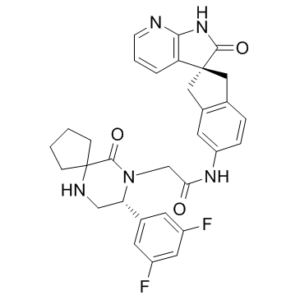
MK-3207 is a novel, potent and orally bioactive CGRP (Calcitonin gene related peptide) receptor antagonist with IC50 and Ki of 0.12 nM and 0.022 nM, it is highly selective versus human AM1, AM2, CTR, and AMY3. MK 3207 demonstrates a markedly greater affinity for the human CGRP receptor, both native and recombinant, as well as the CGRP receptor from rhesus monkeys, with Ki values of 24 pM, ~24 pM, and 22 pM, respectively, in comparison to CGRP receptors from other species, such as canines and rodents (10 nM).
Physicochemical Properties
| Molecular Formula | C31H29F2N5O3 |
| Molecular Weight | 557.590473890305 |
| Exact Mass | 557.223 |
| Elemental Analysis | C, 66.78; H, 5.24; F, 6.81; N, 12.56; O, 8.61 |
| CAS # | 957118-49-9 |
| Related CAS # | MK-3207 Hydrochloride; 957116-20-0 |
| PubChem CID | 25019940 |
| Appearance | White to off-white solid powder |
| Density | 1.5±0.1 g/cm3 |
| Boiling Point | 812.1±65.0 °C at 760 mmHg |
| Flash Point | 444.9±34.3 °C |
| Vapour Pressure | 0.0±2.9 mmHg at 25°C |
| Index of Refraction | 1.689 |
| LogP | 4.87 |
| Hydrogen Bond Donor Count | 3 |
| Hydrogen Bond Acceptor Count | 7 |
| Rotatable Bond Count | 4 |
| Heavy Atom Count | 41 |
| Complexity | 1040 |
| Defined Atom Stereocenter Count | 2 |
| SMILES | O=C1NC2N=CC=CC=2[C@@]21CC1C=CC(=CC=1C2)NC(=O)CN1C(=O)C2(CCCC2)NC[C@H]1C1C=C(F)C=C(F)C=1 |
| InChi Key | AZAANWYREOQRFB-SETSBSEESA-N |
| InChi Code | InChI=1S/C31H29F2N5O3/c32-21-10-19(11-22(33)13-21)25-16-35-31(7-1-2-8-31)29(41)38(25)17-26(39)36-23-6-5-18-14-30(15-20(18)12-23)24-4-3-9-34-27(24)37-28(30)40/h3-6,9-13,25,35H,1-2,7-8,14-17H2,(H,36,39)(H,34,37,40)/t25-,30+/m0/s1 |
| Chemical Name | 2-[(8R)-8-(3,5-difluorophenyl)-10-oxo-6,9-diazaspiro[4.5]decan-9-yl]-N-[(2R)-2'-oxospiro[1,3-dihydroindene-2,3'-1H-pyrrolo[2,3-b]pyridine]-5-yl]acetamide |
| Synonyms | MK-3207 HCl; MK3207; MK 3207 |
| HS Tariff Code | 2934.99.9001 |
| Storage |
Powder-20°C 3 years 4°C 2 years In solvent -80°C 6 months -20°C 1 month Note: Please store this product in a sealed and protected environment (e.g. under nitrogen), avoid exposure to moisture. |
| Shipping Condition | Room temperature (This product is stable at ambient temperature for a few days during ordinary shipping and time spent in Customs) |
Biological Activity
| ln Vitro | MK-3207 (0.3, 0.6, 1.1, 2.3, 4.5, 9.0 nM; 30 min) potently inhibits human α-CGRP-stimulated cAMP responses in human CGRP receptor-expressing HEK293 cells[1]. | ||
| ln Vivo |
MK-3207 (0.3, 0.6, 2.1, 9.1, 21.2, 60.6 µg/kg; i.v.; single) has an EC50 and Emax of roughly 0.8 nM and 81%, respectively, in rhesus monkeys that inhibit CIDV[1]. MK-3207 (10 mg/kg; p.o.; single) indicates a 2–3% CSF/plasma ratio[1]. |
||
| Enzyme Assay | MK-3207 and 40 pM rat amylin are combined in amylin binding assays, and then 25 μg of CTR/RAMP1 or 25 μg of CTR/RAMP3 membranes are added. The mixture is then incubated for three hours at room temperature in binding buffer (10 mM HEPES, 5 mM MgCl2, and 0.2% bovine serum albumin) in a volume of one milliliter. As the radioligand in calcitonin binding assays, 25 μg of CTR membranes are used with 30 pM 125I-human calcitonin. Filtration through GF/B 96-well filter plates blocked with 0.5% polyethylenimine ends the incubation process. Prism is utilized for data analysis, and the equation Ki=IC50/1 + ([ligand]/KD is used to calculate the Ki value. Saturation binding experiments are used to calculate the KD value for each receptor. | ||
| Cell Assay | MK-3207 exhibits a rhesus monkey receptor affinity (Ki) of 0.024±0.001 nM; n=14) that is comparable to that of humans, but its affinity for the canine and rat receptors is >400-fold lower, at 10 nM and 10±1.2 nM, respectively. With Ki values of 16,500 nM and 156±17 nM, respectively, MK-3207 exhibits high selectivity against the human AM1 (CLR/RAMP2) and AM2 (CLR/RAMP3) receptors. At 1.9±0.58 μM, MK-3207 exhibits a high level of selectivity against human CTR. With a Ki value of 128±25 nM, MK-3207 demonstrates good selectivity against the AMY3 (CTR/RAMP3) receptor as well. However, its Ki value of 0.75±0.13 nM indicates less selectivity against the AMY1 (CTR/RAMP1) receptor. In human CGRP receptor-expressing HEK293 cells, MK-3207 potently inhibits human α-CGRP-stimulated cAMP responses (IC50 value: 0.12±0.02 nM). MK-3207 exhibits a pIC50 of 7.31±0.09, indicating a significantly lower potency for the rat CGRP receptor. | ||
| Animal Protocol |
|
||
| References |
[1]. Pharmacological properties of MK-3207, a potent and orally active calcitonin gene-related peptide receptor antagonist. J Pharmacol Exp Ther. 2010 Apr;333(1):152-60. |
||
| Additional Infomation | Mk3207 has been used in trials studying the treatment of Migraine and Migraine Disorders. |
Solubility Data
| Solubility (In Vitro) |
|
|||
| Solubility (In Vivo) |
Solubility in Formulation 1: ≥ 2.5 mg/mL (4.48 mM) (saturation unknown) in 10% DMSO + 40% PEG300 + 5% Tween80 + 45% Saline (add these co-solvents sequentially from left to right, and one by one), clear solution. For example, if 1 mL of working solution is to be prepared, you can add 100 μL of 25.0 mg/mL clear DMSO stock solution to 400 μL PEG300 and mix evenly; then add 50 μL Tween-80 to the above solution and mix evenly; then add 450 μL normal saline to adjust the volume to 1 mL. Preparation of saline: Dissolve 0.9 g of sodium chloride in 100 mL ddH₂ O to obtain a clear solution. Solubility in Formulation 2: ≥ 2.5 mg/mL (4.48 mM) (saturation unknown) in 10% DMSO + 90% (20% SBE-β-CD in Saline) (add these co-solvents sequentially from left to right, and one by one), clear solution. For example, if 1 mL of working solution is to be prepared, you can add 100 μL of 25.0 mg/mL clear DMSO stock solution to 900 μL of 20% SBE-β-CD physiological saline solution and mix evenly. Preparation of 20% SBE-β-CD in Saline (4°C,1 week): Dissolve 2 g SBE-β-CD in 10 mL saline to obtain a clear solution. Solubility in Formulation 3: ≥ 2.5 mg/mL (4.48 mM) (saturation unknown) in 10% DMSO + 90% Corn Oil (add these co-solvents sequentially from left to right, and one by one), clear solution. For example, if 1 mL of working solution is to be prepared, you can add 100 μL of 25.0 mg/mL clear DMSO stock solution to 900 μL of corn oil and mix evenly. Solubility in Formulation 4: 1% DMSO +30% polyethylene glycol+1% Tween 80 : 30mg/mL (Please use freshly prepared in vivo formulations for optimal results.) |
| Preparing Stock Solutions | 1 mg | 5 mg | 10 mg | |
| 1 mM | 1.7934 mL | 8.9672 mL | 17.9343 mL | |
| 5 mM | 0.3587 mL | 1.7934 mL | 3.5869 mL | |
| 10 mM | 0.1793 mL | 0.8967 mL | 1.7934 mL |