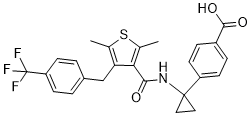
MK-2894 is a novel, potent and selective antagonist of prostaglandin E2 subtype 4 receptor (PGE2). MK-2894 exhibits a good pharmacokinetic profile in several preclinical species and strong anti-inflammatory effects in multiple animal models of inflammation and pain. Comparing MK-2894 to the conventional NSAID indomethacin, rats also exhibit a favorable GI tolerability profile.
Physicochemical Properties
| Molecular Formula | C25H22NO3F3S |
| Molecular Weight | 473.50728 |
| Exact Mass | 473.127 |
| Elemental Analysis | C, 63.41; H, 4.68; F, 12.04; N, 2.96; O, 10.14; S, 6.77 |
| CAS # | 1006036-87-8 |
| Related CAS # | MK-2894 sodium salt; 1006036-88-9; 1006036-87-8 (free acid) |
| PubChem CID | 24952929 |
| Appearance | White to light brown solid powder |
| LogP | 6.666 |
| Hydrogen Bond Donor Count | 2 |
| Hydrogen Bond Acceptor Count | 7 |
| Rotatable Bond Count | 6 |
| Heavy Atom Count | 33 |
| Complexity | 725 |
| Defined Atom Stereocenter Count | 0 |
| SMILES | O=C(O)C1=CC=C(C2(NC(C3=C(C)SC(C)=C3CC4=CC=C(C(F)(F)F)C=C4)=O)CC2)C=C1 |
| InChi Key | QJZQFVRFJCGDKF-UHFFFAOYSA-N |
| InChi Code | InChI=1S/C25H22F3NO3S/c1-14-20(13-16-3-7-19(8-4-16)25(26,27)28)21(15(2)33-14)22(30)29-24(11-12-24)18-9-5-17(6-10-18)23(31)32/h3-10H,11-13H2,1-2H3,(H,29,30)(H,31,32) |
| Chemical Name | 4-[1-[[2,5-dimethyl-4-[[4-(trifluoromethyl)phenyl]methyl]thiophene-3-carbonyl]amino]cyclopropyl]benzoic acid |
| Synonyms | MK 2894; MK-2894; MK2894 |
| HS Tariff Code | 2934.99.9001 |
| Storage |
Powder-20°C 3 years 4°C 2 years In solvent -80°C 6 months -20°C 1 month |
| Shipping Condition | Room temperature (This product is stable at ambient temperature for a few days during ordinary shipping and time spent in Customs) |
Biological Activity
| ln Vitro |
|
|
| ln Vivo |
|
|
| References |
[1]. The discovery of 4-{1-[({2,5-dimethyl-4-[4-(trifluoromethyl)benzyl]-3-thienyl}carbonyl)amino]cyclopropyl}benzoic acid (MK-2894), a potent and selective prostaglandin E2 subtype 4 receptor antagonist. J Med Chem. 2010 Mar 11;53(5):2227-38. [2]. Structural features of subtype-selective EP receptor modulators. Drug Discov Today. 2017 Jan;22(1):57-71. |
Solubility Data
| Solubility (In Vitro) | DMSO: ≥ 50 mg/mL (~105.6 mM) |
| Solubility (In Vivo) |
Solubility in Formulation 1: ≥ 2.5 mg/mL (5.28 mM) (saturation unknown) in 10% DMSO + 40% PEG300 + 5% Tween80 + 45% Saline (add these co-solvents sequentially from left to right, and one by one), clear solution. For example, if 1 mL of working solution is to be prepared, you can add 100 μL of 25.0 mg/mL clear DMSO stock solution to 400 μL PEG300 and mix evenly; then add 50 μL Tween-80 to the above solution and mix evenly; then add 450 μL normal saline to adjust the volume to 1 mL. Preparation of saline: Dissolve 0.9 g of sodium chloride in 100 mL ddH₂ O to obtain a clear solution. Solubility in Formulation 2: 2.5 mg/mL (5.28 mM) in 10% DMSO + 90% (20% SBE-β-CD in Saline) (add these co-solvents sequentially from left to right, and one by one), suspension solution; with ultrasonication. For example, if 1 mL of working solution is to be prepared, you can add 100 μL of 25.0 mg/mL clear DMSO stock solution to 900 μL of 20% SBE-β-CD physiological saline solution and mix evenly. Preparation of 20% SBE-β-CD in Saline (4°C,1 week): Dissolve 2 g SBE-β-CD in 10 mL saline to obtain a clear solution. Solubility in Formulation 3: ≥ 2.5 mg/mL (5.28 mM) (saturation unknown) in 10% DMSO + 90% Corn Oil (add these co-solvents sequentially from left to right, and one by one), clear solution. For example, if 1 mL of working solution is to be prepared, you can add 100 μL of 25.0 mg/mL clear DMSO stock solution to 900 μL of corn oil and mix evenly. (Please use freshly prepared in vivo formulations for optimal results.) |
| Preparing Stock Solutions | 1 mg | 5 mg | 10 mg | |
| 1 mM | 2.1119 mL | 10.5594 mL | 21.1189 mL | |
| 5 mM | 0.4224 mL | 2.1119 mL | 4.2238 mL | |
| 10 mM | 0.2112 mL | 1.0559 mL | 2.1119 mL |