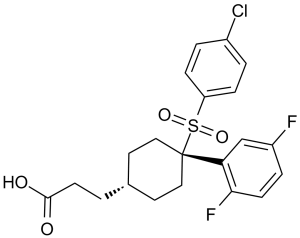
MK0752 (MK0752; MK-0752) is a novel, potent and synthetic small molecule inhibitor of γ-secretase (gamma-secretase). It has potential anti-AD (Alzheimer's disease) and antineoplastic activity, and its IC50 of 5 nM reduces the production of Aβ40.
Physicochemical Properties
| Molecular Formula | C21H21CLF2O4S | |
| Molecular Weight | 442.9 | |
| Exact Mass | 442.081 | |
| Elemental Analysis | C, 56.95; H, 4.78; Cl, 8.00; F, 8.58; O, 14.45; S, 7.24 | |
| CAS # | 471905-41-6 | |
| Related CAS # |
|
|
| PubChem CID | 9803433 | |
| Appearance | White to off-white solid powder | |
| Density | 1.4±0.1 g/cm3 | |
| Boiling Point | 616.9±55.0 °C at 760 mmHg | |
| Flash Point | 326.9±31.5 °C | |
| Vapour Pressure | 0.0±1.9 mmHg at 25°C | |
| Index of Refraction | 1.569 | |
| LogP | 4.41 | |
| Hydrogen Bond Donor Count | 1 | |
| Hydrogen Bond Acceptor Count | 6 | |
| Rotatable Bond Count | 6 | |
| Heavy Atom Count | 29 | |
| Complexity | 665 | |
| Defined Atom Stereocenter Count | 0 | |
| SMILES | O=C(CC[C@H]1CC[C@@](S(=O)(C2=CC=C(C=C2)Cl)=O)(CC1)C3=CC(F)=CC=C3F)O |
|
| InChi Key | XCGJIFAKUZNNOR-UHFFFAOYSA-N | |
| InChi Code | InChI=1S/C21H21ClF2O4S/c22-15-2-5-17(6-3-15)29(27,28)21(18-13-16(23)4-7-19(18)24)11-9-14(10-12-21)1-8-20(25)26/h2-7,13-14H,1,8-12H2,(H,25,26) | |
| Chemical Name | 3-[4-(4-chlorophenyl)sulfonyl-4-(2,5-difluorophenyl)cyclohexyl]propanoic acid | |
| Synonyms | MK0752; MK 0752; MK-0752 | |
| HS Tariff Code | 2934.99.9001 | |
| Storage |
Powder-20°C 3 years 4°C 2 years In solvent -80°C 6 months -20°C 1 month |
|
| Shipping Condition | Room temperature (This product is stable at ambient temperature for a few days during ordinary shipping and time spent in Customs) |
Biological Activity
| Targets |
Aβ (IC50 = 5 nM) MK-0752 is a potent, selective inhibitor of γ-secretase, with an IC50 of 12 nM for human Notch1 intracellular domain (NICD) cleavage and an IC50 of 15 nM for human amyloid beta-protein (Aβ42) production in cell-free assays [2] - MK-0752 shows no significant inhibition of other proteases (e.g., cathepsin G, matrix metalloproteinases) at concentrations up to 1 μM; it weakly inhibits Notch2 cleavage (IC50 = 85 nM) but has no effect on Notch3/4 cleavage [2] - In APP-transfected neuroblastoma cells, MK-0752 inhibits γ-secretase-mediated Aβ40 production with an IC50 of 18 nM [1] |
| ln Vitro |
MK-0752 has been found to be a moderately potent inhibitor of γ-secretase, reducing Aβ40 in human SH-SY5Y cells in a dose-dependent manner with an IC50 of 5 nM. (Source: ) MK-0752 prevents the cleavage of the Notch-intracellular domain (ICD) and the ensuing nuclear translocation in vitro.[2] In human colon cancer HCT116 cells (Notch-activated), treatment with 50 nM MK-0752 for 48 hours inhibited cell proliferation by ~70% (MTT assay) and induced G0/G1 cell cycle arrest (G0/G1 population increased by ~40%); flow cytometry showed ~30% apoptosis. Western blot revealed ~85% reduction in NICD levels and downregulation of Notch target genes (Hes1, Hey1: mRNA levels reduced by ~75% and ~70%, respectively, RT-PCR) [2] - In human pancreatic cancer Panc-1 cells, 100 nM MK-0752 treatment for 72 hours reduced tumor sphere formation by ~65% (spheres >50 μm counted) and inhibited cell invasion by ~60% (Matrigel invasion assay); this was associated with decreased NICD (~80% reduction) and reduced matrix metalloproteinase-2 (MMP-2: protein level reduced by ~65%, immunoblot) [2] - In SH-SY5Y neuroblastoma cells stably expressing human APP695 (Swedish mutation), 20 nM MK-0752 treatment for 48 hours reduced Aβ42 secretion by ~75% and Aβ40 secretion by ~70% (sandwich ELISA); Western blot showed a ~2.2-fold increase in APP C-terminal fragment (CTF) levels (γ-secretase substrate) with no change in total APP [1] |
| ln Vivo |
MK-0752 lowers AUV in the brains of rhesus monkeys by 90% while also reducing the production of newly formed Aβ. Furthermore, Aβ 1-17 levels are decreased while Aβ 1-14, Aβ 1-15, and Aβ 1-16 levels are increased with MK-0752 treatment. (Source: ) When given orally to guinea pigs, MK-0752 (10 mg/kg -30 mg/kg) reduces Aβ40 in plasma, brain, and cerebrospinal fluid (CSF) in a dose-dependent manner, with an IC50 of 440 nM in the brain.[2] In nude mice bearing HCT116 colon cancer xenografts (subcutaneous injection of 2×10⁶ cells), oral administration of MK-0752 at 15 mg/kg once daily for 28 days reduced tumor volume by ~60% and tumor weight by ~55% compared to vehicle; immunohistochemistry of tumor tissues showed decreased NICD-positive cells (~75% reduction) and increased cleaved caspase-3-positive cells (~2.5-fold increase) [2] - In APP-transgenic (APP-Tg) mice (Tg2576 strain), intraperitoneal injection of MK-0752 at 5 mg/kg once daily for 14 days reduced hippocampal Aβ42 levels by ~65% and cortical Aβ40 levels by ~60% (ELISA of brain homogenates); Morris water maze test showed improved cognitive function: escape latency was reduced by ~35% and time spent in target quadrant was increased by ~40% [1] |
| Enzyme Assay |
MK-0752 is a γ-secretase inhibitor of moderate potency that decreases the production of Aβ40 at an IC50 of 5 nM. γ-secretase/Notch cleavage assay (from [2] abstract description): Recombinant human γ-secretase complex was purified from HEK293 cells overexpressing presenilin-1 (PS1), nicastrin, APH-1, and PEN-2. The complex was mixed with a Notch1 C-terminal fragment (Notch1-CTF) substrate in assay buffer (50 mM Tris-HCl pH 7.2, 0.2% CHAPS, 2 mM EDTA). MK-0752 was added at concentrations ranging from 1 nM to 200 nM, and the mixture was incubated at 37°C for 3 hours. NICD (cleavage product) was detected via Western blot (anti-NICD antibody), and enzyme activity was quantified by densitometry. IC50 was calculated via 4-parameter logistic regression [2] - γ-secretase/Aβ production assay (from [1] abstract description): Crude γ-secretase extracts were prepared from SH-SY5Y/APP695 cells. Extracts were mixed with an APP C-terminal fragment (APP-CTF) substrate and MK-0752 (1 nM to 100 nM) in assay buffer (50 mM Tris-HCl pH 6.8, 0.25% CHAPS). The mixture was incubated at 37°C for 4 hours, and Aβ40/Aβ42 levels were measured via sandwich ELISA. Inhibition rates were compared to vehicle controls to determine IC50 [1] |
| Cell Assay |
MK-0752, a moderately potent γ-secretase inhibitor, exhibited dose-dependent inhibition of Aβ40 production in human SH-SY5Y cells, with an IC50 of 5 nM. HCT116 cell proliferation/apoptosis assay (from [2] abstract description): HCT116 cells were cultured in RPMI 1640 with 10% fetal bovine serum until 70% confluence. Cells were treated with MK-0752 (10 nM, 50 nM, 100 nM) for 48 hours. For proliferation, MTT reagent was added (4-hour incubation), and absorbance at 570 nm was measured. For cell cycle/apoptosis, cells were stained with propidium iodide (PI) or Annexin V-FITC/PI and analyzed by flow cytometry. For Notch signaling, cells were lysed for Western blot (anti-NICD, anti-Hes1) or RNA extracted for RT-PCR (Hes1, Hey1 primers) [2] - SH-SY5Y/APP695 cell Aβ assay (from [1] abstract description): SH-SY5Y cells stably expressing APP695 were cultured in DMEM with 10% fetal bovine serum. Cells were seeded at 1×10⁶ cells/well and treated with MK-0752 (5 nM, 20 nM, 50 nM) for 48 hours. Culture supernatants were collected to measure Aβ40/Aβ42 via sandwich ELISA. Cells were lysed in RIPA buffer, and proteins were separated by SDS-PAGE; Western blot was performed with antibodies against APP, APP CTF, and GAPDH (internal control) [1] |
| Animal Protocol |
Cisterna Magna Ported (CMP) Rhesus Monkey Model. ≤240 mg/kg Administered via p.o. Nude mouse HCT116 xenograft model (from [2] abstract description): Female BALB/c nude mice (6-8 weeks old) were subcutaneously injected with 2×10⁶ HCT116 cells (suspended in 0.1 mL PBS + 50% Matrigel) into the right flank. When tumors reached ~120 mm³, MK-0752 was dissolved in 0.5% methylcellulose (oral formulation) and administered via oral gavage at 15 mg/kg once daily for 28 days. Vehicle controls received 0.5% methylcellulose. Tumor volume (V = 0.5 × length × width²) was measured every 3 days. Mice were euthanized on day 29, tumor weight was recorded, and tumor tissues were fixed for immunohistochemistry [2] - APP-Tg mouse cognitive model (from [1] abstract description): 10-week-old male Tg2576 mice were anesthetized with isoflurane for intraperitoneal injection. MK-0752 was dissolved in 10% DMSO + 90% physiological saline (intraperitoneal formulation) and administered at 5 mg/kg once daily for 14 days. Vehicle controls received 10% DMSO/saline. On day 15, Morris water maze test was conducted to assess cognitive function; mice were euthanized after the test, and hippocampus/cortex were dissected for Aβ quantification via ELISA [1] |
| ADME/Pharmacokinetics |
In male Sprague-Dawley rats, oral administration of MK-0752 at 20 mg/kg showed an oral bioavailability of ~32%, a plasma elimination half-life (t₁/₂) of ~3.0 hours, and a peak plasma concentration (Cmax) of 210 ng/mL (reached at 1.0 hour post-dose) [2] - In Tg2576 mice, intraperitoneal injection of MK-0752 at 5 mg/kg resulted in a brain-to-plasma concentration ratio of ~0.4 (measured 2 hours post-dose), indicating moderate blood-brain barrier penetration [1] - MK-0752 has a volume of distribution (Vd) of ~1.8 L/kg in rats and ~1.5 L/kg in mice [2] |
| Toxicity/Toxicokinetics |
n a 28-day repeated-dose toxicity study in rats (oral MK-0752 at 5, 15, 45 mg/kg/day), the no-observed-adverse-effect level (NOAEL) was 15 mg/kg/day; at 45 mg/kg/day, mild gastrointestinal mucosal hyperplasia was observed in 3/5 rats (reversible after treatment cessation). Serum ALT, AST, creatinine, and BUN levels remained normal [2] - In Tg2576 mice treated with intraperitoneal MK-0752 at 5 mg/kg/day for 14 days, no significant changes in body weight (>5% of initial weight) or neuronal degeneration (cortex/hippocampus, HE staining) were observed [1] - MK-0752 shows high plasma protein binding (>95%) in human, rat, and mouse plasma (measured via ultrafiltration) [2] |
| References |
[1]. J Neurosci . 2010 May 12;30(19):6743-50. [2]. Cancer Res . 2010 Jan 15;70(2):709-18. |
| Additional Infomation |
Mk 0752 is under investigation in clinical trial NCT00572182 (MK0752 in Treating Young Patients With Recurrent or Refractory CNS Cancer). Notch Signaling Pathway Inhibitor MK0752 is a synthetic small molecule with potential antineoplastic activity. MK0752 inhibits the Notch signaling pathway, which may result in induction of growth arrest and apoptosis in tumor cells in which the Notch signaling pathway is overactivated. The Notch signaling pathway plays an important role in cell-fate determination, cell survival, and cell proliferation. MK-0752 is a small-molecule γ-secretase inhibitor developed for dual potential applications: treating Notch-activated cancers (e.g., colon, pancreatic cancer) and Alzheimer’s disease (AD, via reducing Aβ production) [1,2] - Compared to non-selective γ-secretase inhibitors, MK-0752 exhibits higher selectivity for γ-secretase (minimal off-target protease inhibition) and better oral bioavailability, supporting its in vivo preclinical and clinical development [2] - In AD preclinical models, MK-0752 reduces brain Aβ burden and improves cognitive function, while in cancer models, it inhibits tumor growth and metastasis by targeting Notch-driven cancer cell proliferation and stemness [1,2] - MK-0752 advanced to Phase I clinical trials for advanced solid tumors and Phase II trials for mild-to-moderate AD, but development was discontinued due to insufficient efficacy in AD patients and concerns about long-term Notch-related toxicity [2] |
Solubility Data
| Solubility (In Vitro) |
|
|||
| Solubility (In Vivo) |
Solubility in Formulation 1: ≥ 2.5 mg/mL (5.64 mM) (saturation unknown) in 10% DMSO + 40% PEG300 + 5% Tween80 + 45% Saline (add these co-solvents sequentially from left to right, and one by one), clear solution. For example, if 1 mL of working solution is to be prepared, you can add 100 μL of 25.0 mg/mL clear DMSO stock solution to 400 μL PEG300 and mix evenly; then add 50 μL Tween-80 to the above solution and mix evenly; then add 450 μL normal saline to adjust the volume to 1 mL. Preparation of saline: Dissolve 0.9 g of sodium chloride in 100 mL ddH₂ O to obtain a clear solution. Solubility in Formulation 2: ≥ 2.5 mg/mL (5.64 mM) (saturation unknown) in 10% DMSO + 90% (20% SBE-β-CD in Saline) (add these co-solvents sequentially from left to right, and one by one), clear solution. For example, if 1 mL of working solution is to be prepared, you can add 100 μL of 25.0 mg/mL clear DMSO stock solution to 900 μL of 20% SBE-β-CD physiological saline solution and mix evenly. Preparation of 20% SBE-β-CD in Saline (4°C,1 week): Dissolve 2 g SBE-β-CD in 10 mL saline to obtain a clear solution. Solubility in Formulation 3: ≥ 2.5 mg/mL (5.64 mM) (saturation unknown) in 10% DMSO + 90% Corn Oil (add these co-solvents sequentially from left to right, and one by one), clear solution. For example, if 1 mL of working solution is to be prepared, you can add 100 μL of 25.0 mg/mL clear DMSO stock solution to 900 μL of corn oil and mix evenly. Solubility in Formulation 4: 30% propylene glycol, 5% Tween 80, 65% D5W: 30 mg/mL (Please use freshly prepared in vivo formulations for optimal results.) |
| Preparing Stock Solutions | 1 mg | 5 mg | 10 mg | |
| 1 mM | 2.2578 mL | 11.2892 mL | 22.5785 mL | |
| 5 mM | 0.4516 mL | 2.2578 mL | 4.5157 mL | |
| 10 mM | 0.2258 mL | 1.1289 mL | 2.2578 mL |