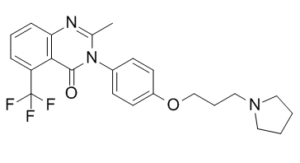
MK-0249 is a novel and potent antagonist of histamine H3 receptor with Ki of 1.7 nM for human H3. H3 antagonists increase the release of brain histamine, acetylcholine, noradrenaline, and dopamine, neurotransmitters that are known to modulate cognitive processes. The ability to release brain histamine supports the effect on attention and vigilance, but histamine also modulates other cognitive domains such as short-term and long-term memory. MK-0249 has advanced to the clinical area for the potential treatment of human cognitive disorders. H(3) antagonists exhibited wake-promoting effects in humans and efficacy in narcoleptic patients, indicating target engagement, but some of them were not efficacious in patients suffering from attention-deficit hyperactivity disorder and schizophrenic patients. Preclinical studies have also shown that H(3) antagonists activate intracellular signaling pathways that may improve cognitive efficacy and disease-modifying effects in Alzheimer's disease. Ongoing clinical studies will be able to determine the utility of H(3) antagonists for the treatment of cognitive disorders in humans.
Physicochemical Properties
| Molecular Formula | C23H24F3N3O2 |
| Molecular Weight | 431.450776100159 |
| Exact Mass | 431.182 |
| CAS # | 1167574-41-5 |
| Related CAS # | 862309-06-6; |
| PubChem CID | 11697697 |
| Appearance | Light yellow to yellow solid powder |
| LogP | 4.515 |
| Hydrogen Bond Donor Count | 0 |
| Hydrogen Bond Acceptor Count | 7 |
| Rotatable Bond Count | 6 |
| Heavy Atom Count | 31 |
| Complexity | 655 |
| Defined Atom Stereocenter Count | 0 |
| InChi Key | DDDZBLNULGDPGA-UHFFFAOYSA-N |
| InChi Code | InChI=1S/C23H24F3N3O2/c1-16-27-20-7-4-6-19(23(24,25)26)21(20)22(30)29(16)17-8-10-18(11-9-17)31-15-5-14-28-12-2-3-13-28/h4,6-11H,2-3,5,12-15H2,1H3 |
| Chemical Name | 2-methyl-3-(4-(3-(pyrrolidin-1-yl)propoxy)phenyl)-5-(trifluoromethyl)quinazolin-4(3H)-one |
| Synonyms | MK-0249; MK0249; MK 0249 |
| HS Tariff Code | 2934.99.9001 |
| Storage |
Powder-20°C 3 years 4°C 2 years In solvent -80°C 6 months -20°C 1 month |
| Shipping Condition | Room temperature (This product is stable at ambient temperature for a few days during ordinary shipping and time spent in Customs) |
Biological Activity
| ln Vitro | MK-0249 (Compound 1) is a substrate for rat P-gp but not for human P-gp, and it exhibits very good hepatic clearance values (CLh e 11 mL/min/kg)[1]. MK-0249 exhibits a strong affinity for binding human, rat, and rhesus H3 receptors, as evidenced by its respective Ki values of 6.8 ± 1.3 nM, 33 ± 3 nM, and 4.3 ± 1.2 nM[1]. High intrinsic activity is displayed by MK-0249[1]. |
| ln Vivo | The rat brain's histamine levels are raised by MK-0249 (Compound 1) (0-30 mg/kg; po; once) in a dose-dependent way[1]. In comparison to mdr1a (+/+) mice, mdr1a (-/-) mice exhibit significantly greater brain penetrability and a lower plasma Occ90 value when exposed to MK-0249 (10 mg/kg; po; once)[1]. In rodents, P-gp mediated efflux greatly limits MK-0249, whereas in humans, this efflux should be very minor or nonexistent[1]. MK-0249 exhibits rat brain permeability. |
| Animal Protocol |
Animal/Disease Models: SD rats[1] Doses: 3, 10 and 30 mg/kg Route of Administration: Oral administration, once Experimental Results: demonstrated a statistically significant increase in tele-methylhistamine levels at 30 mg/kg. Animal/Disease Models: P-gp-deficient mdr1a (-/-) and wild type mdr1a (+/+) CF-1 mice[1] Doses: 10 mg/kg Route of Administration: Oral administration, once Experimental Results: The brain-to-plasma ratio in mdr1a (-/-) mice (b/p = 14) was remarkably higher than that in SD rats (b/p = 1.1) and mdr1a (+/ +) mice (b/p = 0.8). Animal/Disease Models: Male SD (Sprague-Dawley) rats, male Beagle dogs, and male rhesus monkeys[1] Doses: 1 or 3 mg/kg Route of Administration: IV or PO (pharmacokinetic/PK Analysis) Experimental Results: pharmacokinetic/PK Parameters of 1 in Rats, Dogs, and Rhesus Monkeysa[1] |
| References | J Pharmacol Exp Ther. 2011 Jan;336(1):38-46. |
| Additional Infomation | MK0249 has been used in trials studying the treatment of Hypopnea Syndrome, Alzheimer's Disease, Paranoid Schizophrenia, Sleep Apnea, Obstructive, and Excessive Daytime Sleepiness, among others. |
Solubility Data
| Solubility (In Vitro) | May dissolve in DMSO (in most cases), if not, try other solvents such as H2O, Ethanol, or DMF with a minute amount of products to avoid loss of samples |
| Solubility (In Vivo) |
Note: Listed below are some common formulations that may be used to formulate products with low water solubility (e.g. < 1 mg/mL), you may test these formulations using a minute amount of products to avoid loss of samples. Injection Formulations (e.g. IP/IV/IM/SC) Injection Formulation 1: DMSO : Tween 80: Saline = 10 : 5 : 85 (i.e. 100 μL DMSO stock solution → 50 μL Tween 80 → 850 μL Saline) *Preparation of saline: Dissolve 0.9 g of sodium chloride in 100 mL ddH ₂ O to obtain a clear solution. Injection Formulation 2: DMSO : PEG300 :Tween 80 : Saline = 10 : 40 : 5 : 45 (i.e. 100 μL DMSO → 400 μLPEG300 → 50 μL Tween 80 → 450 μL Saline) Injection Formulation 3: DMSO : Corn oil = 10 : 90 (i.e. 100 μL DMSO → 900 μL Corn oil) Example: Take the Injection Formulation 3 (DMSO : Corn oil = 10 : 90) as an example, if 1 mL of 2.5 mg/mL working solution is to be prepared, you can take 100 μL 25 mg/mL DMSO stock solution and add to 900 μL corn oil, mix well to obtain a clear or suspension solution (2.5 mg/mL, ready for use in animals). Injection Formulation 4: DMSO : 20% SBE-β-CD in saline = 10 : 90 [i.e. 100 μL DMSO → 900 μL (20% SBE-β-CD in saline)] *Preparation of 20% SBE-β-CD in Saline (4°C,1 week): Dissolve 2 g SBE-β-CD in 10 mL saline to obtain a clear solution. Injection Formulation 5: 2-Hydroxypropyl-β-cyclodextrin : Saline = 50 : 50 (i.e. 500 μL 2-Hydroxypropyl-β-cyclodextrin → 500 μL Saline) Injection Formulation 6: DMSO : PEG300 : castor oil : Saline = 5 : 10 : 20 : 65 (i.e. 50 μL DMSO → 100 μLPEG300 → 200 μL castor oil → 650 μL Saline) Injection Formulation 7: Ethanol : Cremophor : Saline = 10: 10 : 80 (i.e. 100 μL Ethanol → 100 μL Cremophor → 800 μL Saline) Injection Formulation 8: Dissolve in Cremophor/Ethanol (50 : 50), then diluted by Saline Injection Formulation 9: EtOH : Corn oil = 10 : 90 (i.e. 100 μL EtOH → 900 μL Corn oil) Injection Formulation 10: EtOH : PEG300:Tween 80 : Saline = 10 : 40 : 5 : 45 (i.e. 100 μL EtOH → 400 μLPEG300 → 50 μL Tween 80 → 450 μL Saline) Oral Formulations Oral Formulation 1: Suspend in 0.5% CMC Na (carboxymethylcellulose sodium) Oral Formulation 2: Suspend in 0.5% Carboxymethyl cellulose Example: Take the Oral Formulation 1 (Suspend in 0.5% CMC Na) as an example, if 100 mL of 2.5 mg/mL working solution is to be prepared, you can first prepare 0.5% CMC Na solution by measuring 0.5 g CMC Na and dissolve it in 100 mL ddH2O to obtain a clear solution; then add 250 mg of the product to 100 mL 0.5% CMC Na solution, to make the suspension solution (2.5 mg/mL, ready for use in animals). Oral Formulation 3: Dissolved in PEG400 Oral Formulation 4: Suspend in 0.2% Carboxymethyl cellulose Oral Formulation 5: Dissolve in 0.25% Tween 80 and 0.5% Carboxymethyl cellulose Oral Formulation 6: Mixing with food powders Note: Please be aware that the above formulations are for reference only. InvivoChem strongly recommends customers to read literature methods/protocols carefully before determining which formulation you should use for in vivo studies, as different compounds have different solubility properties and have to be formulated differently. (Please use freshly prepared in vivo formulations for optimal results.) |
| Preparing Stock Solutions | 1 mg | 5 mg | 10 mg | |
| 1 mM | 2.3178 mL | 11.5888 mL | 23.1777 mL | |
| 5 mM | 0.4636 mL | 2.3178 mL | 4.6355 mL | |
| 10 mM | 0.2318 mL | 1.1589 mL | 2.3178 mL |