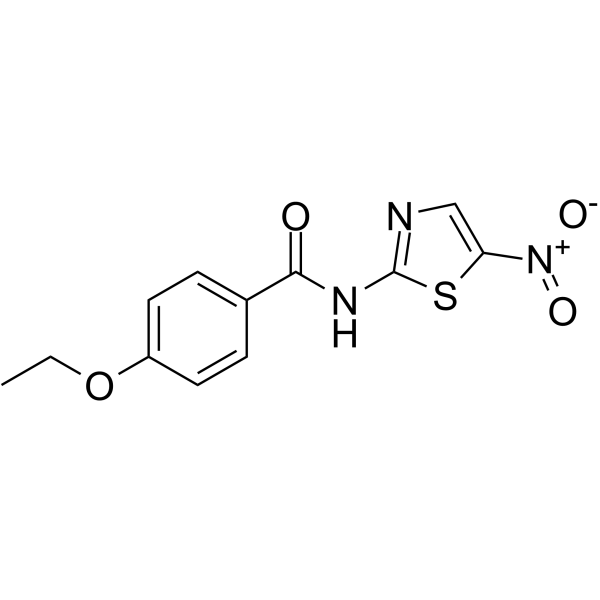
Physicochemical Properties
| Molecular Formula | C12H11N3O4S |
| Molecular Weight | 293.298441171646 |
| Exact Mass | 293.047 |
| CAS # | 312608-54-1 |
| PubChem CID | 2858708 |
| Appearance | Orange to red solid powder |
| LogP | 3.3 |
| Hydrogen Bond Donor Count | 1 |
| Hydrogen Bond Acceptor Count | 6 |
| Rotatable Bond Count | 4 |
| Heavy Atom Count | 20 |
| Complexity | 355 |
| Defined Atom Stereocenter Count | 0 |
| SMILES | S1C(=CN=C1NC(C1C=CC(=CC=1)OCC)=O)[N+](=O)[O-] |
| InChi Key | LMDLIMGAGZHZSR-UHFFFAOYSA-N |
| InChi Code | InChI=1S/C12H11N3O4S/c1-2-19-9-5-3-8(4-6-9)11(16)14-12-13-7-10(20-12)15(17)18/h3-7H,2H2,1H3,(H,13,14,16) |
| Chemical Name | 4-ethoxy-N-(5-nitro-1,3-thiazol-2-yl)benzamide |
| HS Tariff Code | 2934.99.9001 |
| Storage |
Powder-20°C 3 years 4°C 2 years In solvent -80°C 6 months -20°C 1 month |
| Shipping Condition | Room temperature (This product is stable at ambient temperature for a few days during ordinary shipping and time spent in Customs) |
Biological Activity
| ln Vitro | MID-1 (5 μM; 24 h) breaks the MG53-IRS-1 interaction, which raises the level of IRS-1 expression in skeletal muscle[1]. When NLUC-IRS-1 and CLUC-C14A are expressed in HEK 293 cells, MID-1 (10 μM; 12 h) decreases the luciferase activity[1]. In HEK 293 cells, MID-1 (1–20 μM; 12 h) interferes with the MG53–IRS-1 interaction but not the MG53–FAK interaction[1]. In HEK 293 cells, MID-1 (0.1-10 μM; 4-24 h) eliminates MG53-induced IRS-1 ubiquitination and degradation[1]. In C2C12 myotubes, MID-1 (5–10 μM; 24 h) boosts insulin signaling and insulin-elicited glucose uptake[1]. Enhances skeletal myogenesis (5–10 μM; 24 h)[1]. |
| ln Vivo | In vivo MID-1 pharmacokinetics are not good[1]. |
| Cell Assay |
Western Blot Analysis[1] Cell Types: C2C12 myotubes Tested Concentrations: 5 μM Incubation Duration: 24 h Experimental Results: Increased the IRS-1 protein level. |
| References |
[1]. MG53-IRS-1 (Mitsugumin 53-Insulin Receptor Substrate-1) Interaction Disruptor Sensitizes Insulin Signaling in Skeletal Muscle. J Biol Chem. 2016 Dec 23;291(52):26627-26635. |
Solubility Data
| Solubility (In Vitro) | DMSO: 31.25 mg/mL (106.55 mM) |
| Solubility (In Vivo) |
Solubility in Formulation 1: 2.08 mg/mL (7.09 mM) in 10% DMSO + 40% PEG300 +5% Tween-80 + 45% Saline (add these co-solvents sequentially from left to right, and one by one), suspension solution; with sonication. For example, if 1 mL of working solution is to be prepared, you can add 100 μL of 20.8 mg/mL clear DMSO stock solution to 400 μL PEG300 and mix evenly; then add 50 μL Tween-80 + to the above solution and mix evenly; then add 450 μL normal saline to adjust the volume to 1 mL. Preparation of saline: Dissolve 0.9 g of sodium chloride in 100 mL ddH₂ O to obtain a clear solution. (Please use freshly prepared in vivo formulations for optimal results.) |
| Preparing Stock Solutions | 1 mg | 5 mg | 10 mg | |
| 1 mM | 3.4095 mL | 17.0474 mL | 34.0948 mL | |
| 5 mM | 0.6819 mL | 3.4095 mL | 6.8190 mL | |
| 10 mM | 0.3409 mL | 1.7047 mL | 3.4095 mL |