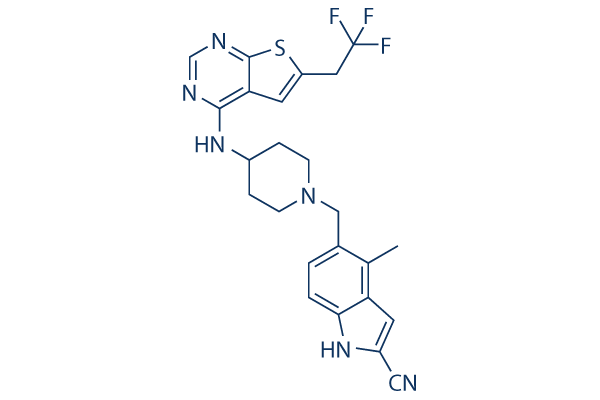
MI-463 is a novel potent & orally bioactive inhibitor of Menin-MLL interaction with an IC50 value of 15.3 nM. MI-463 can reach the target protein in mammalian cells and effectively inhibit the menin-MLL-AF9 interaction at sub-micromolar concentrations. Treatment of murine bone marrow cells (BMC) transformed with the MLL-AF9 oncogene with MI-463 results in substantial growth inhibition, with GI50 of 0.23 μM. MI-463 achieves high level in peripheral blood following a single intravenous or oral dose, while also showing high oral bioavailability (45%).
Physicochemical Properties
| Molecular Formula | C24H23F3N6S | |
| Molecular Weight | 484.54 | |
| Exact Mass | 484.165 | |
| CAS # | 1628317-18-9 | |
| Related CAS # |
|
|
| PubChem CID | 90455046 | |
| Appearance | White to light yellow solid powder | |
| Density | 1.4±0.1 g/cm3 | |
| Boiling Point | 663.2±55.0 °C at 760 mmHg | |
| Flash Point | 354.9±31.5 °C | |
| Vapour Pressure | 0.0±2.0 mmHg at 25°C | |
| Index of Refraction | 1.669 | |
| LogP | 3.88 | |
| Hydrogen Bond Donor Count | 2 | |
| Hydrogen Bond Acceptor Count | 9 | |
| Rotatable Bond Count | 5 | |
| Heavy Atom Count | 34 | |
| Complexity | 751 | |
| Defined Atom Stereocenter Count | 0 | |
| InChi Key | DZACSLYTXLZAAF-UHFFFAOYSA-N | |
| InChi Code | InChI=1S/C24H23F3N6S/c1-14-15(2-3-21-19(14)8-17(11-28)31-21)12-33-6-4-16(5-7-33)32-22-20-9-18(10-24(25,26)27)34-23(20)30-13-29-22/h2-3,8-9,13,16,31H,4-7,10,12H2,1H3,(H,29,30,32) | |
| Chemical Name | 4-methyl-5-((4-((6-(2,2,2-trifluoroethyl)thieno[2,3-d]pyrimidin-4-yl)amino)piperidin-1-yl)methyl)-1H-indole-2-carbonitrile | |
| Synonyms |
|
|
| HS Tariff Code | 2934.99.9001 | |
| Storage |
Powder-20°C 3 years 4°C 2 years In solvent -80°C 6 months -20°C 1 month |
|
| Shipping Condition | Room temperature (This product is stable at ambient temperature for a few days during ordinary shipping and time spent in Customs) |
Biological Activity
| ln Vitro | At sub-micromolar concentrations, MI-463 can efficiently block the menin-mLL-AF9 interaction by binding to the target protein in mammalian cells. When MI-463 is applied to mouse bone marrow cells (BMC) that have been transformed with the mLL-AF9 oncogene, there is a significant growth inhibition observed, with a GI50 of 0.23 μM[1]. | ||
| ln Vivo | After a single intravenous or oral dose, MI-463 exhibits a high level in peripheral blood and a high oral bioavailability of 45%. Through on-target activity, pharmacologic inhibition of the menin-mLL interaction significantly slows the progression of mLL leukemia in murine models without being toxic. MI-463 administered intraperitoneally (i.p.) once daily causes significant inhibition of tumor growth. After receiving MI-463 treatment, the expression of the genes MEIS1 and HOXA9 that are targets of mLL fusion proteins is greatly decreased. Twenty days of treatment with MI-463 in MV4;11 xenograft recipient mice also significantly delays the progression of leukemia, as evidenced by a significant decline in bioluminescence level, which is correlated with a significant reduction in the number of leukemic cells in bone marrow, spleen, and peripheral blood samples[1]. | ||
| Animal Protocol |
|
||
| References |
[1]. Pharmacologic inhibition of the Menin-MLL interaction blocks progression of MLL leukemia in vivo. Cancer Cell. 2015 Apr 13;27(4):589-602. |
Solubility Data
| Solubility (In Vitro) |
|
|||
| Solubility (In Vivo) |
Solubility in Formulation 1: ≥ 2.08 mg/mL (4.29 mM) (saturation unknown) in 10% DMSO + 40% PEG300 + 5% Tween80 + 45% Saline (add these co-solvents sequentially from left to right, and one by one), clear solution. For example, if 1 mL of working solution is to be prepared, you can add 100 μL of 20.8 mg/mL clear DMSO stock solution to 400 μL PEG300 and mix evenly; then add 50 μL Tween-80 to the above solution and mix evenly; then add 450 μL normal saline to adjust the volume to 1 mL. Preparation of saline: Dissolve 0.9 g of sodium chloride in 100 mL ddH₂ O to obtain a clear solution. Solubility in Formulation 2: 2.08 mg/mL (4.29 mM) in 10% DMSO + 90% (20% SBE-β-CD in Saline) (add these co-solvents sequentially from left to right, and one by one), suspension solution; with ultrasonication. For example, if 1 mL of working solution is to be prepared, you can add 100 μL of 20.8 mg/mL clear DMSO stock solution to 900 μL of 20% SBE-β-CD physiological saline solution and mix evenly. Preparation of 20% SBE-β-CD in Saline (4°C,1 week): Dissolve 2 g SBE-β-CD in 10 mL saline to obtain a clear solution. Solubility in Formulation 3: ≥ 2.08 mg/mL (4.29 mM) (saturation unknown) in 10% DMSO + 90% Corn Oil (add these co-solvents sequentially from left to right, and one by one), clear solution. For example, if 1 mL of working solution is to be prepared, you can add 100 μL of 20.8 mg/mL clear DMSO stock solution to 900 μL of corn oil and mix evenly. (Please use freshly prepared in vivo formulations for optimal results.) |
| Preparing Stock Solutions | 1 mg | 5 mg | 10 mg | |
| 1 mM | 2.0638 mL | 10.3191 mL | 20.6381 mL | |
| 5 mM | 0.4128 mL | 2.0638 mL | 4.1276 mL | |
| 10 mM | 0.2064 mL | 1.0319 mL | 2.0638 mL |