Physicochemical Properties
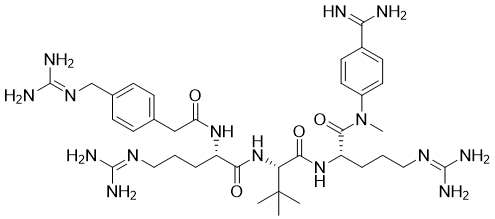
| Molecular Formula | C36H57N15O4 |
| Molecular Weight | 763.95 |
| Exact Mass | 763.4718 |
| Elemental Analysis | C, 56.60; H, 7.52; N, 27.50; O, 8.38 |
| Sequence | 4-guanidinomethyl-phenylacteyl-Arg-Tle-Arg-4-amidinobenzylamide |
| Appearance | Typically exists as solid at room temperature |
| SMILES | CC(C)(C)[C@H](NC([C@@H](NC(CC1=CC=C(C/N=C(N)\N)C=C1)=O)CCC/N=C(N)/N)=O)C(N[C@@H](CCC/N=C(N)\N)C(N(C2=CC=C(C(N)=N)C=C2)C)=O)=O |
| InChi Key | YRJQPWBZZKBQEY-UNCTUWKVSA-N |
| InChi Code | InChI=1S/C36H57N15O4/c1-36(2,3)28(31(54)49-26(8-6-18-46-34(41)42)32(55)51(4)24-15-13-23(14-16-24)29(37)38)50-30(53)25(7-5-17-45-33(39)40)48-27(52)19-21-9-11-22(12-10-21)20-47-35(43)44/h9-16,25-26,28H,5-8,17-20H2,1-4H3,(H3,37,38)(H,48,52)(H,49,54)(H,50,53)(H4,39,40,45)(H4,41,42,46)(H4,43,44,47)/t25-,26-,28+/m0/s1 |
| Chemical Name | (2S)-N-[(2S)-1-[(4-carbamimidoylphenyl)methylamino]-5-(diaminomethylideneamino)-1-oxopentan-2-yl]-2-[[(2S)-5-(diaminomethylideneamino)-2-[[2-[4-[(diaminomethylideneamino)methyl]phenyl]acetyl]amino]pentanoyl]amino]-3,3-dimethylbutanamide |
| Synonyms | MI1148; MI 1148; MI-1148 |
| HS Tariff Code | 2934.99.9001 |
| Storage |
Powder-20°C 3 years 4°C 2 years In solvent -80°C 6 months -20°C 1 month |
| Shipping Condition | Room temperature (This product is stable at ambient temperature for a few days during ordinary shipping and time spent in Customs) |
Biological Activity
| Targets | Furin |
| ln Vitro | New peptidomimetic furin inhibitors with unnatural amino acid residues in the P3 position were synthesized. The most potent compound 4-guanidinomethyl-phenylacteyl-Arg-Tle-Arg-4-amidinobenzylamide (MI-1148) inhibits furin with a Ki value of 5.5 pM. The derivatives also strongly inhibit PC1/3, whereas PC2 is less affected. Selected inhibitors were tested in cell culture for antibacterial and antiviral activity against infectious agents known to be dependent on furin activity. A significant protective effect against anthrax and diphtheria toxin was observed in the presence of the furin inhibitors. Furthermore, the spread of the highly pathogenic H5N1 and H7N1 avian influenza viruses and propagation of canine distemper virus was strongly inhibited. Inhibitor MI-1148 was crystallized in complex with human furin. Its N-terminal guanidinomethyl group in the para position of the P5 phenyl ring occupies the same position as that found previously for a structurally related inhibitor containing this substitution in the meta position, thereby maintaining all of the important P5 interactions. Our results confirm that the inhibition of furin is a promising strategy for a short-term treatment of acute infectious diseases[1]. |
| Enzyme Assay | Proprotein convertases (PCs) are involved in the pathogenesis of various diseases, making them promising drug targets. Most assays for PCs have been performed with few standard substrates, regardless of differences in cleavage efficiencies. Derived from studies on substrate-analogue inhibitors, 11 novel substrates were synthesized and characterized with five PCs. H-Arg-Arg-Tle-Lys-Arg-AMC is the most efficiently cleaved furin substrate based on its kcat/KM value. Due to its higher kcat value, acetyl-Arg-Arg-Tle-Arg-Arg-AMC was selected for further measurements to demonstrate the benefit of this improved substrate. Compared to our standard conditions, its use allowed a 10-fold reduction of the furin concentration, which enabled Ki value determinations of previously described tight-binding inhibitors under classical conditions. Under these circumstances, a slow-binding behavior was observed for the first time with inhibitor MI-1148. In addition to furin, four additional PCs were used to characterize these substrates. The most efficiently cleaved PC1/3 substrate was acetyl-Arg-Arg-Arg-Tle-Lys-Arg-AMC. The highest kcat/KM values for PC2 and PC7 were found for the N-terminally unprotected analogue of this substrate, although other substrates possess higher kcat values. The highest efficiency for PC5/6A was observed for the substrate acetyl-Arg-Arg-Tle-Lys-Arg-AMC. In summary, we have identified new substrates for furin, PC1/3, PC2, and PC7 suitable for improved enzyme-kinetic measurements[3]. |
| References |
[1]. Novel Furin Inhibitors with Potent Anti-infectious Activity. ChemMedChem . 2015 Jul;10(7):1218-31. [2]. Optimization of Substrate-Analogue Furin Inhibitors.. ChemMedChem. 2017 Dec 7;12(23):1953-1968. [3]. Design, synthesis, and characterization of novel fluorogenic substrates of the proprotein convertases furin, PC1/3, PC2, PC5/6, and PC7. Anal Biochem. 2022 Oct 15;655:114836. |
| Additional Infomation | The proprotein convertase furin is a potential target for drug design, especially for the inhibition of furin-dependent virus replication. All effective synthetic furin inhibitors identified thus far are multibasic compounds; the highest potency was found for our previously developed inhibitor 4-(guanidinomethyl)phenylacetyl-Arg-Tle-Arg-4-amidinobenzylamide (MI-1148). An initial study in mice revealed a narrow therapeutic range for this tetrabasic compound, while significantly reduced toxicity was observed for some tribasic analogues. This suggests that the toxicity depends at least to some extent on the overall multibasic character of this inhibitor. Therefore, in a first approach, the C-terminal benzamidine of MI-1148 was replaced by less basic P1 residues. Despite decreased potency, a few compounds still inhibit furin in the low nanomolar range, but display negligible efficacy in cells. In a second approach, the P2 arginine was replaced by lysine; compared to MI-1148, this furin inhibitor has slightly decreased potency, but exhibits similar antiviral activity against West Nile and Dengue virus in cell culture and decreased toxicity in mice. These results provide a promising starting point for the development of efficacious and well-tolerated furin inhibitors.[2] |
Solubility Data
| Solubility (In Vitro) | May dissolve in DMSO (in most cases), if not, try other solvents such as H2O, Ethanol, or DMF with a minute amount of products to avoid loss of samples |
| Solubility (In Vivo) |
Note: Listed below are some common formulations that may be used to formulate products with low water solubility (e.g. < 1 mg/mL), you may test these formulations using a minute amount of products to avoid loss of samples. Injection Formulations (e.g. IP/IV/IM/SC) Injection Formulation 1: DMSO : Tween 80: Saline = 10 : 5 : 85 (i.e. 100 μL DMSO stock solution → 50 μL Tween 80 → 850 μL Saline) *Preparation of saline: Dissolve 0.9 g of sodium chloride in 100 mL ddH ₂ O to obtain a clear solution. Injection Formulation 2: DMSO : PEG300 :Tween 80 : Saline = 10 : 40 : 5 : 45 (i.e. 100 μL DMSO → 400 μLPEG300 → 50 μL Tween 80 → 450 μL Saline) Injection Formulation 3: DMSO : Corn oil = 10 : 90 (i.e. 100 μL DMSO → 900 μL Corn oil) Example: Take the Injection Formulation 3 (DMSO : Corn oil = 10 : 90) as an example, if 1 mL of 2.5 mg/mL working solution is to be prepared, you can take 100 μL 25 mg/mL DMSO stock solution and add to 900 μL corn oil, mix well to obtain a clear or suspension solution (2.5 mg/mL, ready for use in animals). Injection Formulation 4: DMSO : 20% SBE-β-CD in saline = 10 : 90 [i.e. 100 μL DMSO → 900 μL (20% SBE-β-CD in saline)] *Preparation of 20% SBE-β-CD in Saline (4°C,1 week): Dissolve 2 g SBE-β-CD in 10 mL saline to obtain a clear solution. Injection Formulation 5: 2-Hydroxypropyl-β-cyclodextrin : Saline = 50 : 50 (i.e. 500 μL 2-Hydroxypropyl-β-cyclodextrin → 500 μL Saline) Injection Formulation 6: DMSO : PEG300 : castor oil : Saline = 5 : 10 : 20 : 65 (i.e. 50 μL DMSO → 100 μLPEG300 → 200 μL castor oil → 650 μL Saline) Injection Formulation 7: Ethanol : Cremophor : Saline = 10: 10 : 80 (i.e. 100 μL Ethanol → 100 μL Cremophor → 800 μL Saline) Injection Formulation 8: Dissolve in Cremophor/Ethanol (50 : 50), then diluted by Saline Injection Formulation 9: EtOH : Corn oil = 10 : 90 (i.e. 100 μL EtOH → 900 μL Corn oil) Injection Formulation 10: EtOH : PEG300:Tween 80 : Saline = 10 : 40 : 5 : 45 (i.e. 100 μL EtOH → 400 μLPEG300 → 50 μL Tween 80 → 450 μL Saline) Oral Formulations Oral Formulation 1: Suspend in 0.5% CMC Na (carboxymethylcellulose sodium) Oral Formulation 2: Suspend in 0.5% Carboxymethyl cellulose Example: Take the Oral Formulation 1 (Suspend in 0.5% CMC Na) as an example, if 100 mL of 2.5 mg/mL working solution is to be prepared, you can first prepare 0.5% CMC Na solution by measuring 0.5 g CMC Na and dissolve it in 100 mL ddH2O to obtain a clear solution; then add 250 mg of the product to 100 mL 0.5% CMC Na solution, to make the suspension solution (2.5 mg/mL, ready for use in animals). Oral Formulation 3: Dissolved in PEG400 Oral Formulation 4: Suspend in 0.2% Carboxymethyl cellulose Oral Formulation 5: Dissolve in 0.25% Tween 80 and 0.5% Carboxymethyl cellulose Oral Formulation 6: Mixing with food powders Note: Please be aware that the above formulations are for reference only. InvivoChem strongly recommends customers to read literature methods/protocols carefully before determining which formulation you should use for in vivo studies, as different compounds have different solubility properties and have to be formulated differently. (Please use freshly prepared in vivo formulations for optimal results.) |
| Preparing Stock Solutions | 1 mg | 5 mg | 10 mg | |
| 1 mM | 1.3090 mL | 6.5449 mL | 13.0899 mL | |
| 5 mM | 0.2618 mL | 1.3090 mL | 2.6180 mL | |
| 10 mM | 0.1309 mL | 0.6545 mL | 1.3090 mL |