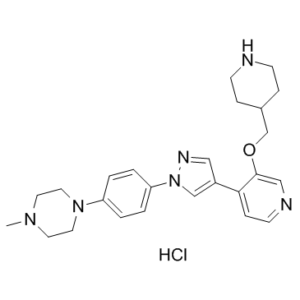
MELK-8a HCl is a novel, highly potent and selective MELK (Maternal Embryonic Leucine Zipper Kinase) inhibitor. MELK kinase has been suggested to be a key player in the development of tumors. A subset of basal-like breast cancer cell lines with high MELK expression experience growth inhibition as a result of genetic MELK depletion. MELK is involved in the regulation of cell cycle. Short hairpin ribonucleic acid (shRNA)-mediated MELK knockdown in cellular models is recapitulated by MELK inhibitors 8a. It was discovered that a novel hydrophobic collapse caused by fluorine locked the ligand in its bioactive conformation and produced a 20-fold increase in potency. These brand-new pharmacological inhibitors had a good safety profile and high levels of in vivo exposure, which may open the door for more in vivo testing.
Physicochemical Properties
| Molecular Formula | C25H33CLN6O | |
| Molecular Weight | 469.022124052048 | |
| Exact Mass | 468.24 | |
| Elemental Analysis | C, 64.02; H, 7.09; Cl, 7.56; N, 17.92; O, 3.41 | |
| CAS # | 2096992-20-8 | |
| Related CAS # | MELK-8a;1922153-17-0 | |
| PubChem CID | 126843227 | |
| Appearance | Light yellow to yellow solid powder | |
| Hydrogen Bond Donor Count | 2 | |
| Hydrogen Bond Acceptor Count | 6 | |
| Rotatable Bond Count | 6 | |
| Heavy Atom Count | 33 | |
| Complexity | 557 | |
| Defined Atom Stereocenter Count | 0 | |
| InChi Key | AFGMSRRNYDSRPT-UHFFFAOYSA-N | |
| InChi Code | InChI=1S/C25H32N6O.ClH/c1-29-12-14-30(15-13-29)22-2-4-23(5-3-22)31-18-21(16-28-31)24-8-11-27-17-25(24)32-19-20-6-9-26-10-7-20;/h2-5,8,11,16-18,20,26H,6-7,9-10,12-15,19H2,1H3;1H | |
| Chemical Name | 1-methyl-4-[4-[4-[3-(piperidin-4-ylmethoxy)pyridin-4-yl]pyrazol-1-yl]phenyl]piperazine;hydrochloride | |
| Synonyms |
|
|
| HS Tariff Code | 2934.99.9001 | |
| Storage |
Powder-20°C 3 years 4°C 2 years In solvent -80°C 6 months -20°C 1 month Note: Please store this product in a sealed and protected environment, avoid exposure to moisture. |
|
| Shipping Condition | Room temperature (This product is stable at ambient temperature for a few days during ordinary shipping and time spent in Customs) |
Biological Activity
| Targets |
MELK (IC50 = 2 nM)
Maternal Embryonic Leucine Zipper Kinase (MELK) (IC₅₀=0.9 nM in recombinant kinase assay; Ki=0.3 nM by SPR binding assay) [1] |
| ln Vitro |
MELK-8a remains very potent (IC50=140 nM) when the ATP concentration in the biochemical assay is shifted from 20 μM to 2 mM. The difference in potency between the catalytic domain construct and full-length MELK (5 nM versus 2 nM) is clearly visible. In addition to MELK, it only inhibits seven other off-target kinases, showing excellent selectivity with >85% binding inhibition at 1 μM . MELK-8a HCl is a highly potent and selective ATP-competitive inhibitor of MELK, with minimal cross-reactivity against a panel of 468 human kinases (selectivity score S₁₀=0.01, indicating >99% selectivity for MELK) [1] - It potently inhibits recombinant human MELK kinase activity, with an IC₅₀ of 0.9 nM in a HTRF-based kinase assay and a Ki of 0.3 nM determined by surface plasmon resonance (SPR) binding analysis [1] - Exhibits dose-dependent antiproliferative activity against MELK-overexpressing cancer cell lines: GI₅₀ values are 0.12 μM (triple-negative breast cancer (TNBC) cell line MDA-MB-468), 0.18 μM (TNBC cell line BT-549), 0.25 μM (colorectal cancer cell line HCT-116), 0.31 μM (ovarian cancer cell line SKOV3), and 0.45 μM (pancreatic cancer cell line PANC-1); cells with low MELK expression (e.g., MCF-7, GI₅₀=5.8 μM) show reduced sensitivity [1] - Induces cell cycle arrest at the G₂/M phase in MDA-MB-468 cells: treatment with 0.2 μM MELK-8a HCl for 24 hours increases the G₂/M population from 18% to 42% compared to vehicle control, accompanied by downregulation of Cyclin B1 and Cdc25C mRNA and protein levels [1] - Promotes apoptosis in MELK-overexpressing cancer cells: Annexin V/PI staining shows that 0.5 μM treatment for 48 hours increases apoptotic rates of MDA-MB-468 and BT-549 cells to 38% and 32%, respectively (vs 6% and 5% in vehicle controls); Western blot detects cleavage of Caspase-3 and PARP [1] - Inhibits MELK-mediated downstream signaling: 0.1–1 μM MELK-8a HCl dose-dependently reduces phosphorylation of STAT3 (Tyr705) and BAD (Ser112) in MDA-MB-468 cells, while total STAT3 and BAD levels remain unchanged [1] - Suppresses colony formation of MDA-MB-468 cells: 0.05–0.2 μM MELK-8a HCl reduces colony formation efficiency by 40–75% compared to vehicle control after 14 days of culture [1] - Knockdown of MELK by siRNA in MDA-MB-468 cells reduces sensitivity to MELK-8a HCl (GI₅₀ increases from 0.12 μM to 1.8 μM), confirming that antiproliferative activity is MELK-dependent [1] |
| ln Vivo |
In C57BL/6 mice, plasma exposure from the subcutaneous administration of MELK-8a at 30 mg/kg is good. Peak plasma concentration reaches 6.6 M and compound adsorption into the systemic circulation occurs quickly (Tmax=0.4 h). According to an ascending dose PK study done on female athymic nude mice, all clearance mechanisms can be saturated at 240 mg/kg, where the rate of compound release is at its maximum. On the other hand, it exhibits very poor PK (3.6% oral bioavailability) in C57BL/6 male mouse models when given orally at a dose of 10 mg/kg[1]. In MDA-MB-468 (TNBC) xenograft model (BALB/c nude mice): Oral administration of MELK-8a HCl at 25 mg/kg, 50 mg/kg, and 100 mg/kg twice daily (BID) for 21 days results in dose-dependent tumor growth inhibition (TGI) of 56%, 78%, and 91%, respectively; the 100 mg/kg BID group achieves partial tumor regression (PR) in 3/6 mice [1] - Pharmacodynamic analysis in xenograft tumors: Treatment with 50 mg/kg BID MELK-8a HCl for 7 days reduces MELK kinase activity by 65% and decreases p-STAT3 (Tyr705) and Cyclin B1 protein levels by 58% and 62%, respectively, compared to vehicle control [1] - No significant weight loss (<5%) is observed in any treatment group, indicating good in vivo tolerability [1] |
| Enzyme Assay |
Recombinant MELK kinase activity assay (HTRF-based): Recombinant human MELK kinase is diluted in assay buffer (50 mM Tris-HCl pH 7.5, 10 mM MgCl₂, 1 mM EGTA, 0.01% BSA, 1 mM DTT). Serial 3-fold dilutions of MELK-8a HCl (0.001–10 nM) are mixed with the kinase and pre-incubated for 30 minutes at room temperature. The reaction is initiated by adding ATP (final concentration 5 μM) and biotinylated peptide substrate (final concentration 2 μM), followed by incubation at 37°C for 60 minutes. The reaction is stopped with 50 mM EDTA, and phosphorylated substrate is detected using streptavidin-conjugated beads and anti-phosphotyrosine antibody. Fluorescence intensity is measured, and IC₅₀ values are calculated via nonlinear regression [1] - SPR binding assay: Recombinant human MELK kinase domain is immobilized on a sensor chip. Serial 2-fold dilutions of MELK-8a HCl (0.01–100 nM) are injected over the chip surface in running buffer (10 mM HEPES pH 7.4, 150 mM NaCl, 0.05% Tween 20). Binding affinity (Ki) is determined by analyzing sensorgrams using steady-state affinity models [1] - Kinase selectivity panel assay: MELK-8a HCl is tested at 1 μM against a panel of 468 recombinant human kinases using a radiometric kinase assay. Selectivity score S₁₀ (fraction of kinases inhibited >90%) is calculated to evaluate off-target activity [1] |
| Cell Assay |
MDA-MB-468 and MCF7 cells are seeded at 1000 and 4000 cells/well in 96-well plates of growth medium, respectively. MELK-8a is added 16 hours after plating and is incubated for 7 days. The ATPLite reagent is added to each well and then incubated. A multi-label plate reader is used to measure luminescence[1]. Cancer cell antiproliferation assay: MELK-overexpressing and low-expressing cancer cell lines are seeded in 96-well plates (5×10³ cells/well) and incubated overnight. Serial 3-fold dilutions of MELK-8a HCl (0.001–10 μM) are added, and cells are cultured for 72 hours. Cell viability is detected by MTS assay, and GI₅₀ values are calculated [1] - Cell cycle analysis: MDA-MB-468 cells are seeded in 6-well plates (2×10⁵ cells/well) and treated with MELK-8a HCl (0.05–0.5 μM) for 24 hours. Cells are harvested, fixed with 70% ethanol, stained with propidium iodide (PI), and analyzed by flow cytometry to determine cell cycle distribution [1] - Apoptosis assay: MDA-MB-468 and BT-549 cells are treated with MELK-8a HCl (0.1–1 μM) for 48 hours, harvested, stained with Annexin V-FITC and PI, and analyzed by flow cytometry to quantify apoptotic rates [1] - Western blot for signaling pathways: Cancer cells are treated with MELK-8a HCl (0.05–1 μM) for 24 hours, lysed, and proteins are separated by SDS-PAGE. Membranes are probed with antibodies against p-STAT3 (Tyr705), STAT3, p-BAD (Ser112), BAD, Cyclin B1, Cdc25C, cleaved Caspase-3, cleaved PARP, and β-actin [1] - Clone formation assay: MDA-MB-468 cells are seeded in 6-well plates (500 cells/well) and incubated overnight. MELK-8a HCl (0.05–0.2 μM) is added, and cells are cultured for 14 days. Colonies are fixed with methanol, stained with crystal violet, and counted; colony formation efficiency is calculated relative to vehicle control [1] - MELK siRNA knockdown assay: MDA-MB-468 cells are transfected with MELK-specific siRNA or scrambled siRNA. After 48 hours of transfection, cells are treated with MELK-8a HCl (0.01–10 μM) for 72 hours. Cell viability is detected by MTS assay, and GI₅₀ values are compared between knockdown and control cells [1] |
| Animal Protocol |
Mice: The intravenous and oral doses are prepared in a solution containing 5% ethanol, 100% PG, 5% CremophorEL, and 80% PBS for pharmacokinetic studies. The formulation for the subcutaneous dose is 10% PG and 25% (20%, v/v) Solutol. Prior to MELK-8a analysis, plasma samples are collected at predetermined intervals and kept frozen (20 °C). MELK-8a drug levels in plasma are quantified using an LC-MS/MS technique[1]. MDA-MB-468 TNBC xenograft model: BALB/c nude mice (6–8 weeks old) are subcutaneously implanted with 5×10⁶ MDA-MB-468 cells (suspended in 50% Matrigel/PBS) into the right flank. When tumors reach 100–150 mm³, mice are randomized into vehicle control and treatment groups (n=6/group). MELK-8a HCl is formulated in 0.5% carboxymethylcellulose sodium (CMC-Na) + 0.1% Tween 80 and administered orally at 25 mg/kg, 50 mg/kg, or 100 mg/kg twice daily for 21 days. Vehicle control mice receive the same volume of 0.5% CMC-Na + 0.1% Tween 80. Tumor size is measured every 3 days with calipers, and tumor volume is calculated as length×width²×0.5 [1] - Pharmacodynamic sampling: Mice bearing MDA-MB-468 xenografts are treated with MELK-8a HCl 50 mg/kg BID for 7 days. Tumors are harvested at study end, frozen in liquid nitrogen, and analyzed by Western blot for p-STAT3, Cyclin B1, and total MELK levels; MELK kinase activity is measured using a HTRF-based kinase assay [1] - In vivo tolerability monitoring: Body weight of mice is measured twice weekly; general health status (activity, food intake, diarrhea) is observed daily throughout the study [1] |
| ADME/Pharmacokinetics |
Oral bioavailability: 58% in rats (10 mg/kg oral), 65% in dogs (5 mg/kg oral) [1] - Plasma pharmacokinetics: In rats, oral administration of 10 mg/kg results in Cmax=2.8 μg/mL, AUC₀–24h=18.5 μg·h/mL, and terminal half-life (t₁/₂)=6.3 hours; intravenous administration (2 mg/kg) shows Vd=2.1 L/kg and CL=0.15 L/h/kg [1] - In dogs, oral 5 mg/kg gives Cmax=1.9 μg/mL, AUC₀–24h=14.2 μg·h/mL, and t₁/₂=8.7 hours [1] - Plasma protein binding rate: 92–94% in human, rat, and dog plasma (equilibrium dialysis, 0.1–10 μg/mL) [1] - Metabolism: Metabolized primarily by cytochrome P450 3A4 (CYP3A4) in human liver microsomes; one major metabolite (M1) is identified, with MELK inhibitory potency 30-fold lower than the parent drug [1] |
| Toxicity/Toxicokinetics |
Acute toxicity (mice): Single oral dose of 300 mg/kg MELK-8a HCl causes no mortality or severe toxicity; mild transient diarrhea is observed in 2/6 mice [1] - Subchronic toxicity (rats, 28 days): Oral doses up to 100 mg/kg BID show no significant changes in body weight, food intake, or hematological/biochemical parameters (ALT, AST, BUN, creatinine); no histopathological abnormalities are found in major organs (liver, kidney, heart, lung) [1] - No significant inhibition of CYP450 enzymes (CYP1A2, CYP2C9, CYP2C19, CYP2D6, CYP3A4) at concentrations up to 10 μM [1] |
| References |
[1]. Toward the Validation of Maternal Embryonic Leucine Zipper Kinase: Discovery, Optimization of Highly Potent and Selective Inhibitors, and Preliminary Biology Insight. J Med Chem. 2016 May 26;59(10):4711-23. |
| Additional Infomation |
MELK-8a HCl is a highly potent and selective small-molecule inhibitor of MELK, developed to validate MELK as a therapeutic target for cancer treatment [1] - MELK (Maternal Embryonic Leucine Zipper Kinase) is overexpressed in various human cancers (e.g., triple-negative breast cancer, colorectal cancer, ovarian cancer) and plays a critical role in regulating cell cycle progression, apoptosis, and cancer cell stemness [1] - Its mechanism of action involves ATP-competitive binding to the MELK kinase domain, inhibiting MELK catalytic activity and downstream signaling pathways (STAT3/BAD and Cyclin B1/Cdc25C), leading to G₂/M cell cycle arrest and apoptosis in MELK-overexpressing cancer cells [1] - The high selectivity for MELK minimizes off-target effects, and favorable pharmacokinetic properties (good oral bioavailability, moderate half-life, high plasma protein binding) support its potential for clinical development [1] - Preclinical data in TNBC xenograft models demonstrate robust antitumor efficacy and good tolerability, suggesting that MELK-8a HCl could be a promising therapeutic agent for MELK-overexpressing cancers, particularly triple-negative breast cancer [1] |
Solubility Data
| Solubility (In Vitro) |
|
|||
| Solubility (In Vivo) |
Solubility in Formulation 1: 50 mg/mL (106.61 mM) in PBS (add these co-solvents sequentially from left to right, and one by one), clear solution; with sonication. (Please use freshly prepared in vivo formulations for optimal results.) |
| Preparing Stock Solutions | 1 mg | 5 mg | 10 mg | |
| 1 mM | 2.1321 mL | 10.6605 mL | 21.3211 mL | |
| 5 mM | 0.4264 mL | 2.1321 mL | 4.2642 mL | |
| 10 mM | 0.2132 mL | 1.0661 mL | 2.1321 mL |