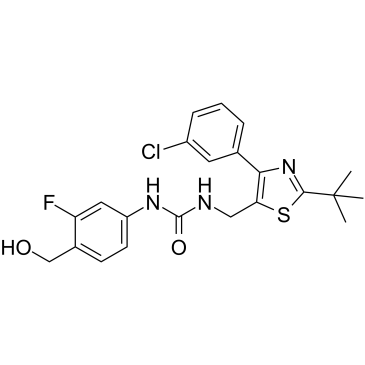
MDR-652 is a novel and highly specific and efficacious transient receptor potential vanilloid 1 (TRPV1) ligand with agonist activity. The Kis are 11.4 and 23.8 nM for hTRPV1 and rTRPV1, respectively. The EC50s are 5.05 and 93 nM for hTRPV1 and rTRPV1, respectively. agonist discovered to be a strong topical analgesic.
Physicochemical Properties
| Molecular Formula | C22H23CLFN3O2S |
| Molecular Weight | 447.9533 |
| Exact Mass | 447.118 |
| Elemental Analysis | C, 58.99; H, 5.18; Cl, 7.91; F, 4.24; N, 9.38; O, 7.14; S, 7.16 |
| CAS # | 1933528-96-1 |
| Related CAS # | 1933528-96-1; |
| PubChem CID | 121364823 |
| Appearance | Off-white to light yellow solid powder |
| LogP | 4.7 |
| Hydrogen Bond Donor Count | 3 |
| Hydrogen Bond Acceptor Count | 5 |
| Rotatable Bond Count | 6 |
| Heavy Atom Count | 30 |
| Complexity | 579 |
| Defined Atom Stereocenter Count | 0 |
| InChi Key | HKMPJRGWSUCANB-UHFFFAOYSA-N |
| InChi Code | InChI=1S/C22H23ClFN3O2S/c1-22(2,3)20-27-19(13-5-4-6-15(23)9-13)18(30-20)11-25-21(29)26-16-8-7-14(12-28)17(24)10-16/h4-10,28H,11-12H2,1-3H3,(H2,25,26,29) |
| Chemical Name | 1-((2-(tert-butyl)-4-(3-chlorophenyl)thiazol-5-yl)methyl)-3-(3-fluoro-4-(hydroxymethyl)phenyl)urea |
| Synonyms | MDR-652 MDR652 MDR 652 |
| HS Tariff Code | 2934.99.9001 |
| Storage |
Powder-20°C 3 years 4°C 2 years In solvent -80°C 6 months -20°C 1 month |
| Shipping Condition | Room temperature (This product is stable at ambient temperature for a few days during ordinary shipping and time spent in Customs) |
Biological Activity
| Targets |
MDR-652 targets the transient receptor potential vanilloid 1 (TRPV1) channel, acting as a nonpungent agonist with an EC50 of 3.2 μM for human TRPV1 activation and 4.5 μM for mouse TRPV1 [1] It shows >100-fold selectivity over other TRP channels (TRPV2, TRPV3, TRPA1, TRPM8) with EC50 > 300 μM [1] |
| ln Vitro |
In HEK293 cells stably expressing human TRPV1, MDR-652 (0.1-30 μM) dose-dependently induced intracellular calcium influx, with an EC50 of 3.2 μM; the maximum response was ~85% of capsaicin (positive control) [1] - Unlike capsaicin, MDR-652 did not induce pungency-related TRPV1-mediated currents in dorsal root ganglion (DRG) neurons at concentrations up to 30 μM, as measured by patch-clamp electrophysiology [1] - The compound (10 μM, 30 min) desensitized TRPV1 channels in DRG neurons: subsequent stimulation with capsaicin (1 μM) induced a 78% reduction in calcium influx compared to non-desensitized neurons [1] - MDR-652 showed no significant cytotoxicity to HEK293-TRPV1 cells or primary DRG neurons at concentrations up to 100 μM (MTT assay) [1] |
| ln Vivo |
MDR-652 (0.5 and 5 mg/kg) demonstrated a drop in body temperature that was dose-dependent, corroborating the idea that in intact animals, MDR-652 exhibits TRPV1 agonism [1]. MDR-652 (5–10 mg/kg; intraperitoneal and subcutaneous injection) exhibits 100% maximum potential effect (MPE) in blocking neuropathic pain [1]. Good local pharmacokinetic properties are possessed by MDR-652 [1]. It doesn't seem that MDR-652 is harmful. The LD50 of MDR-652 given intraperitoneally (i.p.) and topically (po) exceeded 200 and 2000 mg/kg, respectively, in single-dose toxicity investigations [1]. In the mouse hot plate test (thermal pain model), topical application of MDR-652 (0.5%, 1%, 2% w/w) on the hind paw dose-dependently increased the thermal pain threshold: the 2% formulation prolonged the latency time from ~10 s (vehicle) to ~28 s at 1 hour post-application, with analgesic effect lasting for 6 hours [1] - In the mouse formalin test (inflammatory pain model), topical administration of MDR-652 (2% w/w) reduced the licking/biting response in the late phase (15-30 min post-formalin) by 62% compared to vehicle control; it had no effect on the early phase (0-5 min) [1] - In a rat chronic constriction injury (CCI) model of neuropathic pain, topical application of MDR-652 (2% w/w) once daily for 7 days significantly reduced mechanical allodynia: the paw withdrawal threshold increased from ~6 g (vehicle) to ~18 g at day 7, with no signs of local irritation (erythema/edema score = 0) [1] |
| Enzyme Assay |
TRPV1 activation assay (calcium influx): HEK293 cells stably expressing human/mouse TRPV1 were loaded with Fluo-4 AM dye. Serial dilutions of MDR-652 were added, and intracellular calcium levels were measured by a fluorescence plate reader (excitation 485 nm, emission 535 nm). EC50 values were calculated by fitting the dose-response curves of fluorescence intensity [1] - TRPV1 selectivity assay: HEK293 cells expressing TRPV2, TRPV3, TRPA1, or TRPM8 were subjected to the same calcium influx assay with MDR-652 (0.1-500 μM) to evaluate cross-reactivity [1] |
| Cell Assay |
DRG neuron patch-clamp assay: Primary DRG neurons were isolated from mice, and whole-cell patch-clamp recordings were performed. MDR-652 (0.1-30 μM) was applied to the bath solution, and TRPV1-mediated inward currents were recorded to assess pungency-related activity (compared to capsaicin) [1] - TRPV1 desensitization assay: DRG neurons were pre-treated with MDR-652 (10 μM) for 30 min, then stimulated with capsaicin (1 μM). Calcium influx was measured to quantify desensitization efficiency [1] - Cytotoxicity assay: HEK293-TRPV1 cells or primary DRG neurons were seeded in 96-well plates, treated with MDR-652 (0.1-100 μM) for 24 hours, and cell viability was assessed by MTT assay [1] |
| Animal Protocol |
Animal/Disease Models: ICR mice [1] Doses: 0.5 and 5 mg/kg Route of Administration: intraperitonealadministration; 7 hrs (hrs (hours)) Experimental Results: Body temperature diminished in a dose-dependent manner. Animal/Disease Models: Rat spinal nerve ligation (SNL) model [1] Doses: 1, 2, 5, 10 mg/kg Route of Administration: intraperitonealand subcutaneous injection; 24-hour Experimental Results: intraperitonealadministration demonstrated excellent dosage Dependent analgesic properties, ED50 is 0.5-2 mg/kg. subcutaneous injection also demonstrated excellent analgesic effects, with maximal effects occurring 30 minutes after administration. Mouse hot plate test: Female ICR mice (20-25 g) were acclimated to the hot plate (55°C) for 3 days. MDR-652 was formulated in 10% ethanol, 30% propylene glycol, and 60% water (vehicle) at 0.5%, 1%, 2% w/w. The test formulation (50 μL) was topically applied to the right hind paw. Latency to paw withdrawal was measured at 0.5, 1, 2, 4, 6 hours post-application [1] - Mouse formalin test: Mice were given a subcutaneous injection of 20 μL 5% formalin into the right hind paw. MDR-652 (2% w/w, 50 μL) was topically applied 30 min before formalin injection. The total time of paw licking/biting was recorded in the early (0-5 min) and late (15-30 min) phases [1] - Rat CCI neuropathic pain model: Male Sprague-Dawley rats (200-250 g) underwent CCI surgery on the sciatic nerve. Seven days post-surgery, MDR-652 (2% w/w, 100 μL) was topically applied to the injured paw once daily for 7 days. Mechanical allodynia was assessed using von Frey filaments, and local skin irritation was scored (0-4 scale) [1] |
| ADME/Pharmacokinetics |
In rats, topical application of MDR-652 (2% w/w, 100 μL) resulted in minimal systemic absorption: plasma concentration was <10 ng/mL at all time points (0.5-24 hours post-application) [1] - Skin penetration study: Ex vivo human skin was mounted in Franz diffusion cells. MDR-652 (2% w/w) was applied to the stratum corneum, and receptor fluid was collected over 24 hours. The cumulative amount of MDR-652 penetrating the skin was 12.5 μg/cm², with a flux rate of 0.52 μg/cm²/h [1] |
| Toxicity/Toxicokinetics |
In a 14-day repeated topical toxicity study in rats, MDR-652 (2% w/w, once daily) caused no local skin irritation (erythema/edema score = 0) or systemic toxicity (no changes in body weight, hematology, or liver/kidney function) [1] - The compound did not induce TRPV1-mediated pungency in a human skin patch test (2% w/w, 24 hours): no volunteers reported burning, stinging, or pruritus [1] |
| References |
[1]. Discovery of Nonpungent Transient Receptor Potential Vanilloid 1 (TRPV1) Agonist as Strong Topical Analgesic. J Med Chem. 2020 Jan 9;63(1):418-424. |
| Additional Infomation |
MDR-652 is a nonpungent TRPV1 agonist developed as a topical analgesic for the treatment of acute and chronic pain (e.g., inflammatory pain, neuropathic pain) [1] - Its mechanism of action involves selective activation and subsequent desensitization of TRPV1 channels on sensory neurons, which blocks pain signal transmission without inducing the pungency associated with capsaicin [1] - The nonpungent property is attributed to its distinct binding mode to TRPV1: it interacts with the channel’s vanilloid binding pocket but does not trigger the conformational change responsible for pungency [1] - It exhibits favorable topical bioavailability, minimal systemic absorption, and good safety profile, supporting its potential as a clinical candidate for localized pain management [1] |
Solubility Data
| Solubility (In Vitro) | DMSO : ~250 mg/mL (~558.10 mM) |
| Solubility (In Vivo) |
Solubility in Formulation 1: ≥ 6.25 mg/mL (13.95 mM) (saturation unknown) in 10% DMSO + 40% PEG300 + 5% Tween80 + 45% Saline (add these co-solvents sequentially from left to right, and one by one), clear solution. For example, if 1 mL of working solution is to be prepared, you can add 100 μL of 62.5 mg/mL clear DMSO stock solution to 400 μL PEG300 and mix evenly; then add 50 μL Tween-80 to the above solution and mix evenly; then add 450 μL normal saline to adjust the volume to 1 mL. Preparation of saline: Dissolve 0.9 g of sodium chloride in 100 mL ddH₂ O to obtain a clear solution. Solubility in Formulation 2: ≥ 6.25 mg/mL (13.95 mM) (saturation unknown) in 10% DMSO + 90% Corn Oil (add these co-solvents sequentially from left to right, and one by one), clear solution. For example, if 1 mL of working solution is to be prepared, you can add 100 μL of 62.5 mg/mL clear DMSO stock solution to 900 μL corn oil and mix evenly. (Please use freshly prepared in vivo formulations for optimal results.) |
| Preparing Stock Solutions | 1 mg | 5 mg | 10 mg | |
| 1 mM | 2.2324 mL | 11.1620 mL | 22.3239 mL | |
| 5 mM | 0.4465 mL | 2.2324 mL | 4.4648 mL | |
| 10 mM | 0.2232 mL | 1.1162 mL | 2.2324 mL |