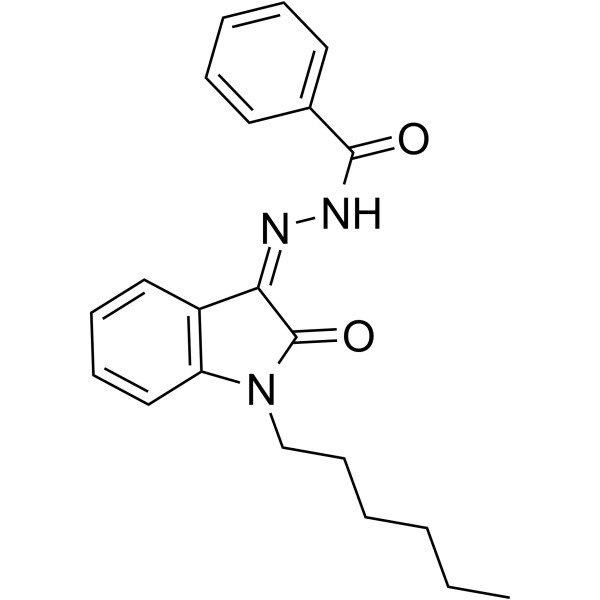
Physicochemical Properties
| Molecular Formula | C21H23N3O2 |
| Molecular Weight | 349.434 |
| Exact Mass | 349.179 |
| CAS # | 1048973-47-2 |
| PubChem CID | 135743701 |
| Appearance | Light yellow to yellow solid powder |
| Density | 1.2±0.1 g/cm3 |
| Index of Refraction | 1.607 |
| LogP | 4.99 |
| Hydrogen Bond Donor Count | 1 |
| Hydrogen Bond Acceptor Count | 3 |
| Rotatable Bond Count | 7 |
| Heavy Atom Count | 26 |
| Complexity | 476 |
| Defined Atom Stereocenter Count | 0 |
| InChi Key | ICNRTDOKKSWDRL-UHFFFAOYSA-N |
| InChi Code | InChI=1S/C21H23N3O2/c1-2-3-4-10-15-24-18-14-9-8-13-17(18)19(21(24)26)22-23-20(25)16-11-6-5-7-12-16/h5-9,11-14,26H,2-4,10,15H2,1H3 |
| Chemical Name | N-(1-hexyl-2-hydroxyindol-3-yl)iminobenzamide |
| Synonyms | MDA19; MDA 19; MDA-19 |
| HS Tariff Code | 2934.99.9001 |
| Storage |
Powder-20°C 3 years 4°C 2 years In solvent -80°C 6 months -20°C 1 month |
| Shipping Condition | Room temperature (This product is stable at ambient temperature for a few days during ordinary shipping and time spent in Customs) |
Biological Activity
| ln Vitro | MDA19 has an approximately 70-fold higher affinity for the human CB1 receptor and a 4-fold higher affinity for the human CB(2) receptor compared to the human CB1 receptor (K(i) = 43.3 +/- 10.3 vs 162.4 +/- 7.6 nM). periods. K(i) = 16.3 +/- 2.1 vs. 1130 +/- 574 nM for rat CB2 vs. rat CB1 receptor. MDA19 functioned as an agonist at rat CB1 receptors, human CB1 and CB2 receptors, and inversely as an agonist at rat CB2 receptors in guanosine triphosphate (GTP)gamma[(35)S] functional tests. In the 3',5'-cyclic adenosine monophosphate (cAMP) experiment, MDA19 functioned as an agonist at the rat CB1 receptor but did not exhibit any functional activity at the rat CB(2) receptor. In the test for extracellular signal-regulated kinase 1 and 2. |
| ln Vivo | Rat CB2 receptors are agonistically activated by MDA19. MDA19, but not CB2(-/-) mice, dose-dependently reduces the tactile allodynia caused by spinal nerve ligation or paclitaxel in rats and CB2(+/+) mice. This suggests that the CB2 receptor mediates the role of MDA19. In rats, MDA19 has no effect on locomotor activity. |
| References |
[1]. Design and Synthesis of a Novel Series of N-Alkyl Isatin Acylhydrazone Derivatives that Act as Selective Cannabinoid Receptor 2 Agonists for the Treatment of Neuropathic Pain. Journal of Medicinal Chemi. [2]. Pharmacological characterization of a novel cannabinoid ligand, MDA19, for treatment of neuropathic pain. Anesth Analg. 2010 Jul;111(1):99-109. |
Solubility Data
| Solubility (In Vitro) | DMSO : ~14.29 mg/mL (~40.90 mM) |
| Solubility (In Vivo) |
Solubility in Formulation 1: 1.43 mg/mL (4.09 mM) in 10% DMSO + 90% (20% SBE-β-CD in Saline) (add these co-solvents sequentially from left to right, and one by one), suspension solution; with sonication. For example, if 1 mL of working solution is to be prepared, you can add 100 μL of 14.3 mg/mL clear DMSO stock solution to 900 μL of 20% SBE-β-CD physiological saline solution and mix evenly. Preparation of 20% SBE-β-CD in Saline (4°C,1 week): Dissolve 2 g SBE-β-CD in 10 mL saline to obtain a clear solution. Solubility in Formulation 2: ≥ 1.43 mg/mL (4.09 mM) (saturation unknown) in 10% DMSO + 90% Corn Oil (add these co-solvents sequentially from left to right, and one by one), clear solution. For example, if 1 mL of working solution is to be prepared, you can add 100 μL of 14.3 mg/mL clear DMSO stock solution to 900 μL of corn oil and mix evenly. (Please use freshly prepared in vivo formulations for optimal results.) |
| Preparing Stock Solutions | 1 mg | 5 mg | 10 mg | |
| 1 mM | 2.8618 mL | 14.3090 mL | 28.6180 mL | |
| 5 mM | 0.5724 mL | 2.8618 mL | 5.7236 mL | |
| 10 mM | 0.2862 mL | 1.4309 mL | 2.8618 mL |