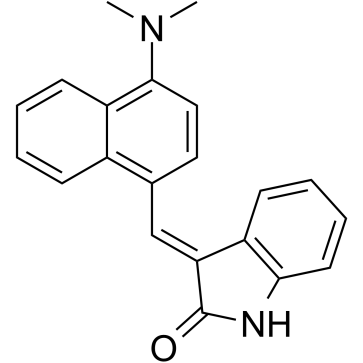
Physicochemical Properties
| Molecular Formula | C₂₁H₁₈N₂O |
| Molecular Weight | 314.38 |
| Exact Mass | 314.141 |
| CAS # | 163655-37-6 |
| Related CAS # | 163655-37-6 |
| PubChem CID | 9839842 |
| Appearance | Orange to red solid |
| Density | 1.3±0.1 g/cm3 |
| Boiling Point | 553.9±50.0 °C at 760 mmHg |
| Flash Point | 288.8±30.1 °C |
| Vapour Pressure | 0.0±1.5 mmHg at 25°C |
| Index of Refraction | 1.729 |
| LogP | 5.15 |
| Hydrogen Bond Donor Count | 1 |
| Hydrogen Bond Acceptor Count | 2 |
| Rotatable Bond Count | 2 |
| Heavy Atom Count | 24 |
| Complexity | 512 |
| Defined Atom Stereocenter Count | 0 |
| SMILES | CN(C1=CC=C(C2=CC=CC=C21)/C=C/3\C4=CC=CC=C4NC3=O)C |
| InChi Key | VFCXONOPGCDDBQ-QGOAFFKASA-N |
| InChi Code | InChI=1S/C21H18N2O/c1-23(2)20-12-11-14(15-7-3-4-9-17(15)20)13-18-16-8-5-6-10-19(16)22-21(18)24/h3-13H,1-2H3,(H,22,24)/b18-13+ |
| Chemical Name | (3E)-3-[[4-(dimethylamino)naphthalen-1-yl]methylidene]-1H-indol-2-one |
| Synonyms | MAZ51; MAZ-51; MAZ 51 |
| HS Tariff Code | 2934.99.9001 |
| Storage |
Powder-20°C 3 years 4°C 2 years In solvent -80°C 6 months -20°C 1 month Note: This product is not stable in solution, please use freshly prepared working solution for optimal results. |
| Shipping Condition | Room temperature (This product is stable at ambient temperature for a few days during ordinary shipping and time spent in Customs) |
Biological Activity
| Targets |
VEGFR-3; Akt; GSK3β; RhoA MAZ51 preferentially targets vascular endothelial growth factor receptor 3 (VEGFR-3, Flt-4) with an IC50 of 25 nM for VEGF-C-induced VEGFR-3 activation, and exhibits lower potency against VEGFR-2 (KDR/Flk-1) with an IC50 of 4.5 μM [1] It shows no significant inhibition of other kinases (e.g., PDGFRβ, c-Kit, EGFR) at concentrations up to 10 μM [1] |
| ln Vitro |
MAZ51 (2.5-10 μM; 24 hours) causes apoptosis and inhibits the growth of many different types of tumor cells[2].
MAZ51 (0.5-50 μM; 25 minutes) does not affect the ligand-induced autophosphorylation of PDGFRβ, IGF-1R, or EGFR in A431 cells, HEK-293 cells, or PAE cells, respectively[2]. MAZ51 (1-100 nM) dose-dependently inhibits VEGF-C- and VEGF-D-induced VEGFR-3 phosphorylation in human umbilical vein endothelial cells (HUVECs), with maximum inhibition (>80%) at 50 nM [1] - It blocks VEGF-C-mediated HUVEC proliferation (IC50 = 32 nM) and migration (50% inhibition at 25 nM), without affecting basal proliferation of HUVECs in the absence of VEGF-C [1] - Against various tumor cell lines (A549 lung cancer, MCF-7 breast cancer, HT-29 colorectal cancer, B16F10 melanoma), MAZ51 inhibits proliferation with IC50 values ranging from 0.8 μM to 3.5 μM after 72 hours of treatment [2] - Western blot analysis reveals that MAZ51 (1 μM, 24 h) inhibits VEGFR-3-mediated downstream signaling (ERK1/2 and AKT phosphorylation) in HUVECs and A549 cells, without altering total VEGFR-3, ERK1/2, or AKT protein levels [1][2] - The compound (2 μM, 48 h) induces G1 cell cycle arrest in A549 cells (G1 phase ratio increased from ~40% to ~63%) and reduces colony formation by 65% compared to the control group [2] |
| ln Vivo |
MAZ51 (8 mg/kg; i.p.; daily for 15 day) tumor growth is significantly suppressed by MAZ51[2]. In B16F10 melanoma xenograft model in C57BL/6 mice, intraperitoneal administration of MAZ51 at 25 mg/kg and 50 mg/kg once daily for 14 days results in tumor growth inhibition (TGI) rates of 58% and 79%, respectively [2] - MAZ51 (50 mg/kg) reduces tumor weight from ~1.0 g (vehicle control) to ~0.21 g, and decreases microvessel density (CD31-positive vessels) in tumors by ~60% (immunohistochemical staining) [2] - No significant body weight loss (<4%) or histopathological abnormalities in major organs (liver, kidney, heart, lung) are observed in treated mice [2] |
| Enzyme Assay |
VEGFR-3 kinase activity assay: Recombinant human VEGFR-3 kinase domain is incubated with ATP (Km = 15 μM) and biotinylated peptide substrate in the presence of serial dilutions of MAZ51. After incubation at 30°C for 60 minutes, streptavidin-conjugated beads are added to capture the substrate, and phosphorylated peptide is detected using an anti-phosphotyrosine antibody. IC50 values are calculated by fitting dose-response curves of kinase activity inhibition [1] - VEGFR-2 selectivity assay: The same kinase activity assay is performed with recombinant VEGFR-2 kinase domain to determine the IC50 for VEGFR-2, and selectivity ratio (VEGFR-2 IC50 / VEGFR-3 IC50) is calculated [1] |
| Cell Assay |
HUVEC proliferation assay: HUVECs are seeded in 96-well plates and starved for 12 hours. MAZ51 (0.1 nM-1 μM) is added, followed by VEGF-C (50 ng/mL) stimulation. Cells are cultured for 72 hours, and cell viability is assessed using a tetrazolium salt-based colorimetric assay to determine IC50 [1] - Tumor cell antiproliferative assay: A549, MCF-7, HT-29, or B16F10 cells are seeded in 96-well plates, treated with MAZ51 (0.1 μM-10 μM) for 72 hours, and cell viability is measured by the same colorimetric assay to calculate IC50 [2] - Western blot assay: HUVECs or A549 cells are treated with MAZ51 (0.1-5 μM) for 24 hours, lysed in buffer containing protease and phosphatase inhibitors. Proteins are separated by SDS-PAGE, transferred to membranes, and probed with antibodies against p-VEGFR-3, VEGFR-3, p-ERK1/2, ERK1/2, p-AKT, AKT, and β-actin [1][2] - Colony formation assay: A549 cells are seeded in 6-well plates at 500 cells/well, treated with MAZ51 (0.5-2 μM) for 14 days. Colonies are fixed, stained with crystal violet, and counted to calculate inhibition rate [2] |
| Animal Protocol |
Wistar Furth rats (bearing MT450 cells)[1] 8 mg/kg Intraperitoneal injection; daily for 15 day B16F10 melanoma xenograft model: Female C57BL/6 mice (6-7 weeks old) are subcutaneously inoculated with 2×10⁶ B16F10 cells into the right flank. When tumors reach an average volume of 100 mm³, mice are randomly divided into three groups (n=8 per group): vehicle control, MAZ51 25 mg/kg, and 50 mg/kg. The compound is dissolved in DMSO and diluted with normal saline (final DMSO concentration ≤5%) and administered via intraperitoneal injection once daily for 14 consecutive days. Tumor volume (length × width² / 2) and body weight are recorded every 2 days. At sacrifice, tumors are excised for weight measurement and immunohistochemical staining (CD31) [2] |
| Toxicity/Toxicokinetics |
In the 14-day in vivo study, MAZ51 at doses up to 50 mg/kg (intraperitoneal) does not cause significant body weight loss, mortality, or histopathological abnormalities in major organs (liver, kidney, heart, lung, spleen) [2] - The compound shows no obvious cytotoxicity to normal human dermal fibroblasts (NHDF) at concentrations up to 5 μM [2] |
| References |
[1]. Characterization of indolinones which preferentially inhibit VEGF-C- and VEGF-D-induced activation of VEGFR-3 rather than VEGFR-2. Eur J Biochem. 2001 Nov;268(21):5530-40. [2]. MAZ51, an indolinone that inhibits endothelial cell and tumor cell growth in vitro, suppresses tumor growth in vivo. Int J Cancer. 2004 Dec 20;112(6):986-93. |
| Additional Infomation |
3-[[4-(dimethylamino)-1-naphthalenyl]methylidene]-1H-indol-2-one is a member of naphthalenes. MAZ51 is an indolinone-derived selective inhibitor of VEGFR-3, developed for the treatment of cancer by targeting lymphangiogenesis and angiogenesis [1][2] - Its mechanism of action involves competitive binding to the ATP-binding pocket of VEGFR-3, inhibiting VEGF-C/D-induced VEGFR-3 phosphorylation and downstream ERK1/2/AKT signaling pathways, thereby suppressing endothelial cell proliferation/migration and tumor angiogenesis/lymphangiogenesis [1] - It exhibits preferential selectivity for VEGFR-3 over VEGFR-2 (>180-fold), which reduces potential off-target effects associated with VEGFR-2 inhibition (e.g., hypertension, proteinuria) [1] - The compound exerts both anti-angiogenic and direct antitumor effects by inhibiting tumor cell proliferation and inducing cell cycle arrest [2] |
Solubility Data
| Solubility (In Vitro) | DMSO: 11.4~63 mg/mL (36.1~200.4 mM) |
| Solubility (In Vivo) |
Solubility in Formulation 1: ≥ 0.83 mg/mL (2.64 mM) (saturation unknown) in 10% DMSO + 90% (20% SBE-β-CD in Saline) (add these co-solvents sequentially from left to right, and one by one), clear solution. For example, if 1 mL of working solution is to be prepared, you can add 100 μL of 8.3 mg/mL clear DMSO stock solution to 900 μL of 20% SBE-β-CD physiological saline solution and mix evenly. Preparation of 20% SBE-β-CD in Saline (4°C,1 week): Dissolve 2 g SBE-β-CD in 10 mL saline to obtain a clear solution. Solubility in Formulation 2: 4 mg/mL (12.72 mM) in 50% PEG300 50% Saline (add these co-solvents sequentially from left to right, and one by one), suspension solution; with ultrasonication. Preparation of saline: Dissolve 0.9 g of sodium chloride in 100 mL ddH₂ O to obtain a clear solution. (Please use freshly prepared in vivo formulations for optimal results.) |
| Preparing Stock Solutions | 1 mg | 5 mg | 10 mg | |
| 1 mM | 3.1809 mL | 15.9043 mL | 31.8086 mL | |
| 5 mM | 0.6362 mL | 3.1809 mL | 6.3617 mL | |
| 10 mM | 0.3181 mL | 1.5904 mL | 3.1809 mL |