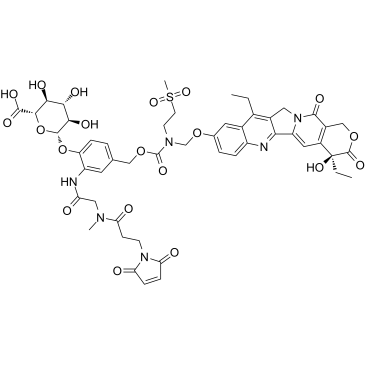
MAC glucuronide phenol-linked SN-38 is an SN-38 based drug-linker conjugate used for ADC synthesis. It is a pH-susceptible lactone and cleavable MAC glucuronide phenol-linked SN-38 conjugate.
Physicochemical Properties
| Molecular Formula | C50H52N6O20S |
| Molecular Weight | 1089.04109287262 |
| Exact Mass | 1090.311 |
| CAS # | 2246380-69-6 |
| PubChem CID | 139035092 |
| Appearance | Light yellow to yellow solid powder |
| LogP | -1.4 |
| Hydrogen Bond Donor Count | 6 |
| Hydrogen Bond Acceptor Count | 21 |
| Rotatable Bond Count | 20 |
| Heavy Atom Count | 77 |
| Complexity | 2540 |
| Defined Atom Stereocenter Count | 6 |
| SMILES | S(C)(CCN(C(=O)OCC1C=CC(=C(C=1)NC(CN(C)C(CCN1C(C=CC1=O)=O)=O)=O)O[C]1[C@@H]([C]([C@@H]([C@@H](C(=O)O)O1)O)O)O)COC1C=CC2=C(C=1)C(CC)=C1C(C3=CC4=C(COC([C@@]4(CC)O)=O)C(N3C1)=O)=N2)(=O)=O |^1:33,35| |
| InChi Key | IKQSTTAUHYHYCV-GVAVQZEZSA-N |
| InChi Code | InChI=1S/C50H54N6O20S/c1-5-27-28-18-26(8-9-32(28)52-40-29(27)20-56-34(40)19-31-30(45(56)64)23-72-48(67)50(31,69)6-2)74-24-54(15-16-77(4,70)71)49(68)73-22-25-7-10-35(75-47-43(63)41(61)42(62)44(76-47)46(65)66)33(17-25)51-36(57)21-53(3)37(58)13-14-55-38(59)11-12-39(55)60/h7-12,17-19,41-44,47,61-63,69H,5-6,13-16,20-24H2,1-4H3,(H,51,57)(H,65,66)/t41-,42-,43+,44-,47+,50-/m0/s1 |
| Chemical Name | (2S,3S,4S,5R,6S)-6-[4-[[[(19S)-10,19-diethyl-19-hydroxy-14,18-dioxo-17-oxa-3,13-diazapentacyclo[11.8.0.02,11.04,9.015,20]henicosa-1(21),2,4(9),5,7,10,15(20)-heptaen-7-yl]oxymethyl-(2-methylsulfonylethyl)carbamoyl]oxymethyl]-2-[[2-[3-(2,5-dioxopyrrol-1-yl)propanoyl-methylamino]acetyl]amino]phenoxy]-3,4,5-trihydroxyoxane-2-carboxylic acid |
| Synonyms | MAC glucuronide phenol-linked SN-38; 2246380-69-6; SCHEMBL24978656; |
| HS Tariff Code | 2934.99.9001 |
| Storage |
Powder-20°C 3 years 4°C 2 years In solvent -80°C 6 months -20°C 1 month Note: (1). This product requires protection from light (avoid light exposure) during transportation and storage.(2). Please store this product in a sealed and protected environment (e.g. under nitrogen), avoid exposure to moisture. |
| Shipping Condition | Room temperature (This product is stable at ambient temperature for a few days during ordinary shipping and time spent in Customs) |
Biological Activity
| Targets | ADC drug-linker conjugate; Camptothecins/DNA Topoisomerase I |
| ln Vitro | Camptothecins exist in a pH-dependent equilibrium between the active, closed lactone and the inactive open-carboxylate forms. Several previous reports underscore the need for lactone stabilization in generating improved camptothecins, and indeed, such designs have been incorporated into antibody-drug conjugates containing this drug. Here, we demonstrate that lactone stabilization is not necessary for camptothecin-based ADC efficacy. We synthesized and evaluated camptothecin SN-38 drug linkers that differed with respect to lactone stability and released SN-38 or the hydrolyzed open-lactone form upon cleavage from the antibody carrier. An α-hydroxy lactone-linked SN-38 drug linker preserved the closed-lactone ring structure, while the phenol-linked version allowed conversion between the closed-lactone and open-carboxylate structures. The in vitro cytotoxicity, pharmacokinetic properties, and in vivo efficacy in the L540cy Hodgkin's lymphoma model of the corresponding ADCs were found to be indistinguishable, leading us to conclude that camptothecin-based antibody-drug conjugates possess pronounced activity regardless of the lactone state of the bound drug. This is most likely a result of ADC processing within acidic intracellular vesicles, delivering camptothecin in its active closed-lactone form[1]. |
| ln Vivo | There have been many attempts in pharmaceutical industries and academia to improve the pharmacokinetic characteristics of anti-tumor small-molecule drugs by conjugating them with large molecules, such as monoclonal antibodies, called ADCs. In this context, albumin, one of the most abundant proteins in the blood, has also been proposed as a large molecule to be conjugated with anti-cancer small-molecule drugs. The half-life of albumin is 3 weeks in humans, and its distribution to tumors is higher than in normal tissues. However, few studies have been conducted for the in vivo prepared albumin-drug conjugates, possibly due to the lack of robust bioanalytical methods, which are critical for evaluating the ADME/PK properties of in vivo prepared albumin-drug conjugates. In this study, we developed a bioanalytical method of the albumin-conjugated MAC glucuronide phenol linked SN-38 ((2S,3S,4S,5R,6S)-6-(4-(((((((S)-4,11-diethyl-4-hydroxy-3,14-dioxo-3,4,12,14-tetrahydro-1H-pyrano [3',4':6,7] indolizino [1,2-b] quinolin-9-yl)oxy)methyl)(2 (methylsulfonyl)ethyl)carbamoyl)oxy)methyl)-2-(2-(3-(2,5-dioxo-2,5-dihydro-1H-pyrrol-1-yl)-N-methylpropanamido)acetamido)phenoxy)-3,4,5-trihydroxytetra-hydro-2H-pyran-2-carboxylic acid) as a proof-of-concept. This method is based on immunoprecipitation using magnetic beads and the quantification of albumin-conjugated drug concentration using LC-qTOF/MS in mouse plasma. Finally, the developed method was applied to the in vivo intravenous (IV) mouse pharmacokinetic study of MAC glucuronide phenol-linked SN-38[2]. |
| References |
[1]. Lactone Stabilization is Not a Necessary Feature for Antibody Conjugates of Camptothecins. Mol Pharm. 2018 Sep 4;15(9):4063-4072. [2]. Evaluation of In Vivo Prepared Albumin-Drug Conjugate Using Immunoprecipitation Linked LC-MS Assay and Its Application to Mouse Pharmacokinetic Study. Molecules. 2023 Apr 4;28(7):3223. |
Solubility Data
| Solubility (In Vitro) | May dissolve in DMSO (in most cases), if not, try other solvents such as H2O, Ethanol, or DMF with a minute amount of products to avoid loss of samples |
| Solubility (In Vivo) |
Note: Listed below are some common formulations that may be used to formulate products with low water solubility (e.g. < 1 mg/mL), you may test these formulations using a minute amount of products to avoid loss of samples. Injection Formulations (e.g. IP/IV/IM/SC) Injection Formulation 1: DMSO : Tween 80: Saline = 10 : 5 : 85 (i.e. 100 μL DMSO stock solution → 50 μL Tween 80 → 850 μL Saline) *Preparation of saline: Dissolve 0.9 g of sodium chloride in 100 mL ddH ₂ O to obtain a clear solution. Injection Formulation 2: DMSO : PEG300 :Tween 80 : Saline = 10 : 40 : 5 : 45 (i.e. 100 μL DMSO → 400 μLPEG300 → 50 μL Tween 80 → 450 μL Saline) Injection Formulation 3: DMSO : Corn oil = 10 : 90 (i.e. 100 μL DMSO → 900 μL Corn oil) Example: Take the Injection Formulation 3 (DMSO : Corn oil = 10 : 90) as an example, if 1 mL of 2.5 mg/mL working solution is to be prepared, you can take 100 μL 25 mg/mL DMSO stock solution and add to 900 μL corn oil, mix well to obtain a clear or suspension solution (2.5 mg/mL, ready for use in animals). Injection Formulation 4: DMSO : 20% SBE-β-CD in saline = 10 : 90 [i.e. 100 μL DMSO → 900 μL (20% SBE-β-CD in saline)] *Preparation of 20% SBE-β-CD in Saline (4°C,1 week): Dissolve 2 g SBE-β-CD in 10 mL saline to obtain a clear solution. Injection Formulation 5: 2-Hydroxypropyl-β-cyclodextrin : Saline = 50 : 50 (i.e. 500 μL 2-Hydroxypropyl-β-cyclodextrin → 500 μL Saline) Injection Formulation 6: DMSO : PEG300 : castor oil : Saline = 5 : 10 : 20 : 65 (i.e. 50 μL DMSO → 100 μLPEG300 → 200 μL castor oil → 650 μL Saline) Injection Formulation 7: Ethanol : Cremophor : Saline = 10: 10 : 80 (i.e. 100 μL Ethanol → 100 μL Cremophor → 800 μL Saline) Injection Formulation 8: Dissolve in Cremophor/Ethanol (50 : 50), then diluted by Saline Injection Formulation 9: EtOH : Corn oil = 10 : 90 (i.e. 100 μL EtOH → 900 μL Corn oil) Injection Formulation 10: EtOH : PEG300:Tween 80 : Saline = 10 : 40 : 5 : 45 (i.e. 100 μL EtOH → 400 μLPEG300 → 50 μL Tween 80 → 450 μL Saline) Oral Formulations Oral Formulation 1: Suspend in 0.5% CMC Na (carboxymethylcellulose sodium) Oral Formulation 2: Suspend in 0.5% Carboxymethyl cellulose Example: Take the Oral Formulation 1 (Suspend in 0.5% CMC Na) as an example, if 100 mL of 2.5 mg/mL working solution is to be prepared, you can first prepare 0.5% CMC Na solution by measuring 0.5 g CMC Na and dissolve it in 100 mL ddH2O to obtain a clear solution; then add 250 mg of the product to 100 mL 0.5% CMC Na solution, to make the suspension solution (2.5 mg/mL, ready for use in animals). Oral Formulation 3: Dissolved in PEG400 Oral Formulation 4: Suspend in 0.2% Carboxymethyl cellulose Oral Formulation 5: Dissolve in 0.25% Tween 80 and 0.5% Carboxymethyl cellulose Oral Formulation 6: Mixing with food powders Note: Please be aware that the above formulations are for reference only. InvivoChem strongly recommends customers to read literature methods/protocols carefully before determining which formulation you should use for in vivo studies, as different compounds have different solubility properties and have to be formulated differently. (Please use freshly prepared in vivo formulations for optimal results.) |
| Preparing Stock Solutions | 1 mg | 5 mg | 10 mg | |
| 1 mM | 0.9182 mL | 4.5912 mL | 9.1824 mL | |
| 5 mM | 0.1836 mL | 0.9182 mL | 1.8365 mL | |
| 10 mM | 0.0918 mL | 0.4591 mL | 0.9182 mL |