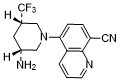
Enpatoran (M-5049) is a novel and selective inhibitor of Toll-Like Receptor 7/8 with IC50 of 11.1 and 24 nM, respectively. No activity against TLR3, TLR4, and TLR9. It has the potential to be used for the treatment of autoimmune diseases.
Physicochemical Properties
| Molecular Formula | C16H15F3N4 |
| Molecular Weight | 320.3192 |
| Exact Mass | 320.124 |
| Elemental Analysis | C, 60.00; H, 4.72; F, 17.79; N, 17.49 |
| CAS # | 2101938-42-3 |
| Related CAS # | Enpatoran hydrochloride;2101945-93-9 |
| PubChem CID | 129240620 |
| Appearance | Light yellow to yellow solid powder |
| LogP | 2.7 |
| Hydrogen Bond Donor Count | 1 |
| Hydrogen Bond Acceptor Count | 7 |
| Rotatable Bond Count | 1 |
| Heavy Atom Count | 23 |
| Complexity | 472 |
| Defined Atom Stereocenter Count | 2 |
| SMILES | C1[C@@H](CN(C[C@@H]1N)C2=C3C=CC=NC3=C(C=C2)C#N)C(F)(F)F |
| InChi Key | BJXYHBKEQFQVES-NWDGAFQWSA-N |
| InChi Code | InChI=1S/C16H15F3N4/c17-16(18,19)11-6-12(21)9-23(8-11)14-4-3-10(7-20)15-13(14)2-1-5-22-15/h1-5,11-12H,6,8-9,21H2/t11-,12+/m0/s1 |
| Chemical Name | 5-((3R,5S)-3-amino-5-(trifluoromethyl)piperidin-1-yl)quinoline-8-carbonitrile |
| Synonyms | Enpatoran M-5049 M 5049M5049Enpatoranum |
| HS Tariff Code | 2934.99.9001 |
| Storage |
Powder-20°C 3 years 4°C 2 years In solvent -80°C 6 months -20°C 1 month Note: Please store this product in a sealed and protected environment (e.g. under nitrogen), avoid exposure to moisture and light. |
| Shipping Condition | Room temperature (This product is stable at ambient temperature for a few days during ordinary shipping and time spent in Customs) |
Biological Activity
| ln Vitro | Enpatoran (0.01 nM–10 μM) has IC50 values between 35 and 45 nM and suppresses the production of IL-6 induced by all ligands (miR–122, Let7c RNA, Alu RNA, and R848)[1]. |
| ln Vivo | In a ligation-dependent manner, epatoran (M5049; gavage; 1 mg/kg) delivered prior to R848 (25 μg intraperitoneally) kills mice via inhibiting the generation of IL-6 and IFN-α [1]. showed excellent bioavailability following one draft (1.0 mg/kg for TB, TB, and dogs; 100% for TB, 87% for TB, and 84% for dogs) [1]. Higher braid clearance rates (1.4, 1.2, and 0.59 L/h/kg, respectively) and larger animals (2.7, 8.7, and 5.7 L/kg, respectively) were seen in structural and canine 1.0 mg/kg; iv) cases. |
| Animal Protocol |
Animal/Disease Models: Female C57BL/6 mice[1] Doses: 0.1 mg/kg and 1 mg/kg Route of Administration: po (oral gavage); moderate half-life (mouse 1.4, stability 5.0 and dog 13 hrs (hrs (hours)))[1 ]. Results of R848 administration 1 hour before challenge: TLR7/8 agonist R848 stimulated the production of IFN-α and IL-6 in mice. Enpatoran reduces R848-stimulated IFN-α and IL-6 production. Animal/Disease Models: female CD1 mice, female Wistar rats, female beagle dogs [1] Doses: 1 mg/kg (pharmacokinetic/PK/PK analysis) Route of Administration: intravenous (iv) (iv)(iv) or po (oral gavage) Experimental Results:Mouse T1 /2 are 1.4, 5.0 and 13 h for mice and dogs respectively. |
| References |
[1]. Discovery of M5049: A Novel Selective TLR7/8 Inhibitor for Treatment of Autoimmunity. J Pharmacol Exp Ther. 2020 Dec 16;JPET-AR-2020-000275. |
| Additional Infomation | Enpatoran is an orally bioavailable toll-like receptor type 7 and 8 (TLR 7/8) dual antagonist, with potential anti-inflammatory and immunomodulating activities. Upon oral administration, enpatoran binds to and inhibits the activity of TLR7 and 8, thereby inhibiting TLR7/8-mediated pathways. This may inhibit the production of pro-inflammatory cytokines, and block the activation of immune responses. TLR7 and 8, members of the TLR family, play fundamental roles in the activation of the innate immune system, myeloid cell responses and tumor antigen presentation. |
Solubility Data
| Solubility (In Vitro) | DMSO : ~24.44 mg/mL (~76.30 mM) |
| Solubility (In Vivo) |
Solubility in Formulation 1: ≥ 2.44 mg/mL (7.62 mM) (saturation unknown) in 10% DMSO + 40% PEG300 + 5% Tween80 + 45% Saline (add these co-solvents sequentially from left to right, and one by one), clear solution. For example, if 1 mL of working solution is to be prepared, you can add 100 μL of 24.4 mg/mL clear DMSO stock solution to 400 μL PEG300 and mix evenly; then add 50 μL Tween-80 to the above solution and mix evenly; then add 450 μL normal saline to adjust the volume to 1 mL. Preparation of saline: Dissolve 0.9 g of sodium chloride in 100 mL ddH₂ O to obtain a clear solution. Solubility in Formulation 2: ≥ 2.44 mg/mL (7.62 mM) (saturation unknown) in 10% DMSO + 90% (20% SBE-β-CD in Saline) (add these co-solvents sequentially from left to right, and one by one), clear solution. For example, if 1 mL of working solution is to be prepared, you can add 100 μL of 24.4 mg/mL clear DMSO stock solution to 900 μL of 20% SBE-β-CD physiological saline solution and mix evenly. Preparation of 20% SBE-β-CD in Saline (4°C,1 week): Dissolve 2 g SBE-β-CD in 10 mL saline to obtain a clear solution. (Please use freshly prepared in vivo formulations for optimal results.) |
| Preparing Stock Solutions | 1 mg | 5 mg | 10 mg | |
| 1 mM | 3.1219 mL | 15.6094 mL | 31.2188 mL | |
| 5 mM | 0.6244 mL | 3.1219 mL | 6.2438 mL | |
| 10 mM | 0.3122 mL | 1.5609 mL | 3.1219 mL |