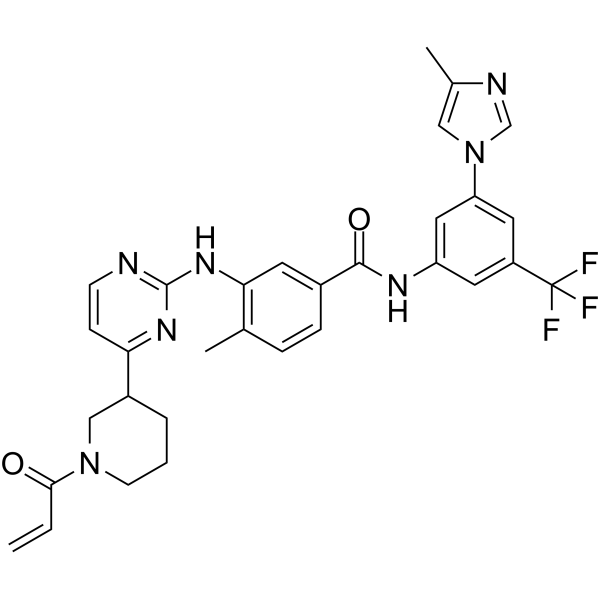
Physicochemical Properties
| Molecular Formula | C31H30F3N7O2 |
| Molecular Weight | 589.610816478729 |
| Exact Mass | 589.241 |
| CAS # | 1820684-31-8 |
| PubChem CID | 92042851 |
| Appearance | Light yellow to yellow solid powder |
| LogP | 5 |
| Hydrogen Bond Donor Count | 2 |
| Hydrogen Bond Acceptor Count | 9 |
| Rotatable Bond Count | 7 |
| Heavy Atom Count | 43 |
| Complexity | 984 |
| Defined Atom Stereocenter Count | 0 |
| InChi Key | QAQFNUYJUCJMKF-UHFFFAOYSA-N |
| InChi Code | InChI=1S/C31H30F3N7O2/c1-4-28(42)40-11-5-6-22(17-40)26-9-10-35-30(38-26)39-27-12-21(8-7-19(27)2)29(43)37-24-13-23(31(32,33)34)14-25(15-24)41-16-20(3)36-18-41/h4,7-10,12-16,18,22H,1,5-6,11,17H2,2-3H3,(H,37,43)(H,35,38,39) |
| Chemical Name | 4-methyl-N-[3-(4-methylimidazol-1-yl)-5-(trifluoromethyl)phenyl]-3-[[4-(1-prop-2-enoylpiperidin-3-yl)pyrimidin-2-yl]amino]benzamide |
| Synonyms | M 443; M-443; M443 |
| HS Tariff Code | 2934.99.9001 |
| Storage |
Powder-20°C 3 years 4°C 2 years In solvent -80°C 6 months -20°C 1 month |
| Shipping Condition | Room temperature (This product is stable at ambient temperature for a few days during ordinary shipping and time spent in Customs) |
Biological Activity
| ln Vitro | MRK depletion decreased cell survival to 33% of control after 3 Gy of IR. Similarly, at 10% viability, clonogenic experiments demonstrated a significant reduction of survival at a dosage enhancement factor (DEF) of 1.6. The peak of IR-induced MRK activation occurs 30 minutes following radiation exposure. Consequently, this time point was selected for further analysis. 500 nM M443 significantly reduced the activation of MRK, Chk2, and p38 in response to IR in both cell cultures. The following procedures were used to prepare the cells for immunofluorescence: they were seeded on coverslips, pretreated with 500 nM M443 or vehicle, subjected to 6 Gy IR, frozen at different intervals after IR, and processed using an MPM2 phospho-specific antibody that specifically detects mitotic cells. M443-treated cells did not arrest following IR, in contrast to control cells, and they retained a mitotic index that was comparable to that of non-irradiated cells. As a result, blocking MRK inhibits Chk2 and does not stop the cell cycle reaction to damage to DNA caused by IR [1]. |
| ln Vivo | The average survival time of control mice following tumor cell implantation was 32 days. Only M443 treatment increased survival by 5.5 days, while certain low-dose radiation did not show a discernible improvement in survival. On the other hand, IR and M443 together increased survival; the median survival increased by 16 days when compared to the control group. Animal body weight was not impacted by M443 treatment, as weight loss was seen in all groups in the days preceding the animals' demise. The findings demonstrated that tumor-containing regions (lane RB in the brain injected with a vehicle) had higher levels of both total and active MRK. MRK activity was completely absent from tumor-containing regions of the brain that were treated with M443. Curiously, normal brain areas that had some MRK protein in control brains likewise lost MRK in treated brains, indicating that normal MRK is suppressed by M443 spreading across the cerebellum [1]. |
| References | [1]. Markowitz D, et al. Pharmacological Inhibition of the Protein Kinase MRK/ZAK Radiosensitizes Medulloblastoma. Mol Cancer Ther. 2016 Aug;15(8):1799-808 |
Solubility Data
| Solubility (In Vitro) | DMSO : ~55 mg/mL (~93.28 mM) |
| Solubility (In Vivo) |
Note: Listed below are some common formulations that may be used to formulate products with low water solubility (e.g. < 1 mg/mL), you may test these formulations using a minute amount of products to avoid loss of samples. Injection Formulations (e.g. IP/IV/IM/SC) Injection Formulation 1: DMSO : Tween 80: Saline = 10 : 5 : 85 (i.e. 100 μL DMSO stock solution → 50 μL Tween 80 → 850 μL Saline) *Preparation of saline: Dissolve 0.9 g of sodium chloride in 100 mL ddH ₂ O to obtain a clear solution. Injection Formulation 2: DMSO : PEG300 :Tween 80 : Saline = 10 : 40 : 5 : 45 (i.e. 100 μL DMSO → 400 μLPEG300 → 50 μL Tween 80 → 450 μL Saline) Injection Formulation 3: DMSO : Corn oil = 10 : 90 (i.e. 100 μL DMSO → 900 μL Corn oil) Example: Take the Injection Formulation 3 (DMSO : Corn oil = 10 : 90) as an example, if 1 mL of 2.5 mg/mL working solution is to be prepared, you can take 100 μL 25 mg/mL DMSO stock solution and add to 900 μL corn oil, mix well to obtain a clear or suspension solution (2.5 mg/mL, ready for use in animals). Injection Formulation 4: DMSO : 20% SBE-β-CD in saline = 10 : 90 [i.e. 100 μL DMSO → 900 μL (20% SBE-β-CD in saline)] *Preparation of 20% SBE-β-CD in Saline (4°C,1 week): Dissolve 2 g SBE-β-CD in 10 mL saline to obtain a clear solution. Injection Formulation 5: 2-Hydroxypropyl-β-cyclodextrin : Saline = 50 : 50 (i.e. 500 μL 2-Hydroxypropyl-β-cyclodextrin → 500 μL Saline) Injection Formulation 6: DMSO : PEG300 : castor oil : Saline = 5 : 10 : 20 : 65 (i.e. 50 μL DMSO → 100 μLPEG300 → 200 μL castor oil → 650 μL Saline) Injection Formulation 7: Ethanol : Cremophor : Saline = 10: 10 : 80 (i.e. 100 μL Ethanol → 100 μL Cremophor → 800 μL Saline) Injection Formulation 8: Dissolve in Cremophor/Ethanol (50 : 50), then diluted by Saline Injection Formulation 9: EtOH : Corn oil = 10 : 90 (i.e. 100 μL EtOH → 900 μL Corn oil) Injection Formulation 10: EtOH : PEG300:Tween 80 : Saline = 10 : 40 : 5 : 45 (i.e. 100 μL EtOH → 400 μLPEG300 → 50 μL Tween 80 → 450 μL Saline) Oral Formulations Oral Formulation 1: Suspend in 0.5% CMC Na (carboxymethylcellulose sodium) Oral Formulation 2: Suspend in 0.5% Carboxymethyl cellulose Example: Take the Oral Formulation 1 (Suspend in 0.5% CMC Na) as an example, if 100 mL of 2.5 mg/mL working solution is to be prepared, you can first prepare 0.5% CMC Na solution by measuring 0.5 g CMC Na and dissolve it in 100 mL ddH2O to obtain a clear solution; then add 250 mg of the product to 100 mL 0.5% CMC Na solution, to make the suspension solution (2.5 mg/mL, ready for use in animals). Oral Formulation 3: Dissolved in PEG400 Oral Formulation 4: Suspend in 0.2% Carboxymethyl cellulose Oral Formulation 5: Dissolve in 0.25% Tween 80 and 0.5% Carboxymethyl cellulose Oral Formulation 6: Mixing with food powders Note: Please be aware that the above formulations are for reference only. InvivoChem strongly recommends customers to read literature methods/protocols carefully before determining which formulation you should use for in vivo studies, as different compounds have different solubility properties and have to be formulated differently. (Please use freshly prepared in vivo formulations for optimal results.) |
| Preparing Stock Solutions | 1 mg | 5 mg | 10 mg | |
| 1 mM | 1.6960 mL | 8.4802 mL | 16.9604 mL | |
| 5 mM | 0.3392 mL | 1.6960 mL | 3.3921 mL | |
| 10 mM | 0.1696 mL | 0.8480 mL | 1.6960 mL |