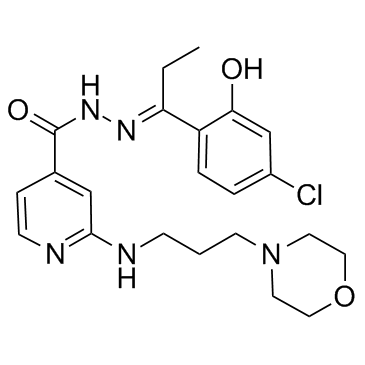
M-110 is a novel and potent inhibitor of protein arginine N-methyltransferases (PRMTs) with anticancer activity. It is also an isoform-selective, cell permeable and potent ATP-competitive inhibitor of the PIM kinase family that prefers PIM-3. IT inhibits the proliferation of prostate cancer cell lines with IC50s between 0.6 to 0.9 μM, with no activity on normal human peripheral blood mononuclear cells up to 40 μM.
Physicochemical Properties
| Molecular Formula | C22H28CLN5O3 |
| Molecular Weight | 445.95 |
| Exact Mass | 445.188 |
| CAS # | 1395048-49-3 |
| PubChem CID | 136639479 |
| Appearance | Light yellow to yellow solid powder |
| Density | 1.3±0.1 g/cm3 |
| Index of Refraction | 1.623 |
| LogP | 4.08 |
| Hydrogen Bond Donor Count | 3 |
| Hydrogen Bond Acceptor Count | 7 |
| Rotatable Bond Count | 9 |
| Heavy Atom Count | 31 |
| Complexity | 588 |
| Defined Atom Stereocenter Count | 0 |
| SMILES | CC/C(=N/NC(=O)C1=CC(=NC=C1)NCCCN2CCOCC2)/C3=C(C=C(C=C3)Cl)O |
| InChi Key | FXXCNYVQIONABS-XHPQRKPJSA-N |
| InChi Code | InChI=1S/C22H28ClN5O3/c1-2-19(18-5-4-17(23)15-20(18)29)26-27-22(30)16-6-8-25-21(14-16)24-7-3-9-28-10-12-31-13-11-28/h4-6,8,14-15,29H,2-3,7,9-13H2,1H3,(H,24,25)(H,27,30)/b26-19- |
| Chemical Name | N-[(Z)-1-(4-chloro-2-hydroxyphenyl)propylideneamino]-2-(3-morpholin-4-ylpropylamino)pyridine-4-carboxamide |
| Synonyms | M110 M 110 M-110 |
| HS Tariff Code | 2934.99.9001 |
| Storage |
Powder-20°C 3 years 4°C 2 years In solvent -80°C 6 months -20°C 1 month |
| Shipping Condition | Room temperature (This product is stable at ambient temperature for a few days during ordinary shipping and time spent in Customs) |
Biological Activity
| ln Vitro | The proliferation of DU-145 cells is inhibited by M-110 (0.01-10 μM; 72 hours) with an IC50 value of 0.9 μM [1]. Below 40 μM, M-110 exhibits no effect on normal human peripheral blood mononuclear cells [1]. STAT3 Tyr705 phosphorylation is inhibited by M-110 (10 μM; 18 hours) [1]. By suppressing PIM-3, M-110 reduces the expression of activated STAT3. Moreover, M-110 has IC50 values between 0.6 and 0.8 μM that prevent the growth of 22Rv1, PC3, and SW480 cells[1]. |
| Cell Assay |
Cell viability assay [1] Cell Types: DU-145 cells Tested Concentrations: 0.01, 0.1, 1, 10 μM Incubation Duration: 72 hrs (hours) Experimental Results: Inhibits DU-145 cell growth, IC50 value is 0.9 μM. Western Blot Analysis [1] Cell Types: DU-145 Cell Tested Concentrations: 10 μM Incubation Duration: 18 hrs (hours) Experimental Results: Compared with untreated cells, the expression of p-STAT3 Tyr705 was diminished to 23.5% without affecting the expression of STAT3. |
| References |
[1]. PIM kinase inhibitors downregulate STAT3(Tyr705) phosphorylation.Mol Cancer Ther. 2010 Sep;9(9):2478-87. [2]. Schisantherin A suppresses osteoclast formation and wear particle-induced osteolysis via modulating RANKL signaling pathways. Biochem Biophys Res Commun. 2014 Jul 4;449(3):344-50. [3]. Schisantherin A protects lipopolysaccharide-induced acute respiratory distress syndrome in mice through inhibiting NF-κB and MAPKs signaling pathways. Int Immunopharmacol. 2014 Sep;22(1):133-40. [4]. Discovery of novel anti-parkinsonian effect of schisantherin A in in vitro and in vivo. Neurosci Lett. 2015 Apr 23;593:7-12. [5]. Schisantherin A protects against 6-OHDA-induced dopaminergic neuron damage in zebrafish and cytotoxicity in SH-SY5Y cells through the ROS/NO and AKT/GSK3β pathways. J Ethnopharmacol. 2015 Apr 29. pii: S0378-8741(15)00306-2. |
Solubility Data
| Solubility (In Vitro) | DMSO : ~33.33 mg/mL (~74.74 mM) |
| Solubility (In Vivo) |
Solubility in Formulation 1: ≥ 2.5 mg/mL (5.61 mM) (saturation unknown) in 10% DMSO + 40% PEG300 + 5% Tween80 + 45% Saline (add these co-solvents sequentially from left to right, and one by one), clear solution. For example, if 1 mL of working solution is to be prepared, you can add 100 μL of 25.0 mg/mL clear DMSO stock solution to 400 μL PEG300 and mix evenly; then add 50 μL Tween-80 to the above solution and mix evenly; then add 450 μL normal saline to adjust the volume to 1 mL. Preparation of saline: Dissolve 0.9 g of sodium chloride in 100 mL ddH₂ O to obtain a clear solution. Solubility in Formulation 2: ≥ 2.08 mg/mL (4.66 mM) (saturation unknown) in 10% DMSO + 90% (20% SBE-β-CD in Saline) (add these co-solvents sequentially from left to right, and one by one), clear solution. For example, if 1 mL of working solution is to be prepared, you can add 100 μL of 20.8 mg/mL clear DMSO stock solution to 900 μL of 20% SBE-β-CD physiological saline solution and mix evenly. Preparation of 20% SBE-β-CD in Saline (4°C,1 week): Dissolve 2 g SBE-β-CD in 10 mL saline to obtain a clear solution. (Please use freshly prepared in vivo formulations for optimal results.) |
| Preparing Stock Solutions | 1 mg | 5 mg | 10 mg | |
| 1 mM | 2.2424 mL | 11.2120 mL | 22.4240 mL | |
| 5 mM | 0.4485 mL | 2.2424 mL | 4.4848 mL | |
| 10 mM | 0.2242 mL | 1.1212 mL | 2.2424 mL |