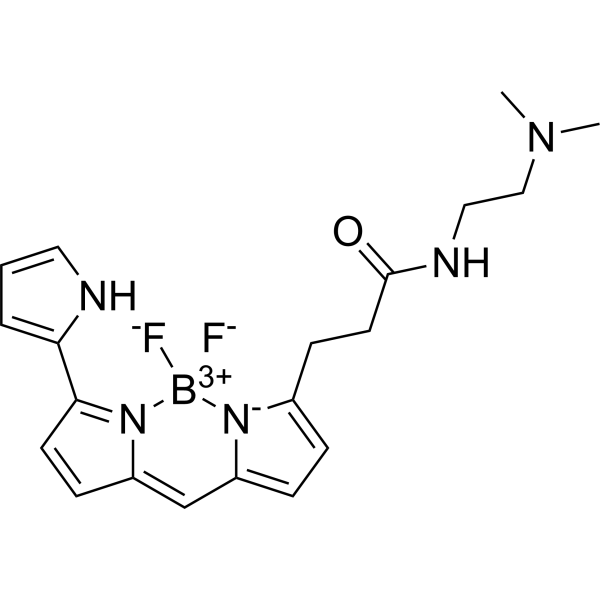
Physicochemical Properties
| Molecular Formula | C20H24BN5OF2 |
| Molecular Weight | 399.245 |
| Exact Mass | 399.204 |
| CAS # | 231946-72-8 |
| PubChem CID | 15410449 |
| Appearance | Brown to dark brown solid powder |
| Hydrogen Bond Donor Count | 2 |
| Hydrogen Bond Acceptor Count | 5 |
| Rotatable Bond Count | 7 |
| Heavy Atom Count | 29 |
| Complexity | 751 |
| Defined Atom Stereocenter Count | 0 |
| SMILES | [F-][B+3]1([N-]2C(=CC=C2C=C2C=CC(C3NC=CC=3)=N12)CCC(=O)NCCN(C)C)[F-] |
| InChi Key | DYYUXMKNXUZBMO-UHFFFAOYSA-N |
| InChi Code | InChI=1S/C20H24BF2N5O/c1-26(2)13-12-25-20(29)10-8-15-5-6-16-14-17-7-9-19(18-4-3-11-24-18)28(17)21(22,23)27(15)16/h3-7,9,11,14,24H,8,10,12-13H2,1-2H3,(H,25,29) |
| Chemical Name | 3-[2,2-difluoro-12-(1H-pyrrol-2-yl)-3-aza-1-azonia-2-boranuidatricyclo[7.3.0.03,7]dodeca-1(12),4,6,8,10-pentaen-4-yl]-N-[2-(dimethylamino)ethyl]propanamide |
| Synonyms | Lysotracker Red; DND-99 dye; 231946-72-8; LysoTracker Red DND-99; CHEBI:52117; |
| HS Tariff Code | 2934.99.9001 |
| Storage |
Powder-20°C 3 years 4°C 2 years In solvent -80°C 6 months -20°C 1 month Note: This product requires protection from light (avoid light exposure) during transportation and storage. |
| Shipping Condition | Room temperature (This product is stable at ambient temperature for a few days during ordinary shipping and time spent in Customs) |
Biological Activity
| Targets | Fluorescent dye |
| ln Vitro |
LysoTracker Red Staining Protocol 1. Preparation of Working Solution • Step 1.1: Thaw the frozen 1 mM LysoTracker Red stock solution to room temperature, and briefly centrifuge to collect the liquid at the bottom of the tube. • Step 1.2: Dilute the stock solution with culture medium (e.g., DMEM, RPMI-1640) or buffer (e.g., PBS) to prepare a working solution of 50-100 nM (the concentration can be adjusted based on experimental needs). Note: It is recommended to prepare the working solution freshly before use to avoid reduced staining efficiency due to prolonged storage. 2. Cell Staining Procedure 2.1 Cell Preparation • Suspension Cells: o Centrifuge at 1000×g, 4℃ for 3-5 min, and discard the supernatant. o Wash twice with PBS, 5 min each time. • Adherent Cells: o Discard the culture medium and dissociate cells with trypsin to prepare a single-cell suspension. o Centrifuge at 1000×g, 4℃ for 3-5 min, and discard the supernatant. o Wash twice with PBS, 5 min each time. 2.2 Staining Incubation • Add 1 mL LysoTracker Red working solution and incubate at room temperature in the dark for 5-30 min (the incubation time can be optimized based on cell type). 2.3 Washing and Detection • Centrifuge at 400×g, 4℃ for 3-4 min, and discard the supernatant. • Wash twice with PBS, 5 min each time. • Resuspend the cells in serum-free medium or PBS for fluorescence microscopy observation or flow cytometry analysis. Note: It is recommended to perform all steps under light-protected conditions to minimize fluorescence quenching. LysoTracker Red dyes have been used in microscopy to image acidic spherical organelles (Chikte et al., 2014). HepG2 cells exposed to BDE-100 presented increased cellular staining with the lysosomal dye, whose accumulation was proportional to the lysosomal acidification typical of the autophagy process (Fig. 1). The control group and BDE-100-treated cells differ qualitatively (Fig. 1A) or quantitatively (Figs. 1B). Compared with the control, exposure to BDE-100 elicited more intense LysoTracker staining after 48 h of exposure, an indication of increased lysosomal vacuoles formation. Assuming that BDE-100 can induce autophagy, as suggested by the results above, our next step was to evaluate the immunofluorescence and protein content of some proteins that are key to autophagy in HepG2 cells. For this purpose three concentrations were chosen in the range of 0.1–25 μM and assayed. [2] Characterization of epsilon-toxin-induced vacuoles [3] We examined the uptake into cells of LysoTracker Red, a fluorescent acidotropic probe that penetrates cell membranes at neutral pH and distributes within acidic organelles such as late endosomes and lysosomes in live cells (Fig. 5C). In control cells not treated with epsilon-toxin, LysoTracker-labeled vesicles were scattered throughout the cytosol. In cells treated with epsilon-toxin for 240 min, LysoTracker Red accumulated in the vacuoles, indicating the vacuoles to be acidic. Effect of Rab5 and Rab7 on epsilon-toxin-induced vacuolation [3] It has been reported that Rab7, a marker of late endosomes and lysosomes, localizes to vacuolar membranes in VacA-treated cells, but Rab5, a marker of early endosomes, does not. We determined whether Rab5 and Rab7 distributes to vacuolar membranes in epsilon-toxin-treated cells. MDCK cells overexpressing green fluorescent protein (GFP)–Rab5 and GFP–Rab7 were exposed to epsilon-toxin. As shown in Fig. 6A,B, vacuolar membranes were labeled with GFP–Rab7 but not with GFP–Rab5. This result suggests that the vacuoles caused by epsilon-toxin originate from late endosomes and lysosomes. To confirm this, MDCK cells transiently transfected with wild-type and dominant negative Myc–Rab5 and Flag–Rab7 were incubated with epsilon-toxin at 37 °C for 240 min. Vacuolation was quantified by direct microscopic visualization. Figure 6C shows a western blot of cell lysate detected with antibody against Myc or antibody against Flag. The expression levels after 24 h were similar for both the wild-type and mutant forms of each protein. As shown in Fig. 6E, expression of dominant negative Rab5 partially decreased vacuolation caused by the toxin. On the other hand, Fig. 6F shows that the dominant negative form of Rab7 strongly inhibited vacuolation, as compared with the vector alone and wild-type Rab7. As shown in Fig. 6D, Rab5DN and Rab7DN expression prevented toxin-induced cell death, as well as inhibition of vacuolation. |
| ln Vivo |
Background: LysoTracker Red (LT) is a paraformaldehyde fixable probe that concentrates into acidic compartments of cells and tissues. After cell death, a high level of lysosomal activity (acidic enzyme) is expressed in tissues resulting from phagocytosis of apoptotic bodies by neighboring cells. LT was shown previously to be an indicator of cell death in a manner similar to other standard assays (Annexin, terminal dUTP nick end labeling, Nile blue sulfate, neutral red, and acridine orange).
Methods: LT fluorescence in fetal rat hindlimbs at gestational day 14 was measured 8 h after administration of the teratogen, 5-fluorouracil (5-FU), with the use of confocal laser scanning microscopy (CLSM). Four dose levels of 5-FU (0, 20, 30, and 40 mg/kg) were studied. The preparation technique involved staining with LT, paraformaldehyde fixation, methanol dehydration, and clearance with benzyl alcohol and benzyl benzoate. After this treatment, the limb was nearly transparent and ready for CLSM analysis. Results: LT staining was observed in specific regions undergoing apoptosis in normal (control) hindlimbs. After 5-FU treatment, highly fluorescent regions appeared in the progress zone (PZ) of the limb. A dose-dependent response to 5-FU treatment was observed. Compared with controls, hindlimbs treated with 20, 30, and 40 mg/kg of 5-FU exhibited more fluorescence within the highly proliferative PZ. These results showed a dose-response relation between 5-FU exposure and LT uptake. Conclusions: We found that three-dimensional volumetric regions indicating a high level of fluorescence in the embryonic limb bud can be quantified with three different computer analysis programs. The combination of a sample preparation procedure that clears tissue, a CLSM technique that addresses the equipment variables, and an application of statistical population analysis procedures enabled the visualization and quantification of fluorescence in entire fetal rat hindlimbs that were approximately 500 microm in thickness.[1] |
| Cell Assay |
Monitoring of lysosome distribution by LysoTracker [2] Because LysoTracker Red dyes are retained within cell granules, they have been used to investigate the degree of autophagy in cells (Rodriguezenriquez et al., 2006, Chikte et al., 2014). For these assays, HepG2 cells were seeded on glass cover slips in six-well plates and were then treated with BDE-100 or not. Next, the cells were gently washed with phosphate buffered saline (PBS) and incubated with 100 nM LysoTracker Red plus 1 μM Hoechst 33342 in culture medium without phenol red for about 30 min, according to the manufacturer’s instruction. The cells were then inspected and photographed with the aid of a Nikon Eclipse TS100 fluorescence microscope. The cells was compared, and the punctuate Lysotracker pattern events in the photographed cells were counted and expressed as percentage with respect to the negative control (n = 3). Immunofluorescence staining and confocal imaging [3] MDCK cells were plated on a polylysine-coated glass-bottomed dish and incubated at 37 °C in a 5% CO2 incubator overnight in fetal bovine serum/DMEM. To study the internalization of the toxin, epsilon-toxin was incubated with cells at 4 °C for 1 h in fetal bovine serum/DMEM. After three washes in cold fetal bovine serum/DMEM, cells were transferred to fetal bovine serum/DMEM prewarmed to 37 °C and incubated at the same temperature for 4 h. They were washed four times with cold NaCl/Pi and fixed with 4% paraformaldehyde at room temperature. For antibody labeling, the dishes were then incubated at room temperature for 15 min in 50 mm NH4Cl in NaCl/Pi, and for 20 min in NaCl/Pi containing 0.1% Triton X-100 at room temperature. After being washed with NaCl/Pi containing 0.02% Triton X-100, the dishes were incubated at room temperature for 1 h with NaCl/Pi containing 4% BSA, and then with primary antibody in NaCl/Pi containing 4% BSA at room temperature for 1 h. They were then washed with NaCl/Pi containing 0.02% Triton X-100, incubated with secondary antibodies (Alexa Fluor 488-conjugated anti-rabbit IgG or Alexa Fluor 568-conjugated anti-mouse IgG) in NaCl/Pi containing 4% BSA at room temperature for 1 h, washed extensively with NaCl/Pi containing 0.02% Triton X-100, and analyzed under a Nikon A1 laser scanning confocal microscope. Actin filaments and nuclei were stained with rhodamine–phalloidin and DAPI, respectively. For experiments with LysoTracker Red DND-99, MDCK cells were incubated with LysoTracker Red DND-99 (100 nm) and Hoechst 33342 (20 μg·mL−1) at 37 °C for 30 min before live cell imaging. All images represent a single section through the focal plane. |
| Animal Protocol |
Animal Treatment and Sample Preparation [1] Timed-pregnant Sprague-Dawley rats were obtained from Charles River Laboratories (Raleigh, NC). The presence of a copulatory plug was designated GD 0. On GD 14, pregnant rats were injected subcutaneously with 20, 30, or 40 mg/kg of 5-FU or saline (control) and killed 8 h later. The pregnant rats were killed by decapitation, the fetuses were removed, and the hindlimbs were dissected immediately and placed in warm phosphate buffered saline (PBS) before incubation. Groups consisting of four hindlimbs each were incubated in 0.5 ml of this medium at 37°C. Sample Preparation: Staining, Fixation, Dehydration, and Clearing [1] The procedure to stain embryonic tissue with LysoTracker Red/LT was described previously. Briefly, a vial of LysoTracker Red/LT containing 50 μl of a 1 mM solution was added to 10 ml of PBS to make a final concentration of 5 μM. PF (20%) was diluted to 4% with PBS and stored frozen at −20°C (14). Limbs were washed twice with PBS after the 30-min staining period, fixed in 4% PF at 4°C overnight, and processed within 24 h. The fetal tissues were washed twice with PBS to remove the fixative and then dehydrated with methanol (MeOH). The limbs were cleared with BABB (1:2 by volume) to produce a nearly transparent limb bud (14, 23, 24). The limbs were placed first into a 1:1 solution of MeOH and BABB for a few hours and then into 100% BABB. The limbs were then transferred into an instrument shop made a ⅛-in. aluminum slide containing a ½-in. hole and sealed. Laser Scanning Confocal Microscopy [1] The Leica CLSM consisted of a Leica inverted DMIRBE microscope and an Omnichrome laser emitting at three wavelengths (488, 568, and 647 nm). The 568-nm line using a triple-dichroic beam splitter–excited LysoTracker Red/LT dye with a slit between 580 and 630 nm was used to measure the emitted light. To visualize an entire GD 14 rat hindlimb with sufficient fluorescent intensity, a Zeiss 5× objective (0.25 numerical aperture [NA]) was used. A Dell 420 workstation with two 933-MHz processors and 1 gigabyte of random access memory and an Nvida Gforce2 video 32-megabyte board were used for the analysis. Image Acquisition [1] The CLSM was evaluated to ensure it was stable and produced good resolution, field illumination, and stable laser power as described in two recent publications from our laboratory. The limb was optically sectioned into 20 to 35 sections with a constant 20-μm thickness between sections. Each 3D volume data set completely encompassed the entire depth (400–700 μm) of the limb tissue. The 40-mg/kg 5-FU–treated limbs containing the brightest fluorescence was measured first, and all confocal settings were kept constant for the other dose groups. These settings included laser power, photomultiplier (PMT) voltage, PMT offset, frame averaging, and step distances between adjacent sections. The size of each image section was 512 × 512 pixels and occupied a region of 1.9 × 1.9 mm. The fluorescent intensity at each voxel was detected and digitized into TIFF images retaining 8 bits of information, or 256 intensity levels. Thus the file size of a representative 512 × 512 × 30 × 8 volume data set was approximately 8 megabytes. Visualization [1] The following software products were used to analyze the raw data: TCS-SP1, VoxBlast, Image-Pro Plus, and Imaris/Surpass. Image Segmentation [1] Each 3D maximum projection image of limbs was segmented into the following regions: whole limb, apical ectodermal ridge (AER), and progress zone (PZ; Fig. 1). The analysis focused on the highly proliferative region of mesenchymal tissue at the front of the limb paddle, the PZ. This region contains proliferating cells that are very reactive to 5-FU and other chemotherapeutic drugs and accumulate most of the LysoTracker Red/LT stain. The PZ was arbitrarily determined to extend 450 μm from the most distal point of the limb into the interior of the limb from a two-dimensional image. A perpendicular line intersecting this interior endpoint was made, and all regions distal to this line were cropped from the image, as shown in Figure 1. The segmentation process for the AER can be performed manually or with an edge-detection technique to remove it from the quantitative analysis procedures. |
| References |
[1]. Quantitative fluorescence of 5-FU-treated fetal rat limbs using confocal laser scanning microscopy and Lysotracker Red. Cytometry A. 2003;53(1):9-21. [2]. An autophagic process is activated in HepG2 cells to mediate BDE-100-induced toxicity. Toxicology. 2017;376:59-65. [3]. Cellular vacuolation induced by Clostridium perfringens epsilon-toxin. FEBS J. 2011;278(18):3395-3407. |
| Additional Infomation |
DND-99 dye is a BODIPY dye. It has a role as a fluorochrome. To reduce flammability and meet regulatory requirements, Brominated Flame Retardants (BFRs) are added to a wide variety of consumer products including furniture, textiles, electronics, and construction materials. Exposure to polybrominated phenyl ethers (PBDEs) adversely affects the human health. Bearing in mind that (i) PBDEs are potentially toxic, (ii) the mechanism of PBDE toxicity is unclear, and (iii) the importance of the autophagy to the field of toxicology is overlooked, this study investigates whether an autophagic process is activated in HepG2 cells (human hepatoblastoma cell line) to mediate BDE-100-induced toxicity. HepG2 cells were exposed with BDE-100 at three concentrations (0.1, 5, and 25μM), selected from preliminary toxicity tests, for 24 and 48h. To assess autophagy, immunocytochemistry was performed after exposure of HepG2 cells to BDE-100. Labeling of HepG2 cells with 100nM LysoTracker Red DND-99 aided examination of lysosome distribution. Proteins that are key to the autophagic process (p62 and LC3) were evaluated by western blotting. DNA was isolated and quantified to assess mitochondrial DNA copy number by qPCR on the basis of the number of DNA copies of a mitochondrial encoded gene normalized against a nuclear encoded gene. Conversion of LC3-I to LC3-II increased in HepG2 cells. Pre-addition of 100nM wortmannin decreased the amount of LC3 in the punctuate form and increased nuclear fragmentation (apoptotic feature). HepG2 cells exposed to BDE-100 presented increased staining with the lysosomal dye and had larger LC3 and p62 content after pre-treatment with ammonium chloride. The mitochondrial DNA copy number decreased, which probably constituted an attempt of the cell to manage mitochondrial damage by selective mitochondrial degradation (mitophagy). In conclusion, an autophagic process is activated in HepG2 cells to mediate BDE-100-induced toxicity. [2] The epsilon-toxin of Clostridium perfringens forms a heptamer in the membranes of Madin-Darby canine kidney cells, leading to cell death. Here, we report that it caused the vacuolation of Madin-Darby canine kidney cells. The toxin induced vacuolation in a dose-dependent and time-dependent manner. The monomer of the toxin formed oligomers on lipid rafts in membranes of the cells. Methyl-β-cyclodextrin and poly(ethylene glycol) 4000 inhibited the vacuolation. Epsilon-toxin was internalized into the cells. Confocal microscopy revealed that the internalized toxin was transported from early endosomes (early endosome antigen 1 staining) to late endosomes and lysosomes (lysosomal-associated membrane protein 2 staining) and then distributed to the membranes of vacuoles. Furthermore, the vacuolation was inhibited by bafilomycin A1, a V-type ATPase inhibitor, and colchicine and nocodazole, microtubule-depolymerizing agents. The early endosomal marker green fluorescent protein-Rab5 and early endosome antigen 1 did not localize to vacuolar membranes. In contrast, the vacuolar membranes were specifically stained by the late endosomal and lysosomal marker green fluorescent protein-Rab7 and lysosomal-associated membrane protein 2. The vacuoles in the toxin-treated cells were stained with LysoTracker Red DND-99, a marker for late endosomes and lysosomes. A dominant negative mutant of Rab7 prevented the vacuolization, whereas a mutant form of Rab5 was less effective. These results demonstrate, for the first time, that: (a) oligomers of epsilon-toxin formed in lipid rafts are endocytosed; and (b) the vacuoles originating from late endosomes and lysosomes are formed by an oligomer of epsilon-toxin. [3] Collectively, the experimental data provided here showed that BDE-100 modulates autophagic markers in human hepatoblastoma cells (HepG2). Increased LC3-I levels, augmented LC3-II conversion, appearance of dot-like formation by lysosomes as probed with lysoTracker and LC3 by immunofluorescence, higher p62 levels after blocking of the lysosomal activity, and smaller mitochondrial DNA copy number suggested selective mitochondrial degradation (damaged mitochondria) by autophagy. In addition, results revealed that autophagy exerted a protective effect against BDE-100 toxicity; indeed, pretreatment of the cells with wortmannin induced cell death by apoptosis. [2] We investigated the internalization of epsilon-toxin by endocytosis. When the toxin was incubated with MDCK cells at 37 °C, it colocalized with EEA1 after 30 min, indicating that it reaches the early endosomes. The toxin no longer localized with EEA1 at 60 min. After 60 min, it colocalized with Lamp2, indicating that the toxin moves to the late endosomes and lysosomes. These results demonstrate that epsilon-toxin is endocytosed, and sorted from early endosomes to late endosomes and lysosomes. Epsilon-toxin induces the formation of cytoplasmic vacuoles. The toxin was internalized by cells and distributed in association with vacuolar membranes, in a distribution similar to that of Rab7 and Lamp2, but not EEA1 and Rab5. The abundance of Rab7 and Lamp2 in the membranes of epsilon-toxin-generated vacuoles suggests that the vacuolar membranes are derived from late endosomes and lysosomes. Furthermore,LysoTracker Red accumulated in vacuoles of epsilon-toxin-treated cells. Several Rab proteins have been implicated in membrane trafficking along the endocytic pathway. Rab5 regulates early endocytic trafficking as well as the overall organization of early endosomes [26]. Overexpression of dominant negative mutants of Rab5 partially, although not completely, inhibited the formation of vacuoles by epsilon-toxin. GFP–Rab5 was absent from vacuoles. Rab7 actually participates in late endosome homotypic fusion and the transport between late endosomes and lysosomes [26]. In this study, Rab7 was present on the membranes of vacuoles. Cells expressing the dominant negative forms of Rab7 did not develop vacuoles when exposed to epsilon-toxin. Upstream blockade of membrane transport to late endosomes prevented the vacuoles from developing, as described above. The present study indicates that Rab7 plays an essential role in the development of vacuoles induced by epsilon-toxin, and that efficient membrane flow from the plasma membrane to late endosomes and lysosomes, mediated by early endosomes, is crucial to the vacuolation process. [3] |
Solubility Data
| Solubility (In Vitro) | DMSO : ~5 mg/mL (~12.52 mM) |
| Solubility (In Vivo) |
Note: Listed below are some common formulations that may be used to formulate products with low water solubility (e.g. < 1 mg/mL), you may test these formulations using a minute amount of products to avoid loss of samples. Injection Formulations (e.g. IP/IV/IM/SC) Injection Formulation 1: DMSO : Tween 80: Saline = 10 : 5 : 85 (i.e. 100 μL DMSO stock solution → 50 μL Tween 80 → 850 μL Saline) *Preparation of saline: Dissolve 0.9 g of sodium chloride in 100 mL ddH ₂ O to obtain a clear solution. Injection Formulation 2: DMSO : PEG300 :Tween 80 : Saline = 10 : 40 : 5 : 45 (i.e. 100 μL DMSO → 400 μLPEG300 → 50 μL Tween 80 → 450 μL Saline) Injection Formulation 3: DMSO : Corn oil = 10 : 90 (i.e. 100 μL DMSO → 900 μL Corn oil) Example: Take the Injection Formulation 3 (DMSO : Corn oil = 10 : 90) as an example, if 1 mL of 2.5 mg/mL working solution is to be prepared, you can take 100 μL 25 mg/mL DMSO stock solution and add to 900 μL corn oil, mix well to obtain a clear or suspension solution (2.5 mg/mL, ready for use in animals). Injection Formulation 4: DMSO : 20% SBE-β-CD in saline = 10 : 90 [i.e. 100 μL DMSO → 900 μL (20% SBE-β-CD in saline)] *Preparation of 20% SBE-β-CD in Saline (4°C,1 week): Dissolve 2 g SBE-β-CD in 10 mL saline to obtain a clear solution. Injection Formulation 5: 2-Hydroxypropyl-β-cyclodextrin : Saline = 50 : 50 (i.e. 500 μL 2-Hydroxypropyl-β-cyclodextrin → 500 μL Saline) Injection Formulation 6: DMSO : PEG300 : castor oil : Saline = 5 : 10 : 20 : 65 (i.e. 50 μL DMSO → 100 μLPEG300 → 200 μL castor oil → 650 μL Saline) Injection Formulation 7: Ethanol : Cremophor : Saline = 10: 10 : 80 (i.e. 100 μL Ethanol → 100 μL Cremophor → 800 μL Saline) Injection Formulation 8: Dissolve in Cremophor/Ethanol (50 : 50), then diluted by Saline Injection Formulation 9: EtOH : Corn oil = 10 : 90 (i.e. 100 μL EtOH → 900 μL Corn oil) Injection Formulation 10: EtOH : PEG300:Tween 80 : Saline = 10 : 40 : 5 : 45 (i.e. 100 μL EtOH → 400 μLPEG300 → 50 μL Tween 80 → 450 μL Saline) Oral Formulations Oral Formulation 1: Suspend in 0.5% CMC Na (carboxymethylcellulose sodium) Oral Formulation 2: Suspend in 0.5% Carboxymethyl cellulose Example: Take the Oral Formulation 1 (Suspend in 0.5% CMC Na) as an example, if 100 mL of 2.5 mg/mL working solution is to be prepared, you can first prepare 0.5% CMC Na solution by measuring 0.5 g CMC Na and dissolve it in 100 mL ddH2O to obtain a clear solution; then add 250 mg of the product to 100 mL 0.5% CMC Na solution, to make the suspension solution (2.5 mg/mL, ready for use in animals). Oral Formulation 3: Dissolved in PEG400 Oral Formulation 4: Suspend in 0.2% Carboxymethyl cellulose Oral Formulation 5: Dissolve in 0.25% Tween 80 and 0.5% Carboxymethyl cellulose Oral Formulation 6: Mixing with food powders Note: Please be aware that the above formulations are for reference only. InvivoChem strongly recommends customers to read literature methods/protocols carefully before determining which formulation you should use for in vivo studies, as different compounds have different solubility properties and have to be formulated differently. (Please use freshly prepared in vivo formulations for optimal results.) |
| Preparing Stock Solutions | 1 mg | 5 mg | 10 mg | |
| 1 mM | 2.5047 mL | 12.5235 mL | 25.0470 mL | |
| 5 mM | 0.5009 mL | 2.5047 mL | 5.0094 mL | |
| 10 mM | 0.2505 mL | 1.2523 mL | 2.5047 mL |