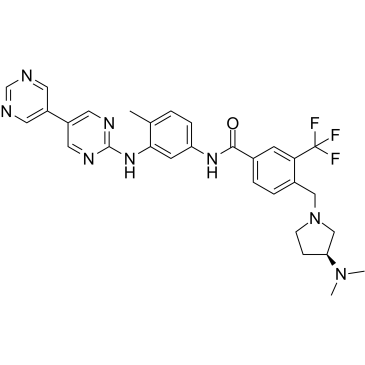
Lyn-IN-1 (Bafetinib analogue), also known as INNO-406 analog and NS-187 analog, is a potent and selective dual Bcr-Abl/Lyn inhibitor, disclosed in patent WO2014169128A1.
Physicochemical Properties
| Molecular Formula | C30H31F3N8O |
| Molecular Weight | 576.6154 |
| Exact Mass | 576.257 |
| Elemental Analysis | C, 62.49; H, 5.42; F, 9.88; N, 19.43; O, 2.77 |
| CAS # | 887650-05-7 |
| Related CAS # | 887650-05-7; 859212-16-1 |
| PubChem CID | 24853523 |
| Appearance | white solid powder |
| Density | 1.4±0.1 g/cm3 |
| Index of Refraction | 1.640 |
| LogP | 3.03 |
| Hydrogen Bond Donor Count | 2 |
| Hydrogen Bond Acceptor Count | 11 |
| Rotatable Bond Count | 8 |
| Heavy Atom Count | 42 |
| Complexity | 864 |
| Defined Atom Stereocenter Count | 1 |
| SMILES | C(N1CC[C@H](N(C)C)C1)C1C=CC(C(=O)NC2C=CC(C)=C(NC3N=CC(C4C=NC=NC=4)=CN=3)C=2)=CC=1C(F)(F)F |
| InChi Key | ZOPBZHLJXQAQON-VWLOTQADSA-N |
| InChi Code | InChI=1S/C30H31F3N8O/c1-19-4-7-24(11-27(19)39-29-36-14-23(15-37-29)22-12-34-18-35-13-22)38-28(42)20-5-6-21(26(10-20)30(31,32)33)16-41-9-8-25(17-41)40(2)3/h4-7,10-15,18,25H,8-9,16-17H2,1-3H3,(H,38,42)(H,36,37,39)/t25-/m0/s1 |
| Chemical Name | 4-[[(3S)-3-(dimethylamino)pyrrolidin-1-yl]methyl]-N-[4-methyl-3-[(5-pyrimidin-5-ylpyrimidin-2-yl)amino]phenyl]-3-(trifluoromethyl)benzamide |
| Synonyms | NS187; NS-187; NS 187; Bafetinib; INNO406; INNO 406; INNO-406 |
| HS Tariff Code | 2934.99.9001 |
| Storage |
Powder-20°C 3 years 4°C 2 years In solvent -80°C 6 months -20°C 1 month |
| Shipping Condition | Room temperature (This product is stable at ambient temperature for a few days during ordinary shipping and time spent in Customs) |
Biological Activity
| ln Vitro | Bafetinib inhibits WT Bcr-Abl autophosphorylation and downstream kinase activity in K562 and 293T cells, with IC50 values of 11 nM and 22 nM, respectively. Without affecting the growth of the Bcr-Abl-negative U937 cell line, bafetinib potently inhibits the growth of Bcr-Abl-positive cell lines, such as K562, KU812, and BaF3/wt cells. Additionally, bafetinib shows antiproliferative activity against Bcr-Abl point mutant cell lines, like BaF3/E255K cells, in a dose-dependent manner.[1] Bafetinib inhibits Bcr-Abl phosphorylation, which results in caspase-mediated and caspase-independent cell death in Bcr-Abl+ leukemia cell lines.[2] |
| ln Vivo | Bafetinib (0.2 mg/kg/day) significantly and completely inhibits tumor growth in the Bcr-Abl–positive KU812 mouse model, with no side effects at doses up to 20 mg/kg/day. Bafetinib has a maximal tolerated dose of 200 mg/kg/d and a bioavailability value (BA) of 32% in Balb/c mice.[1] Combining bafetinib (60 mg/kg) and cyclosporine A (CsA) (50 mg/kg) significantly inhibits leukemia growth in the brain when applied to a Central Nervous System (CNS) leukemia model containing Ba/F3/wt bcr-ablGFP, Ba/F3/Q252H, or Ba/F3/M351T cells.[3] |
| Enzyme Assay | Bcr-Abl kinase assays are carried out using the SignaTECT protein tyrosine kinase assay system in 25 μL of reaction mixture that contains 250 μM peptide substrate, 740 Bq/μL [γ-33P]ATP, and 20 μM cold adenosine triphosphate (ATP). Ten nanometers of each Bcr-Abl kinase are used. Using an enzyme-linked immunosorbent assay (ELISA) kit, kinase tests are performed for Abl, Src, and Lyn. KinaseProfiler is used to assess NS-187's inhibitory effects on 79 tyrosine kinases. |
| Cell Assay | In 96-well plates, K562, BaF3/wt, BaF3/E255K, and BaF3/T315I cells are plated at a density of 1 × 10³, while KU812 and U937 cells are plated at a density of 5 × 10³. Bafetinib is serially diluted and incubated with cells for three days. The MTT (3-(4,5-dimethylthiazol-2-yl)-2,5-diphenyltetrazolium bromide; Nacalai Tesque) assay is used to measure cell proliferation. The data is fitted to a logistic curve to determine the 50% inhibitory concentration (IC50) values. |
| Animal Protocol |
KU812 xenograft is established by subcutaneous injection of KU812 cells into the right flank of Balb/c-nu/nu female mice. ≤20 mg/kg/day Administered via p.o. |
| References |
[1]. Blood . 2005 Dec 1;106(12):3948-54. [2]. Cell Death Differ . 2008 Nov;15(11):1712-22. [3]. Blood . 2007 Jan 1;109(1):306-14. |
| Additional Infomation | See also: Bafetinib (annotation moved to). |
Solubility Data
| Solubility (In Vitro) | DMSO: ~50 mg/mL (86.7 mM) |
| Solubility (In Vivo) |
Solubility in Formulation 1: ≥ 2.5 mg/mL (4.34 mM) (saturation unknown) in 10% DMSO + 40% PEG300 + 5% Tween80 + 45% Saline (add these co-solvents sequentially from left to right, and one by one), clear solution. For example, if 1 mL of working solution is to be prepared, you can add 100 μL of 25.0 mg/mL clear DMSO stock solution to 400 μL PEG300 and mix evenly; then add 50 μL Tween-80 to the above solution and mix evenly; then add 450 μL normal saline to adjust the volume to 1 mL. Preparation of saline: Dissolve 0.9 g of sodium chloride in 100 mL ddH₂ O to obtain a clear solution. Solubility in Formulation 2: 2.5 mg/mL (4.34 mM) in 10% DMSO + 90% (20% SBE-β-CD in Saline) (add these co-solvents sequentially from left to right, and one by one), suspension solution; with ultrasonication. For example, if 1 mL of working solution is to be prepared, you can add 100 μL of 25.0 mg/mL clear DMSO stock solution to 900 μL of 20% SBE-β-CD physiological saline solution and mix evenly. Preparation of 20% SBE-β-CD in Saline (4°C,1 week): Dissolve 2 g SBE-β-CD in 10 mL saline to obtain a clear solution. Solubility in Formulation 3: ≥ 2.5 mg/mL (4.34 mM) (saturation unknown) in 10% DMSO + 90% Corn Oil (add these co-solvents sequentially from left to right, and one by one), clear solution. For example, if 1 mL of working solution is to be prepared, you can add 100 μL of 25.0 mg/mL clear DMSO stock solution to 900 μL of corn oil and mix evenly. (Please use freshly prepared in vivo formulations for optimal results.) |
| Preparing Stock Solutions | 1 mg | 5 mg | 10 mg | |
| 1 mM | 1.7342 mL | 8.6712 mL | 17.3424 mL | |
| 5 mM | 0.3468 mL | 1.7342 mL | 3.4685 mL | |
| 10 mM | 0.1734 mL | 0.8671 mL | 1.7342 mL |