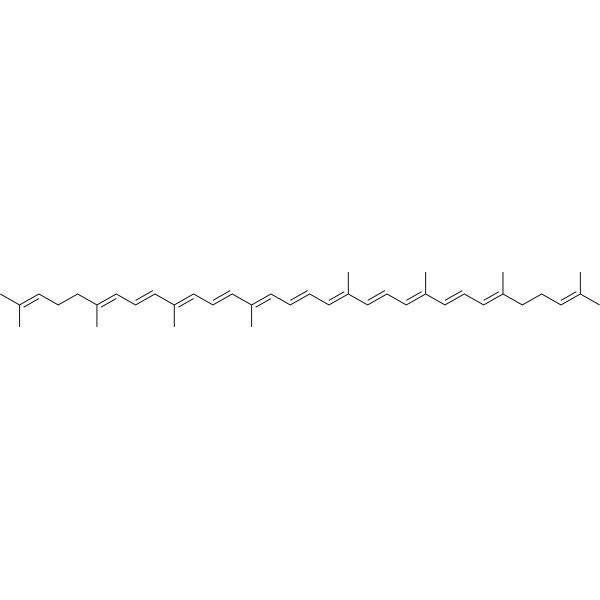
Physicochemical Properties
| Molecular Formula | C40H56 |
| Molecular Weight | 536.8727 |
| Exact Mass | 536.438 |
| CAS # | 502-65-8 |
| PubChem CID | 446925 |
| Appearance | Purple to red solid powder |
| Density | 0.9±0.1 g/cm3 |
| Boiling Point | 660.9±30.0 °C at 760 mmHg |
| Melting Point | 172-173°C |
| Flash Point | 350.7±19.4 °C |
| Vapour Pressure | 0.0±1.0 mmHg at 25°C |
| Index of Refraction | 1.531 |
| LogP | 15.19 |
| Hydrogen Bond Donor Count | 0 |
| Hydrogen Bond Acceptor Count | 0 |
| Rotatable Bond Count | 16 |
| Heavy Atom Count | 40 |
| Complexity | 1050 |
| Defined Atom Stereocenter Count | 0 |
| SMILES | CC(=CCC/C(=C/C=C/C(=C/C=C/C(=C/C=C/C=C(/C=C/C=C(/C=C/C=C(/CCC=C(C)C)\C)\C)\C)/C)/C)/C)C |
| InChi Key | OAIJSZIZWZSQBC-GYZMGTAESA-N |
| InChi Code | InChI=1S/C40H56/c1-33(2)19-13-23-37(7)27-17-31-39(9)29-15-25-35(5)21-11-12-22-36(6)26-16-30-40(10)32-18-28-38(8)24-14-20-34(3)4/h11-12,15-22,25-32H,13-14,23-24H2,1-10H3/b12-11+,25-15+,26-16+,31-17+,32-18+,35-21+,36-22+,37-27+,38-28+,39-29+,40-30+ |
| Chemical Name | (6E,8E,10E,12E,14E,16E,18E,20E,22E,24E,26E)-2,6,10,14,19,23,27,31-octamethyldotriaconta-2,6,8,10,12,14,16,18,20,22,24,26,30-tridecaene |
| HS Tariff Code | 2934.99.9001 |
| Storage |
Powder-20°C 3 years 4°C 2 years In solvent -80°C 6 months -20°C 1 month Note: (1). This product requires protection from light (avoid light exposure) during transportation and storage.(2). Please store this product in a sealed and protected environment (e.g. under nitrogen), avoid exposure to moisture. |
| Shipping Condition | Room temperature (This product is stable at ambient temperature for a few days during ordinary shipping and time spent in Customs) |
Biological Activity
| ln Vitro | Humans cannot synthesis lycopene de novo, thus consuming adequate lycopene through diet is essential to reaping its health benefits. Furthermore, at physiological concentrations of 1.25 μM, lycopene strongly inhibits the growth of scaffolds and embryonic cells and reduces kappa B phosphorylation in cells by 30–40% [1]. growing awareness of lycopene, a significant carotenoid found in tomatoes that lowers the risk of lung and digestive tract malignancies and functions as an all-trans dietary disinfection of alcohol-induced 2E1 cellular free radical scavengers. Lycopene is a singlet oxygen molecule and a scavenger of peroxyl radical that protects against photooxidation. It also functions well in combination with other antioxidant molecules [2]. Reactive oxygen species (ROS) can be reacted with by lycopene as a carotenoid via one of three mechanisms: I) electron transfer, II) hydrogen atom transfer, or III) addition of additives. Physical quenching is the primary method by which lycopene deactivates singlet oxygen [3]. By blocking NADPH oxidase generated in PKC, lycopene lowers ROS generation in SK-Hep-1 cells [5]. |
| ln Vivo | Human bushes contain the carotenoid lycopene, which has a half-life of two to three days [2]. The intima-media thickness of blood vessel walls may decrease as a result of lycopene or processed tomatoes [3]. Lycopene provides defense against toxicity brought on by ATZ. Lycopene's capacity to activate Nrf2/HO-1 and its antioxidant qualities may be the cause of these effects [4]. Lycopene is an antioxidant that decreases oxidative damage by improving hepatotoxicity, lowering GSSG, and controlling tGSH and CAT levels [5]. |
| References |
[1]. Lycopene acts through inhibition of IκB kinase to suppress NF-κB signaling in human prostate and breast cancer cells. Tumour Biol. 2016 Jul;37(7):9375-85. [2]. The role of carotenoids in the prevention of human pathologies. Biomed Pharmacother. 2004 Mar;58(2):100-10. [3]. Lycopene and Its Antioxidant Role in the Prevention of Cardiovascular Diseases-A Critical Review. Crit Rev Food Sci Nutr. 2016 Aug 17;56(11):1868-79. [4]. Lycopene ameliorates atrazine-induced oxidative damage in adrenal cortex of male rats by activation of the Nrf2/HO-1 pathway. Environ Sci Pollut Res Int. 2016 Aug;23(15):15262-74. [5]. Lycopene inhibits reactive oxygen species production in SK-Hep-1 cells and attenuates acetaminophen-induced liver injury in C57BL/6 mice. Chem Biol Interact. 2017 Feb 1;263:7-17. |
| Additional Infomation |
Lycopene is an acyclic carotene commonly obtained from tomatoes and other red fruits. It has a role as an antioxidant and a plant metabolite. It contains a carotenoid psi-end derivative. Lycopene is a naturally occurring red carotenoid pigment that is responsible for red to pink colors seen in tomatoes, pink grapefruit, and other foods. Having a chemical formula of C40H56, lycopene is a tetraterpene assembled from eight isoprene units that are solely composed of carbon and hydrogen. Lycopene may undergo extensive isomerization that allows 1056 theoretical cis-trans configurations; however, the all-trans configuration of lycopene is the most predominant isomer found in foods that gives the red hue. Lycopene is a non-essential human nutrient that is classified as a non-provitamin A carotenoid pigment since it lacks a terminal beta-ionone ring and does not mediate vitamin A activity. However, lycopene is a potent antioxidant molecule that scavenges reactive oxygen species (ROS) singlet oxygen. Tomato lycopene extract is used as a color additive in food products. Lycopene has been reported in Pyracantha angustifolia, Allomyces javanicus, and other organisms with data available. Lycopene is a linear, unsaturated hydrocarbon carotenoid, the major red pigment in fruits such as tomatoes, pink grapefruit, apricots, red oranges, watermelon, rosehips, and guava. As a class, carotenoids are pigment compounds found in photosynthetic organisms (plants, algae, and some types of fungus), and are chemically characterized by a large polyene chain containing 35-40 carbon atoms; some carotenoid polyene chains are terminated by two 6-carbon rings. In animals, carotenoids such as lycopene may possess antioxidant properties which may retard aging and many degenerative diseases. As an essential nutrient, lycopene is required in the animal diet. (NCI04) A carotenoid and red pigment produced by tomatoes, other red fruits and vegetables, and photosynthetic algae. It is a key intermediate in the biosynthesis of other carotenoids, and has antioxidant, anti-carcinogenic, radioprotective, and anti-inflammatory properties. See also: 15-cis-Lycopene (annotation moved to). |
Solubility Data
| Solubility (In Vitro) |
THF : 5 mg/mL (~9.31 mM) Ethanol :< 1 mg/mL |
| Solubility (In Vivo) |
Note: Listed below are some common formulations that may be used to formulate products with low water solubility (e.g. < 1 mg/mL), you may test these formulations using a minute amount of products to avoid loss of samples. Injection Formulations (e.g. IP/IV/IM/SC) Injection Formulation 1: DMSO : Tween 80: Saline = 10 : 5 : 85 (i.e. 100 μL DMSO stock solution → 50 μL Tween 80 → 850 μL Saline) *Preparation of saline: Dissolve 0.9 g of sodium chloride in 100 mL ddH ₂ O to obtain a clear solution. Injection Formulation 2: DMSO : PEG300 :Tween 80 : Saline = 10 : 40 : 5 : 45 (i.e. 100 μL DMSO → 400 μLPEG300 → 50 μL Tween 80 → 450 μL Saline) Injection Formulation 3: DMSO : Corn oil = 10 : 90 (i.e. 100 μL DMSO → 900 μL Corn oil) Example: Take the Injection Formulation 3 (DMSO : Corn oil = 10 : 90) as an example, if 1 mL of 2.5 mg/mL working solution is to be prepared, you can take 100 μL 25 mg/mL DMSO stock solution and add to 900 μL corn oil, mix well to obtain a clear or suspension solution (2.5 mg/mL, ready for use in animals). Injection Formulation 4: DMSO : 20% SBE-β-CD in saline = 10 : 90 [i.e. 100 μL DMSO → 900 μL (20% SBE-β-CD in saline)] *Preparation of 20% SBE-β-CD in Saline (4°C,1 week): Dissolve 2 g SBE-β-CD in 10 mL saline to obtain a clear solution. Injection Formulation 5: 2-Hydroxypropyl-β-cyclodextrin : Saline = 50 : 50 (i.e. 500 μL 2-Hydroxypropyl-β-cyclodextrin → 500 μL Saline) Injection Formulation 6: DMSO : PEG300 : castor oil : Saline = 5 : 10 : 20 : 65 (i.e. 50 μL DMSO → 100 μLPEG300 → 200 μL castor oil → 650 μL Saline) Injection Formulation 7: Ethanol : Cremophor : Saline = 10: 10 : 80 (i.e. 100 μL Ethanol → 100 μL Cremophor → 800 μL Saline) Injection Formulation 8: Dissolve in Cremophor/Ethanol (50 : 50), then diluted by Saline Injection Formulation 9: EtOH : Corn oil = 10 : 90 (i.e. 100 μL EtOH → 900 μL Corn oil) Injection Formulation 10: EtOH : PEG300:Tween 80 : Saline = 10 : 40 : 5 : 45 (i.e. 100 μL EtOH → 400 μLPEG300 → 50 μL Tween 80 → 450 μL Saline) Oral Formulations Oral Formulation 1: Suspend in 0.5% CMC Na (carboxymethylcellulose sodium) Oral Formulation 2: Suspend in 0.5% Carboxymethyl cellulose Example: Take the Oral Formulation 1 (Suspend in 0.5% CMC Na) as an example, if 100 mL of 2.5 mg/mL working solution is to be prepared, you can first prepare 0.5% CMC Na solution by measuring 0.5 g CMC Na and dissolve it in 100 mL ddH2O to obtain a clear solution; then add 250 mg of the product to 100 mL 0.5% CMC Na solution, to make the suspension solution (2.5 mg/mL, ready for use in animals). Oral Formulation 3: Dissolved in PEG400 Oral Formulation 4: Suspend in 0.2% Carboxymethyl cellulose Oral Formulation 5: Dissolve in 0.25% Tween 80 and 0.5% Carboxymethyl cellulose Oral Formulation 6: Mixing with food powders Note: Please be aware that the above formulations are for reference only. InvivoChem strongly recommends customers to read literature methods/protocols carefully before determining which formulation you should use for in vivo studies, as different compounds have different solubility properties and have to be formulated differently. (Please use freshly prepared in vivo formulations for optimal results.) |
| Preparing Stock Solutions | 1 mg | 5 mg | 10 mg | |
| 1 mM | 1.8626 mL | 9.3132 mL | 18.6265 mL | |
| 5 mM | 0.3725 mL | 1.8626 mL | 3.7253 mL | |
| 10 mM | 0.1863 mL | 0.9313 mL | 1.8626 mL |