Physicochemical Properties
| Molecular Formula | C19H20N2O |
| Molecular Weight | 292.3749 |
| Exact Mass | 292.157 |
| Elemental Analysis | C, 78.05; H, 6.90; N, 9.58; O, 5.47 |
| CAS # | 117946-91-5 |
| Related CAS # | Luzindole HCl;117946-91-5; |
| PubChem CID | 122162 |
| Appearance | Off-white to light yellow solid powder |
| Density | 1.2±0.1 g/cm3 |
| Boiling Point | 559.6±38.0 °C at 760 mmHg |
| Melting Point | 44-46°C |
| Flash Point | 292.2±26.8 °C |
| Vapour Pressure | 0.0±1.5 mmHg at 25°C |
| Index of Refraction | 1.632 |
| LogP | 3.04 |
| Hydrogen Bond Donor Count | 2 |
| Hydrogen Bond Acceptor Count | 1 |
| Rotatable Bond Count | 5 |
| Heavy Atom Count | 22 |
| Complexity | 364 |
| Defined Atom Stereocenter Count | 0 |
| SMILES | O=C(C([H])([H])[H])N([H])C([H])([H])C([H])([H])C1C2=C([H])C([H])=C([H])C([H])=C2N([H])C=1C([H])([H])C1C([H])=C([H])C([H])=C([H])C=1[H] |
| InChi Key | WVVXBPKOIZGVNS-UHFFFAOYSA-N |
| InChi Code | InChI=1S/C19H20N2O/c1-14(22)20-12-11-17-16-9-5-6-10-18(16)21-19(17)13-15-7-3-2-4-8-15/h2-10,21H,11-13H2,1H3,(H,20,22) |
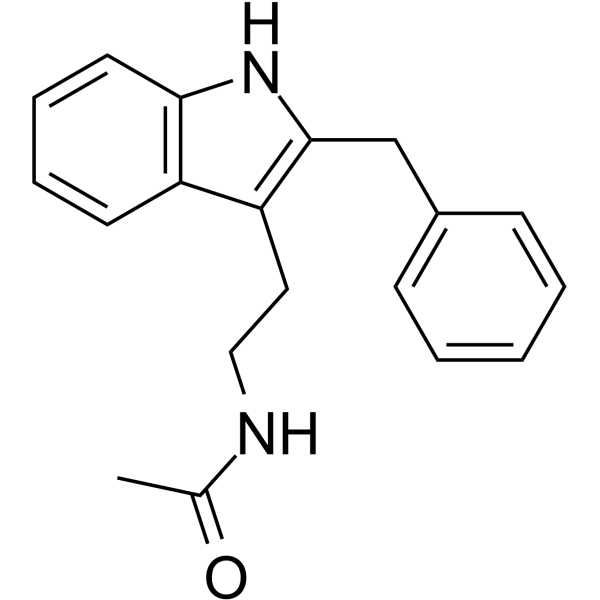
| Chemical Name | N-[2-(2-benzyl-1H-indol-3-yl)ethyl]acetamide |
| Synonyms | Luzindole, N-0774, N0774, N 0774, N-acetyl-2-benzyltryptamine |
| HS Tariff Code | 2934.99.9001 |
| Storage |
Powder-20°C 3 years 4°C 2 years In solvent -80°C 6 months -20°C 1 month |
| Shipping Condition | Room temperature (This product is stable at ambient temperature for a few days during ordinary shipping and time spent in Customs) |
Biological Activity
| ln Vitro | MBP-reactive LV-4 T cell lines' antigen-specific proliferation is inhibited by luteindole (N-0774) (5–10 μg/ml) [1]. |
| ln Vivo | Experimental autoimmune encephalomyelitis is inhibited by luzindole (N-0774) (30 mg/kg; i.p.; days 0-5) [2]. In a dose-dependent manner, luzindole (N-0774) (30 mg/kg ip) shortens immobility time; the impact is greater at midnight (60% decrease) than it is at midday (39% reduction). Luzindole's effects are time-dependent, peaking after 60 minutes. The anti-immobility effects of luzidole (10 mg/kg ip) are countered by the administration of melatonin (30 mg/kg ip). Luzindole (30 mg/kg ip) does not change albino ND/4 mice's or C57BL/6J mice's non-melatonin-producing immobility time at midday or midnight [3]. |
| Animal Protocol |
Animal/Disease Models: 23 to 12 weeks old (SJL , under minimal lighting conditions) Experimental Results: Effective prevention of experimental autoimmune encephalomyelitis. |
| References |
[1]. Melatonin receptor antagonists that differentiate between the human Mel1a and Mel1b recombinant subtypes are used to assess the pharmacological profile of the rabbit retina ML1 presynaptic heteroreceptor. Naunyn Schmiedebergs Arch Pharmacol. 1997 Mar;355(3):365-75. [2]. Luzindole, a melatonin receptor antagonist, suppresses experimental autoimmune encephalomyelitis. Pathobiology. 1997;65(4):190-4. [3]. Dubocovich ML Antidepressant-like activity of the melatonin receptor antagonist, luzindole (N-0774), in the mouse behavioral despair test. Eur J Pharmacol. 1990 Jul 3;182(2):313-25. |
| Additional Infomation | Luzindole is a member of the class of indoles that is tryptamine in which one of the amino hydrogens is replaced by an acetyl group while the hydrogen at position 2 is replaced by a benzyl group. It has a role as a melatonin receptor antagonist. It is a member of acetamides and a member of indoles. It is functionally related to a tryptamine. |
Solubility Data
| Solubility (In Vitro) | DMSO : ~100 mg/mL (~342.03 mM) |
| Solubility (In Vivo) |
Solubility in Formulation 1: ≥ 2.5 mg/mL (8.55 mM) (saturation unknown) in 10% DMSO + 40% PEG300 + 5% Tween80 + 45% Saline (add these co-solvents sequentially from left to right, and one by one), clear solution. For example, if 1 mL of working solution is to be prepared, you can add 100 μL of 25.0 mg/mL clear DMSO stock solution to 400 μL PEG300 and mix evenly; then add 50 μL Tween-80 to the above solution and mix evenly; then add 450 μL normal saline to adjust the volume to 1 mL. Preparation of saline: Dissolve 0.9 g of sodium chloride in 100 mL ddH₂ O to obtain a clear solution. Solubility in Formulation 2: ≥ 2.5 mg/mL (8.55 mM) (saturation unknown) in 10% DMSO + 90% (20% SBE-β-CD in Saline) (add these co-solvents sequentially from left to right, and one by one), clear solution. For example, if 1 mL of working solution is to be prepared, you can add 100 μL of 25.0 mg/mL clear DMSO stock solution to 900 μL of 20% SBE-β-CD physiological saline solution and mix evenly. Preparation of 20% SBE-β-CD in Saline (4°C,1 week): Dissolve 2 g SBE-β-CD in 10 mL saline to obtain a clear solution. Solubility in Formulation 3: ≥ 2.5 mg/mL (8.55 mM) (saturation unknown) in 10% DMSO + 90% Corn Oil (add these co-solvents sequentially from left to right, and one by one), clear solution. For example, if 1 mL of working solution is to be prepared, you can add 100 μL of 25.0 mg/mL clear DMSO stock solution to 900 μL of corn oil and mix evenly. (Please use freshly prepared in vivo formulations for optimal results.) |
| Preparing Stock Solutions | 1 mg | 5 mg | 10 mg | |
| 1 mM | 3.4203 mL | 17.1016 mL | 34.2032 mL | |
| 5 mM | 0.6841 mL | 3.4203 mL | 6.8406 mL | |
| 10 mM | 0.3420 mL | 1.7102 mL | 3.4203 mL |