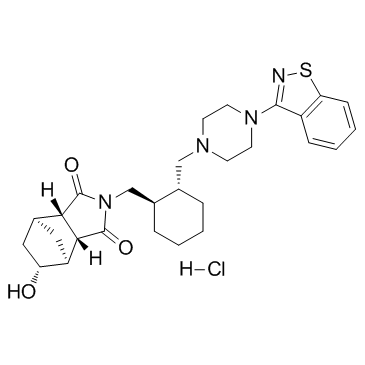
Lurasidone Metabolite 14283 hydrochloride is an inactive metabolite of Lurasidone which is an atypical antipsychotic drug approved for the treatment of schizophrenia and bipolar disorders.
Physicochemical Properties
| Molecular Formula | C28H36N4O3S.HCL |
| Molecular Weight | 545.13638 |
| Exact Mass | 544.227 |
| CAS # | 186204-32-0 |
| Related CAS # | 186204-31-9 |
| PubChem CID | 129011992 |
| Appearance | White to off-white solid powder |
| LogP | 3.969 |
| Hydrogen Bond Donor Count | 2 |
| Hydrogen Bond Acceptor Count | 7 |
| Rotatable Bond Count | 5 |
| Heavy Atom Count | 37 |
| Complexity | 866 |
| Defined Atom Stereocenter Count | 7 |
| SMILES | O=C([C@]([C@@H]1C[C@@H](O)[C@H]2C1)([H])[C@]2([H])C3=O)N3C[C@H]4[C@H](CN(CC5)CCN5C6=NSC7=C6C=CC=C7)CCCC4.Cl[H] |
| InChi Key | WLCWVTUFTGBTDA-HRKUQYLCSA-N |
| InChi Code | InChI=1S/C28H36N4O3S.ClH/c33-22-14-19-13-21(22)25-24(19)27(34)32(28(25)35)16-18-6-2-1-5-17(18)15-30-9-11-31(12-10-30)26-20-7-3-4-8-23(20)36-29-26;/h3-4,7-8,17-19,21-22,24-25,33H,1-2,5-6,9-16H2;1H/t17-,18-,19-,21+,22+,24-,25+;/m0./s1 |
| Chemical Name | (1S,2S,6R,7S,8R)-4-[[(1R,2R)-2-[[4-(1,2-benzothiazol-3-yl)piperazin-1-yl]methyl]cyclohexyl]methyl]-8-hydroxy-4-azatricyclo[5.2.1.02,6]decane-3,5-dione;hydrochloride |
| Synonyms | 186204-32-0; Lurasidone Metabolite 14283 hydrochloride; Lurasidone Inactive Metabolite 14283; (1S,2S,6R,7S,8R)-4-[[(1R,2R)-2-[[4-(1,2-benzothiazol-3-yl)piperazin-1-yl]methyl]cyclohexyl]methyl]-8-hydroxy-4-azatricyclo[5.2.1.02,6]decane-3,5-dione;hydrochloride; LurasidoneMetabolite14283HCl; |
| HS Tariff Code | 2934.99.9001 |
| Storage |
Powder-20°C 3 years 4°C 2 years In solvent -80°C 6 months -20°C 1 month Note: Please store this product in a sealed and protected environment, avoid exposure to moisture. |
| Shipping Condition | Room temperature (This product is stable at ambient temperature for a few days during ordinary shipping and time spent in Customs) |
Biological Activity
| Targets | Active metabolite of Lurasidone |
| References | [1]. Lurasidone : in the treatment of schizophrenia. CNS Drugs. 2013 Jan;27(1):67-80. |
| Additional Infomation | This review focuses on the efficacy and tolerability of lurasidone, which is approved in the USA, Puerto Rico and Canada for the treatment of schizophrenia. In two placebo-controlled, phase II trials, lurasidone 40-120 mg/day was efficacious in reducing the acute symptoms of schizophrenia. In a third phase II trial, the lurasidone groups and haloperidol control group failed to separate from placebo on key endpoints. In two placebo- and active treatment-controlled, phase III trials, lurasidone at dosages of 40-160 mg/day, olanzapine 15 mg/day and quetiapine extended-release (XR) 600 mg/day were efficacious in reducing the symptoms of schizophrenia. In a 12-month, double-blind extension trial, the relapse rate in lurasidone recipients was noninferior to that in quetiapine XR recipients. In a third phase III trial, lurasidone 80 mg/day, but not 40 or 120 mg/day, was more efficacious than placebo for the primary endpoint. In an unpublished trial, there were no significant differences between lurasidone, active comparator and placebo groups on the primary endpoint. Lurasidone was generally well tolerated over the short and longer term. Extrapyramidal symptoms and akathisia occurred in ≈10-13 % of patients. Lurasidone was associated with a low risk of QT interval prolongation, weight gain, metabolic disturbances and hyperprolactinaemia. Further trials against other antipsychotics are needed to fully evaluate its efficacy and tolerability. [1] |
Solubility Data
| Solubility (In Vitro) | Ethanol : ~100 mg/mL (~183.44 mM) |
| Solubility (In Vivo) |
Solubility in Formulation 1: ≥ 2.5 mg/mL (4.59 mM) (saturation unknown) in 10% EtOH + 40% PEG300 + 5% Tween80 + 45% Saline (add these co-solvents sequentially from left to right, and one by one), clear solution. For example, if 1 mL of working solution is to be prepared, you can add 100 μL of 25.0 mg/mL clear EtOH stock solution to 400 μL PEG300 and mix evenly; then add 50 μL Tween-80 to the above solution and mix evenly; then add 450 μL normal saline to adjust the volume to 1 mL. Preparation of saline: Dissolve 0.9 g of sodium chloride in 100 mL ddH₂ O to obtain a clear solution. Solubility in Formulation 2: ≥ 2.5 mg/mL (4.59 mM) (saturation unknown) in 10% EtOH + 90% (20% SBE-β-CD in Saline) (add these co-solvents sequentially from left to right, and one by one), clear solution. For example, if 1 mL of working solution is to be prepared, you can add 100 μL of 25.0 mg/mL clear EtOH stock solution to 900 μL of 20% SBE-β-CD physiological saline solution and mix evenly. Preparation of 20% SBE-β-CD in Saline (4°C,1 week): Dissolve 2 g SBE-β-CD in 10 mL saline to obtain a clear solution. Solubility in Formulation 3: ≥ 2.5 mg/mL (4.59 mM) (saturation unknown) in 10% EtOH + 90% Corn Oil (add these co-solvents sequentially from left to right, and one by one), clear solution. For example, if 1 mL of working solution is to be prepared, you can add 100 μL of 25.0 mg/mL clear EtOH stock solution to 900 μL of corn oil and mix evenly. (Please use freshly prepared in vivo formulations for optimal results.) |
| Preparing Stock Solutions | 1 mg | 5 mg | 10 mg | |
| 1 mM | 1.8344 mL | 9.1720 mL | 18.3439 mL | |
| 5 mM | 0.3669 mL | 1.8344 mL | 3.6688 mL | |
| 10 mM | 0.1834 mL | 0.9172 mL | 1.8344 mL |