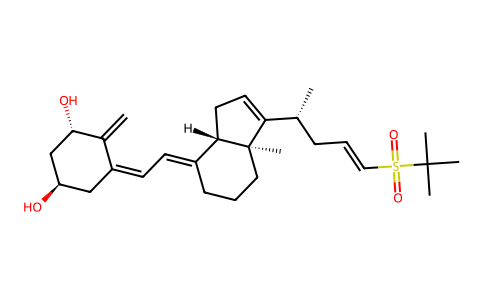
Physicochemical Properties
| Molecular Formula | C28H42O4S |
| Molecular Weight | 474.69568 |
| Exact Mass | 474.28 |
| CAS # | 250384-82-8 |
| PubChem CID | 10672195 |
| Appearance | Typically exists as solid at room temperature |
| LogP | 6.881 |
| Hydrogen Bond Donor Count | 2 |
| Hydrogen Bond Acceptor Count | 4 |
| Rotatable Bond Count | 6 |
| Heavy Atom Count | 33 |
| Complexity | 984 |
| Defined Atom Stereocenter Count | 5 |
| SMILES | C[C@H](C/C=C/S(=O)(=O)C(C)(C)C)C1=CC[C@H]2/C(=C/C=C\3/C[C@H](C[C@@H](C3=C)O)O)/CCC[C@]12C |
| InChi Key | RFQHCLMGLJGZNV-UXXOMSPDSA-N |
| InChi Code | InChI=1S/C28H42O4S/c1-19(9-8-16-33(31,32)27(3,4)5)24-13-14-25-21(10-7-15-28(24,25)6)11-12-22-17-23(29)18-26(30)20(22)2/h8,11-13,16,19,23,25-26,29-30H,2,7,9-10,14-15,17-18H2,1,3-6H3/b16-8+,21-11+,22-12-/t19-,23-,25+,26+,28-/m1/s1 |
| Chemical Name | (1R,3S,5Z)-5-[(2E)-2-[(3aS,7aS)-1-[(E,2R)-5-tert-butylsulfonylpent-4-en-2-yl]-7a-methyl-3a,5,6,7-tetrahydro-3H-inden-4-ylidene]ethylidene]-4-methylidenecyclohexane-1,3-diol |
| HS Tariff Code | 2934.99.9001 |
| Storage |
Powder-20°C 3 years 4°C 2 years In solvent -80°C 6 months -20°C 1 month |
| Shipping Condition | Room temperature (This product is stable at ambient temperature for a few days during ordinary shipping and time spent in Customs) |
Biological Activity
| References |
[1]. A theoretical insight to understand the molecular mechanism of dual target ligand CTA-018 in the chronic kidney disease pathogenesis. PloS one, 2018, 13(10): e0203194. |
| Additional Infomation |
Lunacalcipol is a vitamin D. CTA018 is a member of a new class of vitamin D analogues with a dual mechanism of action, called Vitamin D Signal Amplifiers. This proprietary new drug is both a potent inhibitor of CYP24 (the enzyme responsible for the breakdown of vitamin D) and a potent activator of vitamin D signaling pathways. CTA018 will be the first drug with this novel dual mechanism of action to enter clinical development. Preclinical studies have shown that CTA018 inhibits the proliferation of rapidly dividing cells such as human epidermal keratinocytes (skin cells) and is also effective in inhibiting pro-inflammatory cytokine secretion which may be involved in the etiology of psoriasis. Cytochroma anticipates that CTA018 will be more potent than currently marketed vitamin D analogues such as calcitriol and calcipotriol and it is expected to have a greater safety index. Drug Indication Investigated for use/treatment in kidney disease and psoriasis and psoriatic disorders. Mechanism of Action CTA018 is a rationally designed Vitamin D hormone analog that acts as both a potent VDR agonist and CYP24 inhibitor. The Company believes this dual mechanism of action will provide efficacy and safety advantages over existing Vitamin D hormone replacement therapies for SHPT. CTA018 binds to the VDR located in parathyroid cells and triggers a genomic cascade of events resulting in suppression of PTH secretion. It also binds to the substrate binding pocket of CYP24, a cytochrome P450 enzyme that specifically and efficiently catabolizes Vitamin D hormones. By binding to CYP24 and blocking its activity, CTA018 levels in cells are more readily raised to therapeutic levels. Unlike common cytochrome P450 inhibitors (such as ketoconazole) which act non-specifically on all cytochromes, CTA018 specifically targets CYP24, making drug-drug interactions far less likely. The Company believes the novel dual activity of CTA018 will reduce the incidence of clinically-acquired resistance to Vitamin D hormone replacement therapy, allowing greatly improved efficacy at well tolerated dosages. |
Solubility Data
| Solubility (In Vitro) | May dissolve in DMSO (in most cases), if not, try other solvents such as H2O, Ethanol, or DMF with a minute amount of products to avoid loss of samples |
| Solubility (In Vivo) |
Note: Listed below are some common formulations that may be used to formulate products with low water solubility (e.g. < 1 mg/mL), you may test these formulations using a minute amount of products to avoid loss of samples. Injection Formulations (e.g. IP/IV/IM/SC) Injection Formulation 1: DMSO : Tween 80: Saline = 10 : 5 : 85 (i.e. 100 μL DMSO stock solution → 50 μL Tween 80 → 850 μL Saline) *Preparation of saline: Dissolve 0.9 g of sodium chloride in 100 mL ddH ₂ O to obtain a clear solution. Injection Formulation 2: DMSO : PEG300 :Tween 80 : Saline = 10 : 40 : 5 : 45 (i.e. 100 μL DMSO → 400 μLPEG300 → 50 μL Tween 80 → 450 μL Saline) Injection Formulation 3: DMSO : Corn oil = 10 : 90 (i.e. 100 μL DMSO → 900 μL Corn oil) Example: Take the Injection Formulation 3 (DMSO : Corn oil = 10 : 90) as an example, if 1 mL of 2.5 mg/mL working solution is to be prepared, you can take 100 μL 25 mg/mL DMSO stock solution and add to 900 μL corn oil, mix well to obtain a clear or suspension solution (2.5 mg/mL, ready for use in animals). Injection Formulation 4: DMSO : 20% SBE-β-CD in saline = 10 : 90 [i.e. 100 μL DMSO → 900 μL (20% SBE-β-CD in saline)] *Preparation of 20% SBE-β-CD in Saline (4°C,1 week): Dissolve 2 g SBE-β-CD in 10 mL saline to obtain a clear solution. Injection Formulation 5: 2-Hydroxypropyl-β-cyclodextrin : Saline = 50 : 50 (i.e. 500 μL 2-Hydroxypropyl-β-cyclodextrin → 500 μL Saline) Injection Formulation 6: DMSO : PEG300 : castor oil : Saline = 5 : 10 : 20 : 65 (i.e. 50 μL DMSO → 100 μLPEG300 → 200 μL castor oil → 650 μL Saline) Injection Formulation 7: Ethanol : Cremophor : Saline = 10: 10 : 80 (i.e. 100 μL Ethanol → 100 μL Cremophor → 800 μL Saline) Injection Formulation 8: Dissolve in Cremophor/Ethanol (50 : 50), then diluted by Saline Injection Formulation 9: EtOH : Corn oil = 10 : 90 (i.e. 100 μL EtOH → 900 μL Corn oil) Injection Formulation 10: EtOH : PEG300:Tween 80 : Saline = 10 : 40 : 5 : 45 (i.e. 100 μL EtOH → 400 μLPEG300 → 50 μL Tween 80 → 450 μL Saline) Oral Formulations Oral Formulation 1: Suspend in 0.5% CMC Na (carboxymethylcellulose sodium) Oral Formulation 2: Suspend in 0.5% Carboxymethyl cellulose Example: Take the Oral Formulation 1 (Suspend in 0.5% CMC Na) as an example, if 100 mL of 2.5 mg/mL working solution is to be prepared, you can first prepare 0.5% CMC Na solution by measuring 0.5 g CMC Na and dissolve it in 100 mL ddH2O to obtain a clear solution; then add 250 mg of the product to 100 mL 0.5% CMC Na solution, to make the suspension solution (2.5 mg/mL, ready for use in animals). Oral Formulation 3: Dissolved in PEG400 Oral Formulation 4: Suspend in 0.2% Carboxymethyl cellulose Oral Formulation 5: Dissolve in 0.25% Tween 80 and 0.5% Carboxymethyl cellulose Oral Formulation 6: Mixing with food powders Note: Please be aware that the above formulations are for reference only. InvivoChem strongly recommends customers to read literature methods/protocols carefully before determining which formulation you should use for in vivo studies, as different compounds have different solubility properties and have to be formulated differently. (Please use freshly prepared in vivo formulations for optimal results.) |
| Preparing Stock Solutions | 1 mg | 5 mg | 10 mg | |
| 1 mM | 2.1066 mL | 10.5330 mL | 21.0659 mL | |
| 5 mM | 0.4213 mL | 2.1066 mL | 4.2132 mL | |
| 10 mM | 0.2107 mL | 1.0533 mL | 2.1066 mL |