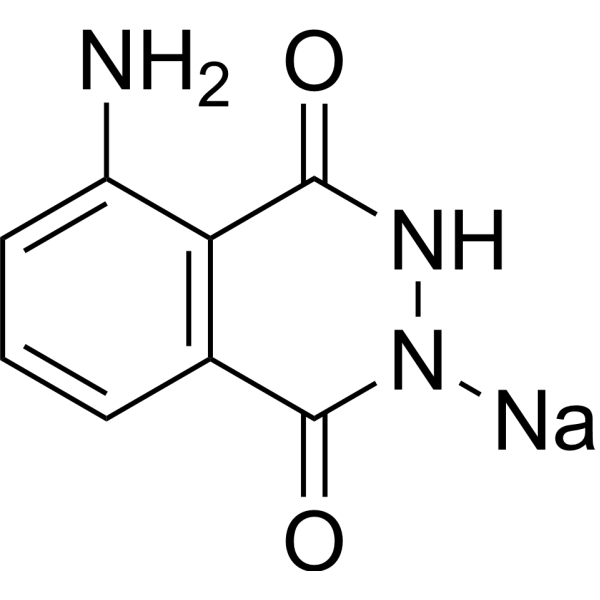
Physicochemical Properties
| Molecular Formula | C8H7N3O2 |
| Molecular Weight | 177.1601 |
| Exact Mass | 177.053 |
| CAS # | 20666-12-0 |
| Related CAS # | Luminol;521-31-3 |
| PubChem CID | 15480750 |
| Appearance | White to off-white solid powder |
| Density | 1.433g/cm3 |
| Boiling Point | 621.9ºC at 760mmHg |
| Melting Point | 319-320ºC |
| Flash Point | 329.9ºC |
| LogP | 0.008 |
| Hydrogen Bond Donor Count | 2 |
| Hydrogen Bond Acceptor Count | 4 |
| Rotatable Bond Count | 0 |
| Heavy Atom Count | 14 |
| Complexity | 259 |
| Defined Atom Stereocenter Count | 0 |
| InChi Key | HWYHZTIRURJOHG-UHFFFAOYSA-N |
| InChi Code | InChI=1S/C8H7N3O2/c9-5-3-1-2-4-6(5)8(13)11-10-7(4)12/h1-3H,9H2,(H,10,12)(H,11,13) |
| Chemical Name | 5-amino-2,3-dihydrophthalazine-1,4-dione |
| HS Tariff Code | 2934.99.9001 |
| Storage |
Powder-20°C 3 years 4°C 2 years In solvent -80°C 6 months -20°C 1 month Note: Please store this product in a sealed and protected environment (e.g. under nitrogen), avoid exposure to moisture and light. |
| Shipping Condition | Room temperature (This product is stable at ambient temperature for a few days during ordinary shipping and time spent in Customs) |
Biological Activity
| ln Vitro |
Chemiluminescence (CL) intensity is significantly influenced by the concentration of luminosol. In addition to luminol concentration, other variables that affect luminol chemiluminescence (LCL) intensity include enzyme and oxidant concentrations, pH levels, and other variables. The highest CL intensity ever measured occurred at 0.3 mM luminol concentration. In the range of 0.01 to 0.3 mM, CL intensity rises linearly with increasing luminol concentration. On the other hand, CL intensity decreases with additional increases in luminol concentration [1]. - Luminol sodium salt exhibited electrochemical luminescence (ECL) activity in vitro, and its ECL signal was significantly regulated by interactions with different types of surfactants. In the absence of surfactants, it showed a baseline ECL intensity at a specific potential range. In the presence of cationic surfactants (e.g., cetyltrimethylammonium bromide, CTAB), the ECL intensity of Luminol sodium salt was remarkably enhanced (up to ~5-fold) due to the adsorption of surfactant molecules on the electrode surface, which promoted the electron transfer between Luminol sodium salt and the electrode. For anionic surfactants (e.g., sodium dodecyl sulfate, SDS), low concentrations slightly enhanced the ECL signal, while high concentrations inhibited it (by ~30%) because of the formation of micelles that hindered the diffusion of Luminol sodium salt to the electrode. Non-ionic surfactants (e.g., Triton X-100) had a negligible effect on the ECL intensity of Luminol sodium salt. Additionally, the ECL signal regulation was concentration-dependent for all tested surfactants, with distinct concentration-response curves [1] |
| References |
[1]. Shedding Light on the Diversity of Surfactant Interactions with Luminol Electrochemiluminescence for Bioanalysis. Anal Chem. 2019 Oct 15;91(20):13080-13087. |
| Additional Infomation |
- Luminol sodium salt is a commonly used electrochemical luminescence reagent in bioanalysis, known for its stable ECL performance and high sensitivity [1] - The ECL mechanism of Luminol sodium salt involves its oxidation at the electrode surface to form an excited-state product, which emits light when returning to the ground state. Surfactants interact with Luminol sodium salt through adsorption, micellization, or electrostatic interactions, thereby regulating the electron transfer kinetics and ECL efficiency [1] |
Solubility Data
| Solubility (In Vitro) | H2O : ~100 mg/mL (~502.16 mM) |
| Solubility (In Vivo) |
Note: Listed below are some common formulations that may be used to formulate products with low water solubility (e.g. < 1 mg/mL), you may test these formulations using a minute amount of products to avoid loss of samples. Injection Formulations (e.g. IP/IV/IM/SC) Injection Formulation 1: DMSO : Tween 80: Saline = 10 : 5 : 85 (i.e. 100 μL DMSO stock solution → 50 μL Tween 80 → 850 μL Saline) *Preparation of saline: Dissolve 0.9 g of sodium chloride in 100 mL ddH ₂ O to obtain a clear solution. Injection Formulation 2: DMSO : PEG300 :Tween 80 : Saline = 10 : 40 : 5 : 45 (i.e. 100 μL DMSO → 400 μLPEG300 → 50 μL Tween 80 → 450 μL Saline) Injection Formulation 3: DMSO : Corn oil = 10 : 90 (i.e. 100 μL DMSO → 900 μL Corn oil) Example: Take the Injection Formulation 3 (DMSO : Corn oil = 10 : 90) as an example, if 1 mL of 2.5 mg/mL working solution is to be prepared, you can take 100 μL 25 mg/mL DMSO stock solution and add to 900 μL corn oil, mix well to obtain a clear or suspension solution (2.5 mg/mL, ready for use in animals). Injection Formulation 4: DMSO : 20% SBE-β-CD in saline = 10 : 90 [i.e. 100 μL DMSO → 900 μL (20% SBE-β-CD in saline)] *Preparation of 20% SBE-β-CD in Saline (4°C,1 week): Dissolve 2 g SBE-β-CD in 10 mL saline to obtain a clear solution. Injection Formulation 5: 2-Hydroxypropyl-β-cyclodextrin : Saline = 50 : 50 (i.e. 500 μL 2-Hydroxypropyl-β-cyclodextrin → 500 μL Saline) Injection Formulation 6: DMSO : PEG300 : castor oil : Saline = 5 : 10 : 20 : 65 (i.e. 50 μL DMSO → 100 μLPEG300 → 200 μL castor oil → 650 μL Saline) Injection Formulation 7: Ethanol : Cremophor : Saline = 10: 10 : 80 (i.e. 100 μL Ethanol → 100 μL Cremophor → 800 μL Saline) Injection Formulation 8: Dissolve in Cremophor/Ethanol (50 : 50), then diluted by Saline Injection Formulation 9: EtOH : Corn oil = 10 : 90 (i.e. 100 μL EtOH → 900 μL Corn oil) Injection Formulation 10: EtOH : PEG300:Tween 80 : Saline = 10 : 40 : 5 : 45 (i.e. 100 μL EtOH → 400 μLPEG300 → 50 μL Tween 80 → 450 μL Saline) Oral Formulations Oral Formulation 1: Suspend in 0.5% CMC Na (carboxymethylcellulose sodium) Oral Formulation 2: Suspend in 0.5% Carboxymethyl cellulose Example: Take the Oral Formulation 1 (Suspend in 0.5% CMC Na) as an example, if 100 mL of 2.5 mg/mL working solution is to be prepared, you can first prepare 0.5% CMC Na solution by measuring 0.5 g CMC Na and dissolve it in 100 mL ddH2O to obtain a clear solution; then add 250 mg of the product to 100 mL 0.5% CMC Na solution, to make the suspension solution (2.5 mg/mL, ready for use in animals). Oral Formulation 3: Dissolved in PEG400 Oral Formulation 4: Suspend in 0.2% Carboxymethyl cellulose Oral Formulation 5: Dissolve in 0.25% Tween 80 and 0.5% Carboxymethyl cellulose Oral Formulation 6: Mixing with food powders Note: Please be aware that the above formulations are for reference only. InvivoChem strongly recommends customers to read literature methods/protocols carefully before determining which formulation you should use for in vivo studies, as different compounds have different solubility properties and have to be formulated differently. (Please use freshly prepared in vivo formulations for optimal results.) |
| Preparing Stock Solutions | 1 mg | 5 mg | 10 mg | |
| 1 mM | 5.6446 mL | 28.2231 mL | 56.4462 mL | |
| 5 mM | 1.1289 mL | 5.6446 mL | 11.2892 mL | |
| 10 mM | 0.5645 mL | 2.8223 mL | 5.6446 mL |