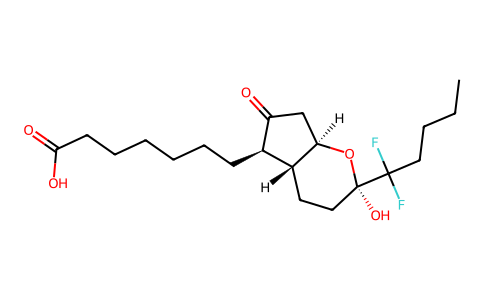
*Note: Please select an appropriate solvent for the preparation of stock solution based on your experiment needs. For most products, DMSO can be used for preparing stock solutions (e.g. 5 mM, 10 mM, or 20 mM concentration); some products with high aqueous solubility may be dissolved in water directly. Solubility information is available at the above Solubility Data section. Once the stock solution is prepared, aliquot it to routine usage volumes and store at -20°C or -80°C. Avoid repeated freeze and thaw cycles.
Physicochemical Properties
| Molecular Formula | C20H32F2O5 |
| Molecular Weight | 390.46 |
| Exact Mass | 390.221 |
| CAS # | 333963-40-9 |
| PubChem CID | 157920 |
| Appearance | White to off-white solid powder |
| Density | 1.2±0.1 g/cm3 |
| Boiling Point | 532.3±50.0 °C at 760 mmHg |
| Flash Point | 275.7±30.1 °C |
| Vapour Pressure | 0.0±3.2 mmHg at 25°C |
| Index of Refraction | 1.486 |
| LogP | 2.85 |
| Hydrogen Bond Donor Count | 2 |
| Hydrogen Bond Acceptor Count | 7 |
| Rotatable Bond Count | 11 |
| Heavy Atom Count | 27 |
| Complexity | 525 |
| Defined Atom Stereocenter Count | 4 |
| SMILES | CCCCC([C@]1(CC[C@@H]2[C@@H](CCCCCCC(=O)O)C(=O)C[C@H]2O1)O)(F)F |
| InChi Key | WGFOBBZOWHGYQH-MXHNKVEKSA-N |
| InChi Code | InChI=1S/C20H32F2O5/c1-2-3-11-19(21,22)20(26)12-10-15-14(16(23)13-17(15)27-20)8-6-4-5-7-9-18(24)25/h14-15,17,26H,2-13H2,1H3,(H,24,25)/t14-,15-,17-,20-/m1/s1 |
| Chemical Name | 7-[(2R,4aR,5R,7aR)-2-(1,1-difluoropentyl)-2-hydroxy-6-oxo-3,4,4a,5,7,7a-hexahydrocyclopenta[b]pyran-5-yl]heptanoic acid |
Biological Activity
| ADME/Pharmacokinetics |
Absorption, Distribution and Excretion Lubiprostone has low systemic availability following oral administration and concentrations of lubiprostone in plasma are below the level of quantitation (10 pg/mL). Peak plasma concentration was shown to be around 1.14 hours, with a majority of the drug excreted in the urine within 48 hours. Lubiprostone and M3 are only detected in trace amounts in human feces. Metabolism / Metabolites The results of both human and animal studies indicate that lubiprostone is rapidly and extensively metabolized by 15-position reduction, α-chain β-oxidation, and ω-chain ω-oxidation. These biotransformations are not mediated by the hepatic cytochrome P450 system but rather appear to be mediated by the ubiquitously expressed carbonyl reductase. M3, a metabolite of lubiprostone in both humans and animals is formed by the reduction of the carbonyl group at the 15-hydroxy moiety that consists of both α-hydroxy and β-hydroxy epimers. M3 makes up less than 10% of the dose of radiolabeled lubiprostone. Biological Half-Life 0.9 to 1.4 hours |
| Toxicity/Toxicokinetics |
Hepatotoxicity In clinical trials, lubiprostone therapy was not associated with significant changes in serum enzyme levels or episodes of clinically apparent liver injury. Since its approval and marketing, isolated case reports of serum aminotransferase elevations have been reported to the sponsor, but there have been no published reports of clinically apparent liver injury attributable to lubiprostone. Thus, liver injury from lubiprostone must be extremely rare, if it occurs at all. Likelihood score: E (unlikely cause of clinically apparent liver injury). Effects During Pregnancy and Lactation ◉ Summary of Use during Lactation No information is available on the use of lubiprostone during breastfeeding. The manufacturer reports that the drug and its metabolite are undetectable in rat milk and would not be expected to cause any adverse effects in a breastfed infant. Monitor the breastfed infant for diarrhea. ◉ Effects in Breastfed Infants Relevant published information was not found as of the revision date. ◉ Effects on Lactation and Breastmilk Relevant published information was not found as of the revision date. Protein Binding 94% |
| References |
[1]. Functional analysis and clinical significance of chloride channel 2 expression in esophageal squamous cell carcinoma. Annals of Surgical Oncology, 2021, 28: 5384-5397. |
| Additional Infomation |
Lubiprostone is a medication used in the management of idiopathic chronic constipation. A prostaglandin E1 derivative, lubiprostone is a bicyclic fatty acid that activates ClC-2 chloride channels located on the apical side of the gastrointestinal epithelial cells. Activation of these channels promotes the secretion of a chloride-rich fluid that soften the stool, increase gastrointestinal motility, and induce spontaneous bowel movements (SBM). Lubiprostone is a Chloride Channel Activator. The mechanism of action of lubiprostone is as a Chloride Channel Activator. Lubiprostone is an activator of chloride channels (ClC-2) in the intestine and is used for treatment of chronic constipation and irritable bowel syndrome. Lubiprostone has not been linked to serum enzyme elevations during treatment or to episodes of clinically apparent liver injury. Lubiprostone is a bicyclic fatty acid derived from prostaglandin E1 and a chloride channel activator with laxative activity. Upon intake, lubiprostone specifically binds to and activates the type 2 chloride channel (ClC-2) in the apical membrane of the gastrointestinal epithelium. This produces an efflux of chloride ions, thereby drawing water into the gastrointestinal lumen. The resulting increased amounts of intestinal fluid soften the stool, increase motility, and improve bowel movements. Member of a bicyclic fatty acid class of compounds derived from PROSTAGLANDIN E1 involved in chloride channel gating. Drug Indication Lubiprostone is indicated for the treatment of adult patients with chronic idiopathic constipation, or opioid-induced constipation in patients with chronic non-cancer pain. It is also indicated for the treatment of irritable bowel syndrome with constipation (IBS-C) in female patients ≥18 years old. Treatment of constipation Mechanism of Action Lubiprostone acts by specifically activating ClC-2 chloride channels, which is a normal constituent of the apical membrane of the human intestine, in a protein kinase A action independent fashion. Activation of ClC-2 chloride channels causes an efflux of chloride ions into the lumen, which in turn leads to an efflux of sodium ions through a paracellular pathway to maintain isoelectric neutrality. As a result, water follows sodium into the lumen in order to maintain isotonic equilibrium, thereby increasing intestinal fluid secretion. By increasing intestinal fluid secretion, lubiprostone increases motility in the intestine, thereby increasing the passage of stool and alleviating symptoms associated with chronic idiopathic constipation. Activation of ClC-2 chloride channels may also stimulate the recovery of muscosal barrier function by restoring tight junction protein complexes in the intestine. Patch clamp cell studies in human cell lines have indicated that the majority of the beneficial biological activity of lubiprostone and its metabolites is observed only on the apical (luminal) portion of the gastrointestinal epithelium. |
Solubility Data
| Preparing Stock Solutions | 1 mg | 5 mg | 10 mg | |
| 1 mM | 2.5611 mL | 12.8054 mL | 25.6108 mL | |
| 5 mM | 0.5122 mL | 2.5611 mL | 5.1222 mL | |
| 10 mM | 0.2561 mL | 1.2805 mL | 2.5611 mL |