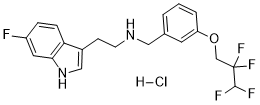
Lu AE58054 hydrochloride (also known as Idalopirdine hydrochloride) is potent and selective antagonist of the 5-HT(6) receptor with Ki value of 0.83 nM. Lu AE58054 exhibited strong suppression of 5-HT-mediated activation but no agonist activity in a 5-HT(6) GTPgammaS efficacy assay. Lu AE58054 showed >50-fold selectivity for more than 70 targets studied in addition to medium affinity to adrenergic alpha(1A)- and alpha(1B)-adrenoreceptors. Lu AE58054 is being tested as an augmentation therapy in phase III clinical trials to treat cognitive deficits linked to schizophrenia and Alzheimer's disease.
Physicochemical Properties
| Molecular Formula | C20H20CLF5N2O | |
| Molecular Weight | 434.83 | |
| Exact Mass | 434.118 | |
| Elemental Analysis | C, 55.24; H, 4.64; Cl, 8.15; F, 21.85; N, 6.44; O, 3.68 | |
| CAS # | 467458-02-2 | |
| Related CAS # | Idalopirdine; 467459-31-0 | |
| PubChem CID | 21071391 | |
| Appearance | White to off-white solid powder | |
| LogP | 6.111 | |
| Hydrogen Bond Donor Count | 3 | |
| Hydrogen Bond Acceptor Count | 7 | |
| Rotatable Bond Count | 9 | |
| Heavy Atom Count | 29 | |
| Complexity | 482 | |
| Defined Atom Stereocenter Count | 0 | |
| SMILES | Cl[H].FC1C([H])=C([H])C2=C(C=1[H])N([H])C([H])=C2C([H])([H])C([H])([H])N([H])C([H])([H])C1C([H])=C([H])C([H])=C(C=1[H])OC([H])([H])C(C([H])(F)F)(F)F |
|
| InChi Key | KXOQNPANAFXKTN-UHFFFAOYSA-N | |
| InChi Code | InChI=1S/C20H19F5N2O.ClH/c21-15-4-5-17-14(11-27-18(17)9-15)6-7-26-10-13-2-1-3-16(8-13)28-12-20(24,25)19(22)23;/h1-5,8-9,11,19,26-27H,6-7,10,12H2;1H | |
| Chemical Name | 2-(6-fluoro-1H-indol-3-yl)-N-[[3-(2,2,3,3-tetrafluoropropoxy)phenyl]methyl]ethanamine;hydrochloride | |
| Synonyms |
|
|
| HS Tariff Code | 2934.99.9001 | |
| Storage |
Powder-20°C 3 years 4°C 2 years In solvent -80°C 6 months -20°C 1 month Note: Please store this product in a sealed and protected environment, avoid exposure to moisture. |
|
| Shipping Condition | Room temperature (This product is stable at ambient temperature for a few days during ordinary shipping and time spent in Customs) |
Biological Activity
| Targets | 5-HT6 Receptor ( Ki = 0.83 nM ) | |
| ln Vitro |
|
|
| ln Vivo |
|
|
| Animal Protocol |
Male Wistar rats 5 mg/kg intraperitoneal injection, daily, 28 days |
|
| References |
[1]. Idalopirdine, a selective 5-HT6 receptor antagonist, reduces food intake and body weight in a model of excessive eating. Metab Brain Dis. 2018 Jun;33(3):733-740. [2]. The 5-HT6 receptor antagonist idalopirdine potentiates the effects of donepezil on gamma oscillations in the frontal cortex of anesthetized and awake rats without affecting sleep-wake architecture. Neuropharmacology. 2017 Feb;113(Pt A):45-59. |
Solubility Data
| Solubility (In Vitro) |
|
|||
| Solubility (In Vivo) |
Solubility in Formulation 1: ≥ 2.5 mg/mL (5.75 mM) (saturation unknown) in 10% DMSO + 40% PEG300 + 5% Tween80 + 45% Saline (add these co-solvents sequentially from left to right, and one by one), clear solution. For example, if 1 mL of working solution is to be prepared, you can add 100 μL of 25.0 mg/mL clear DMSO stock solution to 400 μL PEG300 and mix evenly; then add 50 μL Tween-80 to the above solution and mix evenly; then add 450 μL normal saline to adjust the volume to 1 mL. Preparation of saline: Dissolve 0.9 g of sodium chloride in 100 mL ddH₂ O to obtain a clear solution. Solubility in Formulation 2: ≥ 2.5 mg/mL (5.75 mM) (saturation unknown) in 10% DMSO + 90% (20% SBE-β-CD in Saline) (add these co-solvents sequentially from left to right, and one by one), clear solution. For example, if 1 mL of working solution is to be prepared, you can add 100 μL of 25.0 mg/mL clear DMSO stock solution to 900 μL of 20% SBE-β-CD physiological saline solution and mix evenly. Preparation of 20% SBE-β-CD in Saline (4°C,1 week): Dissolve 2 g SBE-β-CD in 10 mL saline to obtain a clear solution. Solubility in Formulation 3: ≥ 2.5 mg/mL (5.75 mM) (saturation unknown) in 10% DMSO + 90% Corn Oil (add these co-solvents sequentially from left to right, and one by one), clear solution. For example, if 1 mL of working solution is to be prepared, you can add 100 μL of 25.0 mg/mL clear DMSO stock solution to 900 μL of corn oil and mix evenly. (Please use freshly prepared in vivo formulations for optimal results.) |
| Preparing Stock Solutions | 1 mg | 5 mg | 10 mg | |
| 1 mM | 2.2997 mL | 11.4987 mL | 22.9975 mL | |
| 5 mM | 0.4599 mL | 2.2997 mL | 4.5995 mL | |
| 10 mM | 0.2300 mL | 1.1499 mL | 2.2997 mL |