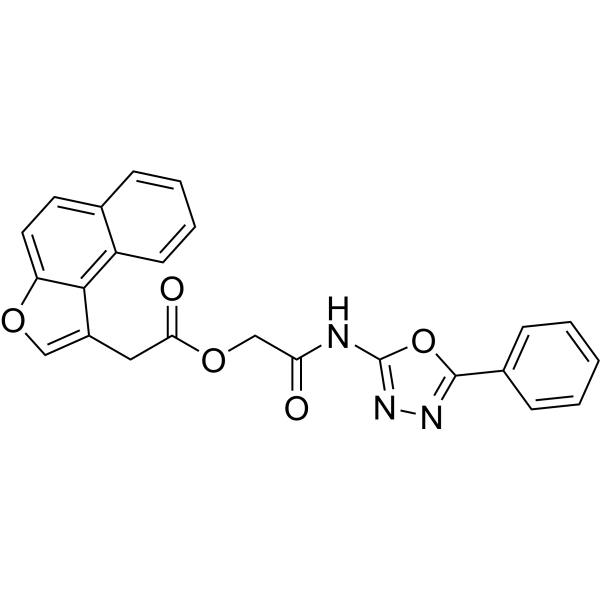
Physicochemical Properties
| Molecular Formula | C₂₄H₁₇N₃O₅ |
| Molecular Weight | 427.41 |
| Exact Mass | 427.116 |
| CAS # | 877950-01-1 |
| PubChem CID | 16286907 |
| Appearance | Typically exists as solid at room temperature |
| LogP | 4.1 |
| Hydrogen Bond Donor Count | 1 |
| Hydrogen Bond Acceptor Count | 7 |
| Rotatable Bond Count | 7 |
| Heavy Atom Count | 32 |
| Complexity | 670 |
| Defined Atom Stereocenter Count | 0 |
| InChi Key | KNJXREYSQNBQEX-UHFFFAOYSA-N |
| InChi Code | InChI=1S/C24H17N3O5/c28-20(25-24-27-26-23(32-24)16-7-2-1-3-8-16)14-31-21(29)12-17-13-30-19-11-10-15-6-4-5-9-18(15)22(17)19/h1-11,13H,12,14H2,(H,25,27,28) |
| Chemical Name | [2-oxo-2-[(5-phenyl-1,3,4-oxadiazol-2-yl)amino]ethyl] 2-benzo[e][1]benzofuran-1-ylacetate |
| Synonyms | LtaSIN1; LtaS IN 1 |
| HS Tariff Code | 2934.99.9001 |
| Storage |
Powder-20°C 3 years 4°C 2 years In solvent -80°C 6 months -20°C 1 month |
| Shipping Condition | Room temperature (This product is stable at ambient temperature for a few days during ordinary shipping and time spent in Customs) |
Biological Activity
| ln Vitro | The growth of strain E745 is inhibited in a concentration-dependent manner by LtaS-IN-1 (0-100 μM). The final OD600 of this strain was lowered by 60% at a dose of 10 μM. Nevertheless, LtaS-IN-1 had no effect on Enterococcus faecium growth in the control group [1]. Targeting 28 enterococci strains, LtaS-IN-1's minimum inhibitory concentration (MIC) ranges from 0.5 μg/mL to 64 μg/mL. With a minimum inhibitory concentration (MIC) of 0.5μg/mL, LtaS-IN-1 inhibits strains E1630 and E1590. The growth of strains E7128 and E7130 was inhibited by 97-100% when LtaS-IN-1 (20 μM) was combined with ampicillin (20 μg/mL), gentamicin (10 μg/mL), linezolid (5 μg/mL), daptomycin (10 μg/mL+ 50 μg/mL calcium chloride), or vancomycin (20 μg/mL). However, LtaS-IN-1 alone only produced 73% (strain E7128) and 8% (strain E7130) [1]. |
| References | [1]. Paganelli FL, et al. Lipoteichoic acid synthesis inhibition in combination with antibiotics abrogates growth of multidrug-resistant Enterococcus faecium.Int J Antimicrob Agents. 2017 Mar;49(3):355-363. |
Solubility Data
| Solubility (In Vitro) | DMSO : ~125 mg/mL (~292.46 mM) |
| Solubility (In Vivo) |
Solubility in Formulation 1: 2.08 mg/mL (4.87 mM) in 10% DMSO + 40% PEG300 + 5% Tween80 + 45% Saline (add these co-solvents sequentially from left to right, and one by one), suspension solution; with sonication. For example, if 1 mL of working solution is to be prepared, you can add 100 μL of 20.8 mg/mL clear DMSO stock solution to 400 μL PEG300 and mix evenly; then add 50 μL Tween-80 to the above solution and mix evenly; then add 450 μL normal saline to adjust the volume to 1 mL. Preparation of saline: Dissolve 0.9 g of sodium chloride in 100 mL ddH₂ O to obtain a clear solution. Solubility in Formulation 2: 2.08 mg/mL (4.87 mM) in 10% DMSO + 90% (20% SBE-β-CD in Saline) (add these co-solvents sequentially from left to right, and one by one), suspension solution; with ultrasonication. For example, if 1 mL of working solution is to be prepared, you can add 100 μL of 20.8 mg/mL clear DMSO stock solution to 900 μL of 20% SBE-β-CD physiological saline solution and mix evenly. Preparation of 20% SBE-β-CD in Saline (4°C,1 week): Dissolve 2 g SBE-β-CD in 10 mL saline to obtain a clear solution. Solubility in Formulation 3: ≥ 2.08 mg/mL (4.87 mM) (saturation unknown) in 10% DMSO + 90% Corn Oil (add these co-solvents sequentially from left to right, and one by one), clear solution. For example, if 1 mL of working solution is to be prepared, you can add 100 μL of 20.8 mg/mL clear DMSO stock solution to 900 μL of corn oil and mix evenly. (Please use freshly prepared in vivo formulations for optimal results.) |
| Preparing Stock Solutions | 1 mg | 5 mg | 10 mg | |
| 1 mM | 2.3397 mL | 11.6984 mL | 23.3967 mL | |
| 5 mM | 0.4679 mL | 2.3397 mL | 4.6793 mL | |
| 10 mM | 0.2340 mL | 1.1698 mL | 2.3397 mL |